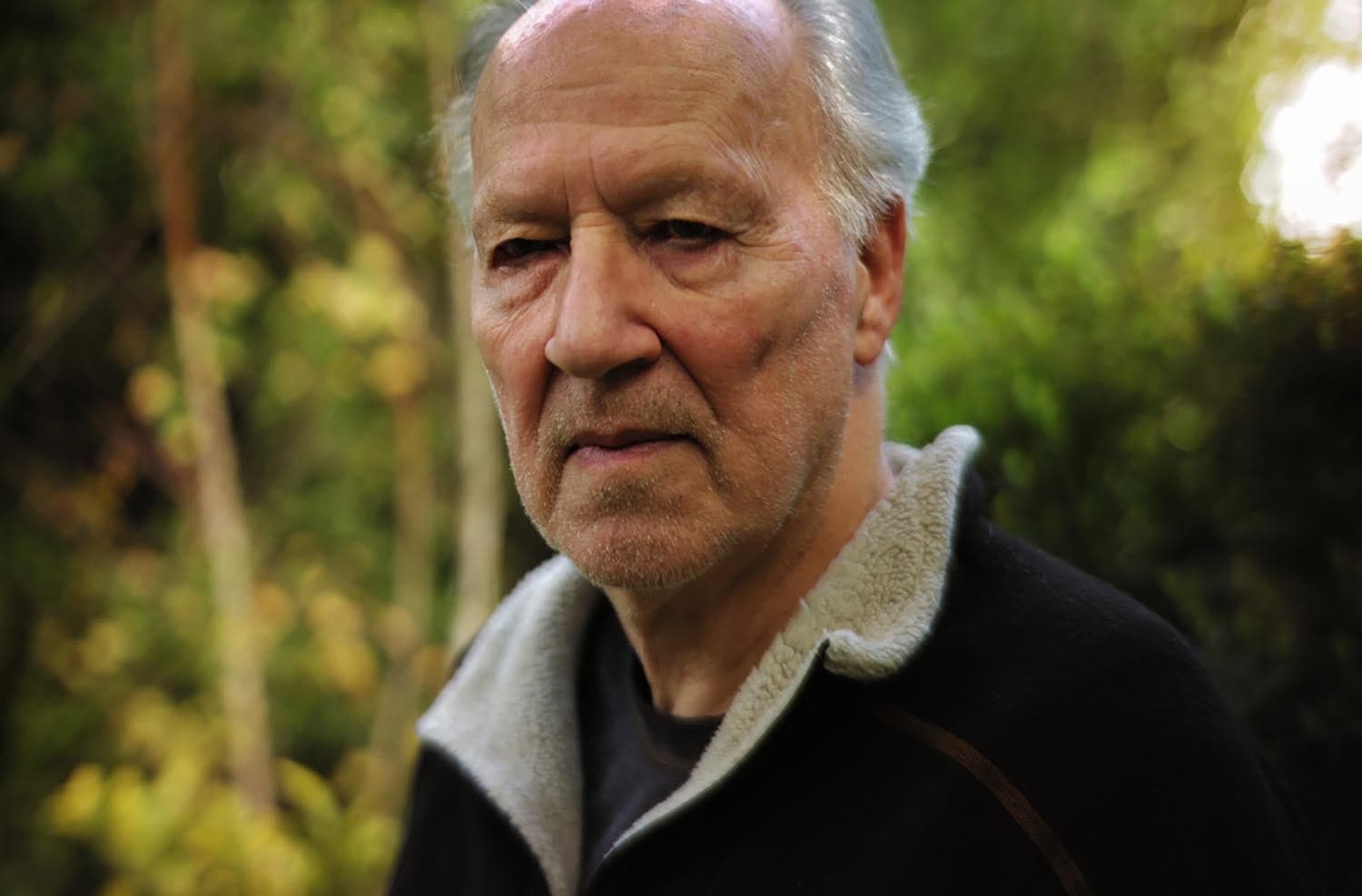
German—or, as he would prefer, Bavarian—filmmaker Werner Herzog has been making films for over 60 years now, and they’ve always pushed boundaries and sought to capture what he has termed “ecstatic truth.” From pulling a boat over a mountain in the Amazon jungle in Fitzcarraldo, to braving the frigid tundra of Antarctica in Encounters at the Edge of the World, to venturing close to the mouths of volcanoes in Into the Inferno, Herzog is one of the most singular, fearless, and uncompromising directors of our times.
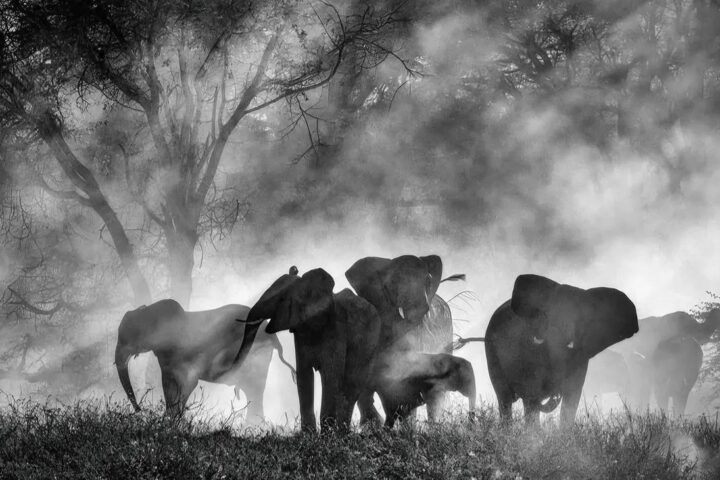
Herzog’s newest documentary, Ghost Elephants, takes the iconoclastic filmmaker to Africa, and covers an arduous 1,000-mile trek from Namibia to the remote stretches of the Angolan highlands in search of an animal that may not even exist. This journey toward potentially discovering the largest mammal on earth provides the director with ample opportunities for his typically poetic, existential musings, as well as an array of fascinating digressions about trackers making a lethal poison and the rites and rituals of various local tribes.
Ahead of the release of Ghost Elephants, I spoke with Herzog over Zoom about the genesis of the documentary, the logistics of its making, the urgency of his filmmaking, and his feelings about his relatively new Instagram account.
Thank you for taking the time to talk to me today, Werner.
Before you talk, I love to see all the books behind you. I encourage everyone: read, read, read, read, read, read. Young filmmakers: read, read.
I know you’ve always said that: “Read and walk, walk with purpose.”
Yes, travel on foot.
The idea of a man spending over a decade searching in the Angolan highlands for mythical beasts that may or may not exist feels like it could have been the plot of one of your fiction films. Why a documentary? Was it the beast that you may not be able to find, or was it Steve Boyes’s mad passion for tracking them down?
Well, what you say is my answer, in a way. Steve Boyes, by coincidence, a mutual friend got us together, of all places in a restaurant in Beverly Hills, since I live in Los Angeles. He says, “Come down quickly,” and it was almost instantly clear that I should be part of the film project. There was already a film team working at it for a while. And he asked me, “Would you consider [coming] to Namibia, to the deepest of the bush and advise us, be in the background, and guide us a little bit. I accepted fairly quickly. But once [I was] in Namibia, after a day or two, it was clear I had to take over, because for the team working there, they didn’t see the [forest for the trees]. And I said, “Okay, let me do this conversation”—the very first conversation with one of the trackers. My first encounter is in the film. I saw him 10 seconds before I rolled the camera. It’s a wonderful conversation, and then everybody said, “You have to take over, please, please.”
Was this National Geographic working on it at the time?
No, it was a separate team of South Africans, and I said, “I do not want to take the job away from you.” “No, no, please do it, do it,” [they said]. And so I took over. National Geographic knew about it, but they came on board when the film was almost finished.
So they were more just sort of securing the funds to finish and distribute it?
No, the funds were secured outside of National Geographic. I had to give them a warning. This is not a wildlife film. You barely see any wildlife. It’s more a film about dreams, about ghosts, about spirits, about a quest like the chase for Moby Dick, the white whale, the mysterious white whale. It’s that kind of a story, and I’m good at that.
You have a conflicted relationship with the Amazon. You’ve made so many films there, and something seems to draw you back there. After spending so much time in Namibia and the Angolan highlands for this film, do you have a similar sense of awe or disdain toward the landscape or area, or do you view it more in reverence?
Not disdain, and never any disdain for the jungle. You’re referring to a statement in Burden of Dreams, where, under the pressure of a border war into which I ran and they destroyed my camp for 900 people, and plane crashes, and my leading actor falling ill and never returning, and on and on and on. Under this extreme pressure, I spoke about the jungle, and I say it explicitly at the end: I don’t hate it. On the contrary, I love it against my better judgment.
But when you speak of Namibia, it’s not jungle. Namibia is Kalahari Desert, white semi-desert, yeah? Angolan highlands is a sparsely strewn-out forest, not a tropical jungle. And besides, the filming in Angola was done by Ariel Leon Isakovich. The producers and I have done films with him before [and he’s] really good in the trenches and literally sleeping next to the car in a ditch without anything. So, because it was evident in the highland and daily running, sometimes sprinting for 10 hours up the hills, down the hills, after the herd of elusive elephants. I’m too old for that. I can do that for an hour or so, but forget about the next nine hours.
Ariel was very, very well instructed. He had a bucket list, a to-do list, and we were in constant contact. So I said, “I need more of that to hold this shot longer next time” or whatever. But physically, he is my, how shall I say, my brother in arms?
Your eyes that can go further into the landscape to capture the images you want.
Yes. So, in other words, I was not up in the forest in the Angolan highlands. That was my closest left hand, right hand, and legs for me.

The film has a bit of a Joseph Conrad quality to it. Did you always envision the film as focusing so much on the extended journey north and what you encountered along the way rather than just starting the film when you get to the highlands?
I knew everything that [we were expecting], including crossing and wading through rivers that had crocodiles in it, but the locals reassured us they come only at sunset. And another advantage of this arduous journey is this area in the highlands, which has no roads, no bridges, no airfields, no villages, nothing, is as large as the entire country of England. So now if you’re a poacher, [and] we don’t give away where in England we found them. And seeing this arduous journey, any poacher in the world would stay away from it. They cannot even fly in by helicopter. A helicopter wouldn’t carry enough fuel to fly you out again. It’s so far out.
Oh yeah. You could get there, but you would be stranded.
The poacher would be stranded, hand carrying a heavy tusk of an elephant for an 11-day march on foot, wading through rivers. So we dissuade the poachers and at the same time it shows that it’s pretty impossible to do it on your own. And, of course, the film shows our relationship to the local king. His people will shoot you dead with arrows if you get close. Armed rangers never can do that job as perfectly as the best trackers or local hunters with poisoned arrows.
So as these kinds of remote biodiverse landscapes become increasingly under threat from climate change, with entire species potentially disappearing, do you feel an increasing sense of urgency to document them and the cultures that live among them since, who knows, in 10, 20, 30 years, if they’re still going to be there?
Sure, there’s an urgency to the film. You see it, right? There’s an urgency because apparently we do have a strange, deep connection to the souls of elephants. It sounds pretentious to speak about it, but the local people speak about the spirits of the elephants that are around them. They do a dance to allow the spirit of an elephant to enter their bodies. The local people know that their ancestors aren’t humans, but elephants as well. So with all that, there’s an urgency. We will disappear from the face of this earth if we allow the elephants to disappear.
At one point, Steve Boyes says that it’s like he’s spent his entire life living in a dream that he never had. Were the dreamlike qualities of certain scenes, like that gorgeous underwater sequence of the elephant, an attempt for you to place the viewer inside of a dream that they never had?
Yes, yes, and that’s the power of the film, because it’s not just an account of an expedition. There’s something very deep about it. And when you refer to the underwater elephants, it’s of unspeakable beauty. I want to take the audience into a world of dreams and beauty and poetry that they’ve never seen in any of my films. So this is why I love the fact that the film is also shown theatrically. I think it does absolutely gain a lot from being shown on a big screen.
I wanted to ask you briefly about your Instagram account. I’m curious, because I know you don’t own a phone, unless you’ve gotten one in the last year or two, and you’ve never really been on social media. Do you see your Instagram account as a legitimate outlet for a different type of storytelling, or is it more of just a creative catch all for whenever the moment of inspiration strikes you?
My son Simon persuaded me. He said, “Even though you’re at the forefront of cinema in many ways, don’t be nostalgic. You should have little vignettes of storytelling, little vignettes of encounters, of things that are neither movie nor literature. There’s something in between, and it would be wise, connect with your audience that’s influenced by the internet.” And they all think I’m this teutonic doomsayer. I have a lot of humor, and I have a different life than they know.
You had a great time in that video where you talked about Robert Stack’s voice on Unsolved Mysteries, and you bring out the ice axe from one of your films and the panel of the plane that crashed before the Aguirre, the Wrath of God shoot. You get an understanding of the value of these objects that you carry with you.
No, I enjoy it, although I cannot look at it because I don’t own a cellphone. I’m probably the last one, however, not for nostalgic reasons. I want to live in the real world, meeting real people. I want to hug someone and have a direct conversation, cook a good meal for friends at my dinner table holding six. But apparently my voice or my presence has had some resonance. I think fairly many people are connected to it. Maybe close to 900,000 it might be, but as I said, I cannot see it myself. I cannot read the comments. It’s something that, I must say, I enjoy to communicate things that are outside of my films, outside of my books.
Since 2001, we've brought you uncompromising, candid takes on the world of film, music, television, video games, theater, and more. Independently owned and operated publications like Slant have been hit hard in recent years, but we’re committed to keeping our content free and accessible—meaning no paywalls or fees.
If you like what we do, please consider subscribing to our Patreon or making a donation.