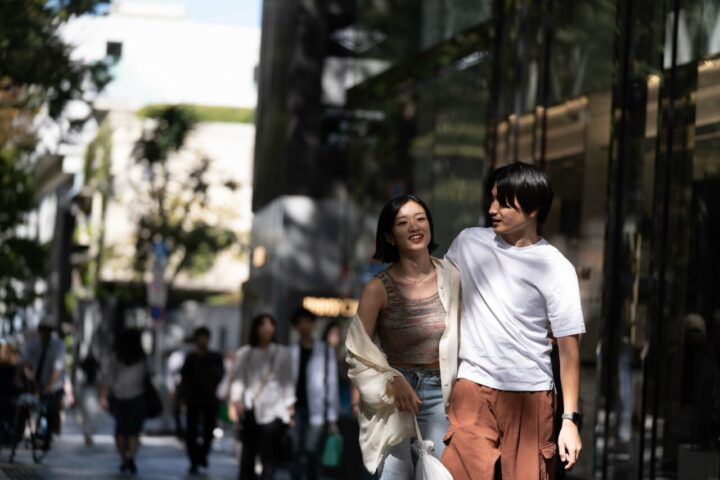
The first shot of Miyake Shō’s Two Seasons, Two Strangers shows a writer, Li (Shim Eun-kyung), as she pauses for a few silent seconds before committing herself to the words that she neatly places between the lines of her notepad. She’s writing a screenplay, an adaptation of a Tsuge Yoshiharu manga, about two strangers who meet on the beach. When we next see her, she’s apologizing to a group of university students for her work after a classroom screening of the film. This ritual of private slogging and self-induced public humiliation should be painfully familiar to anyone who’s ever written anything exposed to public scrutiny.
Miyake has consistently made films that abound in such quietly affecting moments. His prior two features, 2022’s Small, Slow but Steady and 2024’s All the Long Nights, justifiably garnered acclaim for the way they eschew overtly intense dramatic moments. Two Seasons, Two Strangers is no exception to this. Exactly one tense scene occurs throughout the entire film and its consequences are resolved immediately. Instead of theatrics, the film relies on subtle frustrations, such as the slow process of writing, to generate dramatic friction.
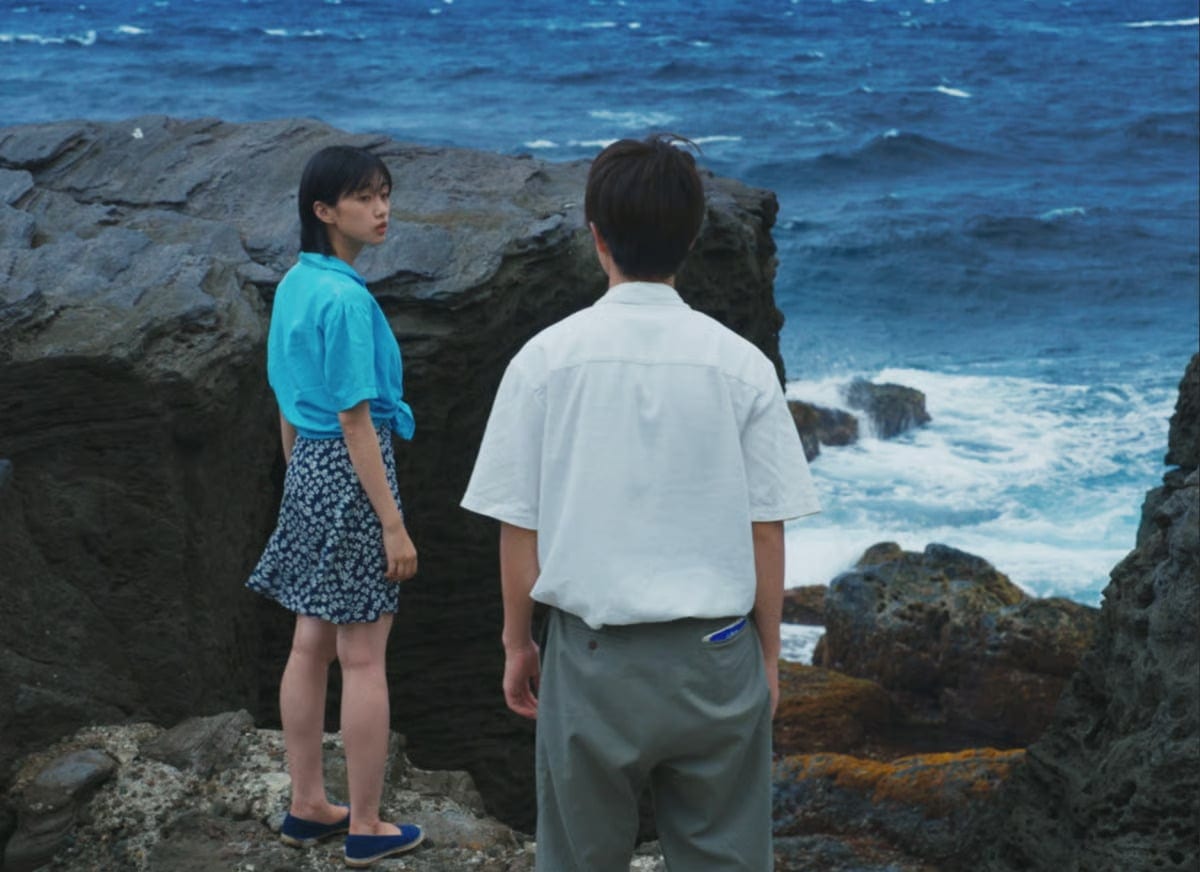
Seconds after introducing Li, the film jumps into the world of her adaptation, where the adventurous Nagisa (Kawai Yūmi) and the shy Natsuo (Takada Mansaku) meet at a secluded beach during the summertime. Before they’ve said a word to each other, Miyake lends us a few scenes to give us some guesses about their personalities. In another part of the town, Nagisa wakes up in the back of a car and barely exchanges even a glance with the driver when he returns. Did Nagisa sneak in the car overnight? Does she even know him? That she doesn’t seem at all worried tells us this isn’t her first time in the back of a stranger’s car. Meanwhile, Natsuo sits alone at the beach, hugging his knees as a European tourist takes uncomfortably close pictures of him. But he raises no objections as he retreats into himself.
Nagisa and Natsuo meet by chance and exchange a few words. Natsuo says he’s upset because he does nothing all day, while Nagisa says she’s upset because she does too much. They promise to meet each other the next day. And, just as their story reaches its climax, Two Seasons, Two Strangers returns to Li as she apologizes to a college class for what they’ve just seen.
Though we know this summer tale was a movie-within-a-movie all along, it’s still a wonderfully disorienting rug-pull to leave these characters just as things were getting interesting. The rest of the film follows Li as she, like Natsuo, takes a journey of her own to a snow-covered tourist village in winter. Her writing has become trite, she thinks, perhaps due to her sense that her soul has become stagnant. So, surely by seeing new people and new places, she will transmogrify her elusive feelings into startling combinations of words.

Also like Natsuo, she happens upon a stranger: the only innkeeper, Benzo (Tsutsumi Shinichi), with a room available. Both Li and Benzo are a bit sullen, and neither can quite lead a conversation. But their curiosity about each other—who’s this woman who didn’t book a room during tourist season? Why does this man work so hard to maintain an empty inn?— lights Li’s creative spark, her curiosity around this encounter leading her to a story she wants to tell.
Miyake’s summer and winter stories, both of which are themselves Tsuge adaptations, are superficially simple, inviting easy comparison to one another. But Miyake intersperses these tales with well-placed observational details. Li is Korean, a fact that no one makes note of, though the film itself does by showing her writing in Hangul. It’s a detail that emphasizes how Li feels out of place, how her switching between Korean and Japanese complicates her mission to “find the right words” or, as she mentions, “get away from words” altogether.
For all its subtle revelations of character and wily risks with structure, the film’s real strength may be its landscapes. Though comparisons of Miyake to Ozu Yasujirō are imperfect—Miyake seems to care very little for family tales or generational conflict, for example—his tendency to place the film’s camera in surprising places without causing distraction recalls Ozu’s renowned tatami shot. Two Seasons, Two Strangers abounds in shots of landscapes, but the narrow frame ensures that we’re not overwhelmed by the breathtaking vistas.
Instead, director of photography Tsukinaga Yuta focuses on layers, like when he frames Li and Benzo’s night trek through the snow by capturing a forest in the background, a snowy hill in the middle ground, and the characters’ trudging in the foreground. At one point, a hill is framed just so, suggesting the steepest of cliffs emerging from the ocean, until we register Natsuo and Nagisa walking down it with ease. Here and elsewhere, puncturing the film’s deceptive mundanity is understood as Miyake’s casual m.o., which he keys to the sense of melancholic discombobulation felt by his characters. In beautifully quiet ways, Two Seasons, Two Strangers captures its characters in the realm of the ineffable, making the mundane utterly sublime.
Since 2001, we've brought you uncompromising, candid takes on the world of film, music, television, video games, theater, and more. Independently owned and operated publications like Slant have been hit hard in recent years, but we’re committed to keeping our content free and accessible—meaning no paywalls or fees.
If you like what we do, please consider subscribing to our Patreon or making a donation.