John Carney’s Power Ballad has most of what it needs to succeed, from a charming pair of leads to a fittingly catchy song. But like the fraught relationship between its two musician characters, Rick (Paul Rudd) and Danny (Nick Jonas), the film never finds the right groove.
Rick is a middle-aged American musician who washed up in Dublin decades ago, putting his band on hold after marrying and having a child with an Irish woman, Rachel (Marcella Plunkett). Now a rocker dad paying the bills fronting a wedding band, the Bride and the Groove, he believes that family life has kept him from stardom. Call it a fantasy, which Carney visualizes at a wedding performance where, to his band’s and the crowd’s irritation, Rick caps a set not with “Jessie’s Girl” or “Message in a Bottle” but a song he wrote. Though this empties the dance floor, in Rick’s mind he’s playing for an adoring crowd of thousands.
Carney and Peter McDonald’s script starts out lightly poking fun at Rick’s delusion, with his bandmates and family rolling their eyes at him but generally putting up with his “could’ve been” thinking. But it also presents the character in an interesting middle range of talent, frustrated by having just enough to realistically think some kind of success is possible but not enough of it to get him there. This helps the film avoid making Rick either solely a figure of ridicule or the cliché of the overlooked genius just waiting for his break.
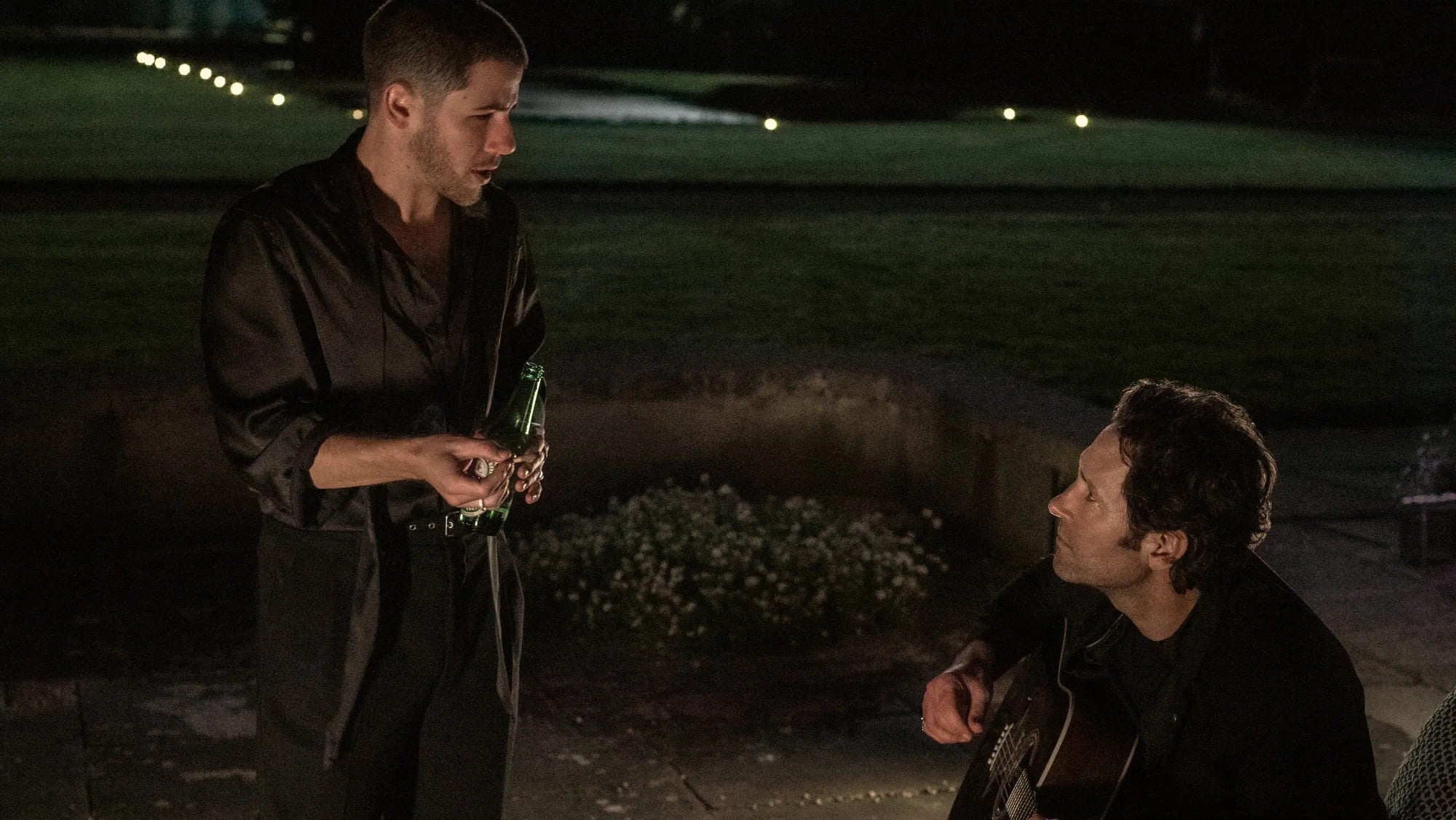
In the film’s central sequence, Rick spends a night following a gig jamming, drinking, and becoming fast friends with Danny, a wedding guest. A floundering and lonely-seeming ex-boyband star trying to kickstart the next stage of his career, Danny latches onto the older rocker as a font of ideas. Rick delights in being taken seriously while the two drink, tell stories, and play around with “How to Write a Song (Without You),” a keening ballad that Rick’s been toying with for years. Months later, Rick hears his song on the radio and watches with mounting fury as Danny rides its success to a second round of the fame that Rick never saw.
Though it starts off as Rick’s story, Power Ballad bifurcates to follow the reverberations in their lives after his and Danny’s magic jam session. This saps the film of its energy, particularly in Danny’s segments. Jonas is game enough in the role, but only really comes alive when singing; scenes with Danny’s coldblooded and profit-chasing manager, Mac (Jack Reynor), or passively waiting girlfriend, Marcia (Havana Rose Liu), are inert, with Danny’s gloomy unspoken guilt over stealing Rick’s song making a poor substitute for actual character development.
At the same time, Rick’s resentment over being denied his break threatens to upend his personal and professional lives. Power Ballad moves quickly past this stretch, where Rick spirals into a gloom that suggests a possible future as a lonely drunk boring everyone at the pub about the song that got away. An ill-considered trip by Rick and bandmate Sandy (co-writer McDonald) to confront Danny in his Los Angeles mansion provides lighthearted third-act hijinks, but the comedic tone makes it hard to determine how seriously to take Rick’s dilemma.
There’s a sweetness, organic flow, and levity to the sequence between Danny and Rick that speaks to Carney’s strengths. The spark lighting up films like Sing Street and especially Once comes from kindred spirits finding each other and turning that bond into sublime music. To the filmmakers’ credit, while “How to Write a Song (Without You)” is no “Falling Slowly,” it’s a catchy and lilting earworm that’s believable as a song thousands of besotted teenagers would sing along to in an arena. But it’s not enough to carry a film that’s largely missing the kind of sustained musical ecstasy or relational alchemy that Carney’s work usually generates.
Since 2001, we've brought you uncompromising, candid takes on the world of film, music, television, video games, theater, and more. Independently owned and operated publications like Slant have been hit hard in recent years, but we’re committed to keeping our content free and accessible—meaning no paywalls or fees.
If you like what we do, please consider subscribing to our Patreon or making a donation.