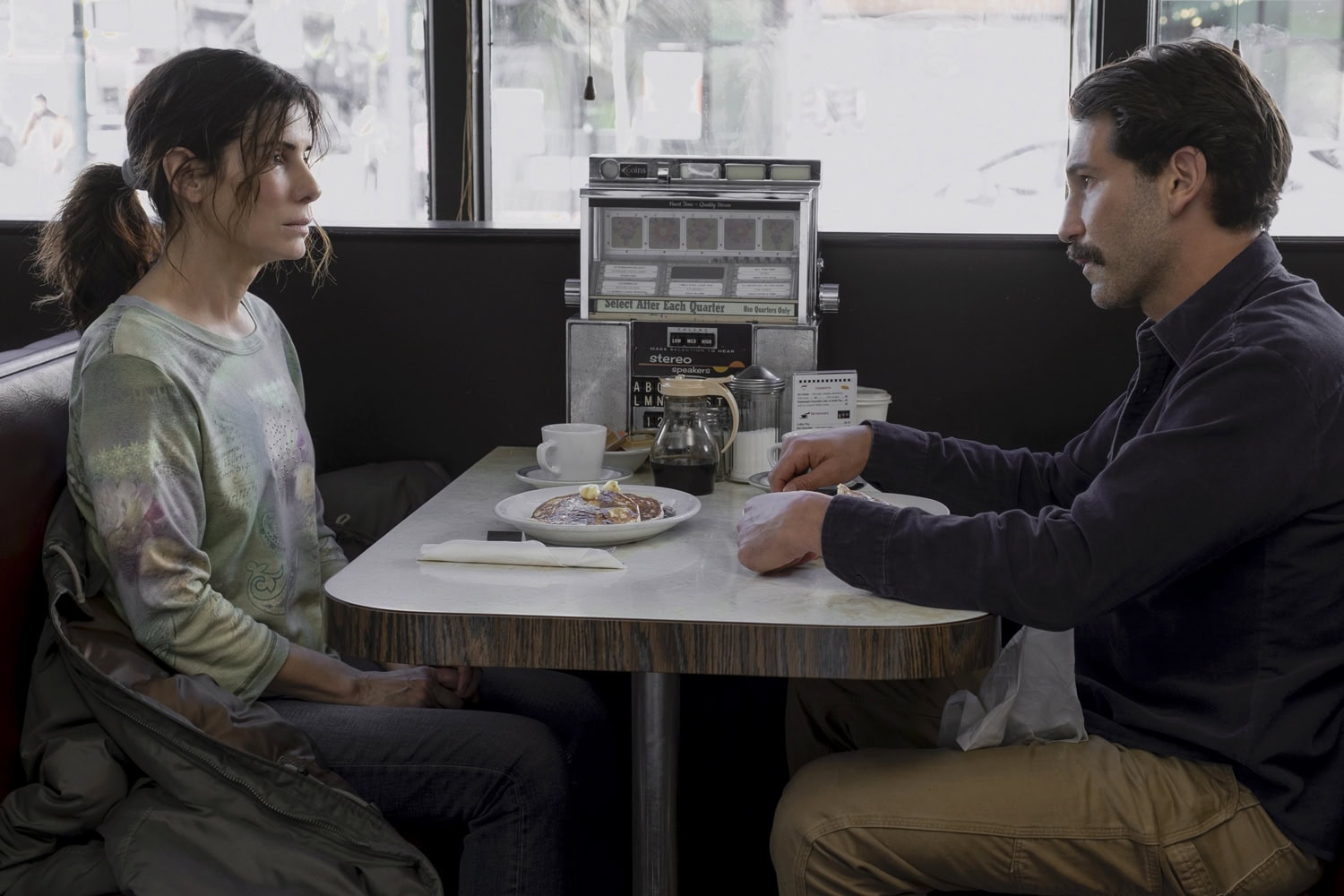
A critique of how our country expects criminals to rehabilitate themselves, all the while hypocritically narrowing their rights, is unexplored fodder for cinema. Case in point: Nora Fingscheidt’s The Unforgivable quickly reveals itself to have adopted such rich issues only as window dressing. The filmmakers’ incuriosity is evident in the opening scenes, in which Ruth (Sandra Bullock) is released from prison. Rather than exploring the emotional aftershocks of impending release, allowing the audience to truly grasp the details of Ruth’s incarceration, Fingscheidt and editors Stephan Bechinger and Joe Walker chop the sequences up to emphasize expository tidbits, all the while cranking up the generic thriller score. The effect of this opening is to prompt lurid curiosity as to what Ruth did to land in jail.
The Unforgivable whiffs on a high-concept gimmick that could have been dirty fun in the right hands. After all, we’re watching one of America’s sweethearts play a perpetrator of an especially gruesome crime. But Bullock plays Ruth, who served 20 years in jail for killing a sheriff under mysterious circumstances, as a drab martyr who long ago accepted her status as a pariah, weathering jeering, threats, beatings, and degrading jobs with a sense of resignation that’s not especially compelling given that the film idles along from one flat-footed episode to the next. It doesn’t help that every character that Ruth encounters is accorded one trait apiece: the saintly potential boyfriend (Jon Bernthal), the do-gooder lawyer (Vincent D’Onofrio), the wife who doesn’t believe in second chances (Viola Davis), and so on.
There’s no sense in The Unforgivable of the chaos of someone being thrown into a new life. No scene is surprising, as all are devoid of textures and emotions that don’t readily affirm the film’s rigid worldview of redemption. If Ruth was allowed to have a spark of liveliness that conflicted with the cliché of convicts as battered husks of people, the film might have felt more original and dangerous. Ruth’s beaten-down quality isn’t unbelievable exactly, but it’s also all that Bullock and the filmmakers allow to bleed through the frames, and so Ruth comes to feel like one of those ironically vain anti-vanity roles that superstars like to indulge in.
This impression of vanity is intensified by another ludicrous plot point: that Ruth may have killed the sheriff to defend her sister, Katie (Aisling Franciosi), who’s now a young adult living with her adopted parents (Richard Thomas and Linda Emond). The age difference between this “little sister” and Bullock is nearly, and quite clearly, 30 years in real life.
Lost in this clutter of dead-ends and sops to Bullock’s stardom is the theoretical point of the entire project: the profoundly flawed way in which our society ushers convicted criminals back into the fold of everyday life. Most egregious is a foreseeable twist, dependent on an astonishing suspension of disbelief involving characters not seeing absolutely unmissable evidence, that finally flushes The Unforgivable’s very premise down the toilet. If Ruth isn’t actually a challenge to forgive and fold back into society, then the audience has been freed of its task to empathize with someone capable of enacting nearly unimaginable psychological damage. Freeing us of that responsibility renders The Unforgivable pointless.
Since 2001, we've brought you uncompromising, candid takes on the world of film, music, television, video games, theater, and more. Independently owned and operated publications like Slant have been hit hard in recent years, but we’re committed to keeping our content free and accessible—meaning no paywalls or fees.
If you like what we do, please consider subscribing to our Patreon or making a donation.