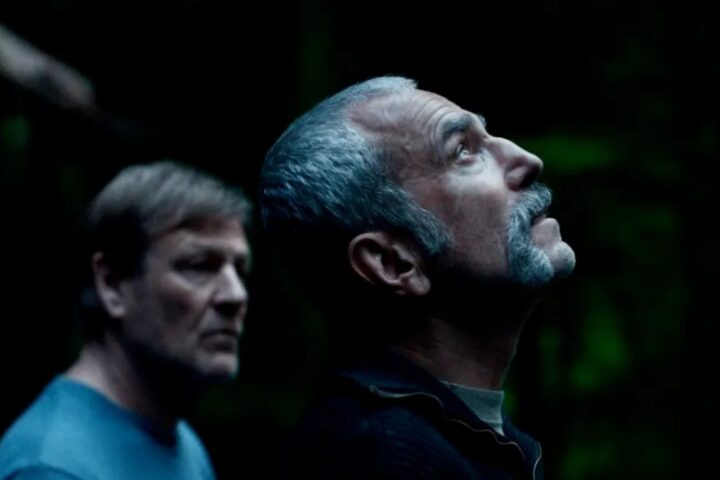
Michel Franco’s Sundown is a cool, clipped, and dispassionate story of a man who’s throwing his life away but doesn’t want to kick up a big fuss about it because, well, life is meaningless. Scions of a filthy-rich slaughterhouse dynasty, Neil (Tim Roth), and his sister, Alice (Charlotte Gainsbourg), and her teenage children (Albertine Kotting McMillan and Samuel Bottomley), laze around at an upscale Acapulco beach resort. When a family emergency sends Alice and the kids flying back to England, Neil stays behind, saying at the last minute that he’s forgotten his passport. But instead of going to look for it at the resort, he checks into a randomly chosen cheap hotel and begins an intense cycle of beach bumming.
At first, as Alice’s calls become increasingly anxious and concerned, Neil pretends to be trying to sort things out so that he can reunite with his family. Franco makes clear that the man is lying—a shot of his open suitcase clearly reveals his passport—but doesn’t spell out why. Neil initially appears content to drink beer and bake in the sun like a good Englishman on holiday, starting a relationship with a shopgirl (Iazua Larios) almost on a whim. And though he has a secret that’s finally revealed near the end of the film, his detachment and ennui may have more to do with a sense of long-gestating class guilt that Franco alludes to throughout.
With limited action for long stretches, Sundown rests primarily on Roth’s ability to sustain interest. It’s a tricky feat, especially given how the character’s dialogue is pared down until he achieves near-mute status, but it’s one that Roth pulls off. His rendering of Neil’s stolid quietude is neatly calibrated, showing a thoughtful determination behind his seeming carelessness. When Neil stares at a pile of dead fish in the pointed opening shot, the look in his eyes signals a realization of mortality that just might be behind everything that follows.
Rather than plumbing the depths of Neil’s psyche, Franco seems more focused on the world around him, namely Mexico’s endemic violence, and the idea of what violence begets and justifies. This is represented in two scenes of bloodshed that jolt the initially serene though eerie film into a more anxious register. As a result, the casually observed class differences between Neil’s family—whose privilege is indicated by their huge inheritance, tidy monthly stipend, and a lawyer who appears when needed, all of it paid for by the industrial-scale massacre of animals—and the blue-collar types whose world he awkwardly inserts himself into start taking on a sharper edge. The irony is that for all of Neil’s attempts to slide into dissipation, the protection provided by his wealth keeps bouncing him back.
Unlike many stories about men throwing their lives away, Sundown isn’t very engaged by the narcissism of self-destruction. In the end, the world that Franco shows around him and his downward spiral appears more driven by extremes. The film, then, leaves you with the impression of a man trying to beat the entropic decay that surrounds him to the punch.
Since 2001, we've brought you uncompromising, candid takes on the world of film, music, television, video games, theater, and more. Independently owned and operated publications like Slant have been hit hard in recent years, but we’re committed to keeping our content free and accessible—meaning no paywalls or fees.
If you like what we do, please consider subscribing to our Patreon or making a donation.