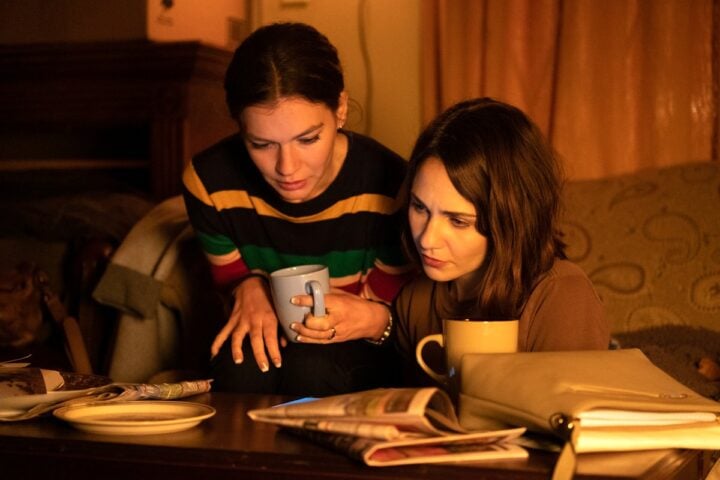
Even for American liberals, abortion has long been a touchy subject. “Legal but rare” is the watchword of cautious Democratic candidates, and popular film has long preferred to romanticize the independent women who make the brave choice not to terminate a pregnancy (see Juno). With Gillian Robespierre’s Obvious Child and, now, Alex Thompson’s Saint Frances, we may be seeing the emergence of something like the abortion comedy. The very concept of such a thing is probably enough to make a heartland conservative retch, which Thompson and his screenwriter and lead actress, Kelly O’Sullivan, no doubt count on.
Bridget (O’Sullivan) is a white Chicagoland millennial who, like so many of her generation, finds herself still living the life of a twentysomething at the age of 34. Messy and a little irresponsible—qualities that could be largely chalked up to the inert decade of post-college poverty she’s endured—she struggles to admit in conversation with her ostensible peers that she works as a server at a greasy diner. In the film’s opening scene, a tidy encapsulation of the tragicomedy of being an underachieving hanger-on in bougie social circles, she’s brought to the verge of tears when a yuppie dude she’s chatting with loses interest in her after her age and employment come up. She immediately pounces on Jace (Max Lipchitz), the next guy who talks to her, after he casually reveals that he, too, works as a waiter.
Fortunately, Jace turns out to be an indefatigably cheerful and supportive 26-year-old who comes across as perhaps a tad too perfect until the precise moment in Saint Frances that the filmmakers need him to come off more like a Wrigleyville bro. At some point during their initial hook-up, Bridget gets her period, and the couple wakes up fairly covered in blood. (Bridget’s nigh-constant unexpected vaginal bleeding and the stains it leaves will serve as both metaphor and punchline throughout the film, and it works better than you may think.) Amused but unphased by the incident, Jace will also prove to be a supportive partner when Bridget chooses to terminate her accidental pregnancy later in the film, even though Bridget remains openly uncertain about whether or not they’re actually dating.
In the wake of her abortion, Bridget is taken on as a nanny for Maya and Annie (Charin Alvarez and Lily Mojekwu), a mixed-race lesbian couple who need someone to look after their unruly daughter, Frances (Ramona Edith Williams), while Maya cares for their newborn. Frances is a self-possessed kindergartner whose dialogue sometimes drifts into “kids say the darnedest things” terrain, even though it can be funny (“My guitar class is a patriarchy,” she proclaims at one point). But O’Sullivan’s screenplay doesn’t overly sentimentalize childhood—or motherhood for that matter. One important subplot involves Bridget’s mother’s (Mary Beth Fisher) reminiscing that she sometimes fantasized about bashing the infant Bridget’s head against the wall, a revelation that helps Maya through her post-partum depression.
Maya and Annie live in Evanston, the Chicago suburb where Northwestern University is located, and Bridget counts as an alumna of sorts, though in conversation she emphasizes that she was only there for a year. She clearly views the town as the epicenter of her shame; underlining this is that the couple’s next-door neighbor turns out to be Cheryl (Rebekah Ward), an insufferable snob who Bridget knew in college, whose “lean in” brand of upper-class feminism doesn’t preclude her from treating her erstwhile peer like an all-purpose servant. Frances’s smarmy guitar teacher, Isaac (Jim True-Frost), also embodies the moral ickiness of the privileged, as he takes advantage of Bridget’s foolhardy crush on him.
Bridget’s relationship with Frances and her parents changes her, but the film isn’t making the point that she learns the majesty of child-rearing and the awesome responsibility of parenthood. It’s that Bridget finds strength in intersectional and intergenerational solidarity, emerging from the isolating cell she’s built herself out of quiet self-shame. If that approach sounds academic, it’s true that at times Saint Frances is staged too much like dramatic enactment of feminist principles—a public confrontation with an anti-public-breast-feeding woman ends up feeling like an after-school special about conflict mediation—but it has almost enough genuine charm and heart to compensate for the moments that feel forced.
Since 2001, we've brought you uncompromising, candid takes on the world of film, music, television, video games, theater, and more. Independently owned and operated publications like Slant have been hit hard in recent years, but we’re committed to keeping our content free and accessible—meaning no paywalls or fees.
If you like what we do, please consider subscribing to our Patreon or making a donation.