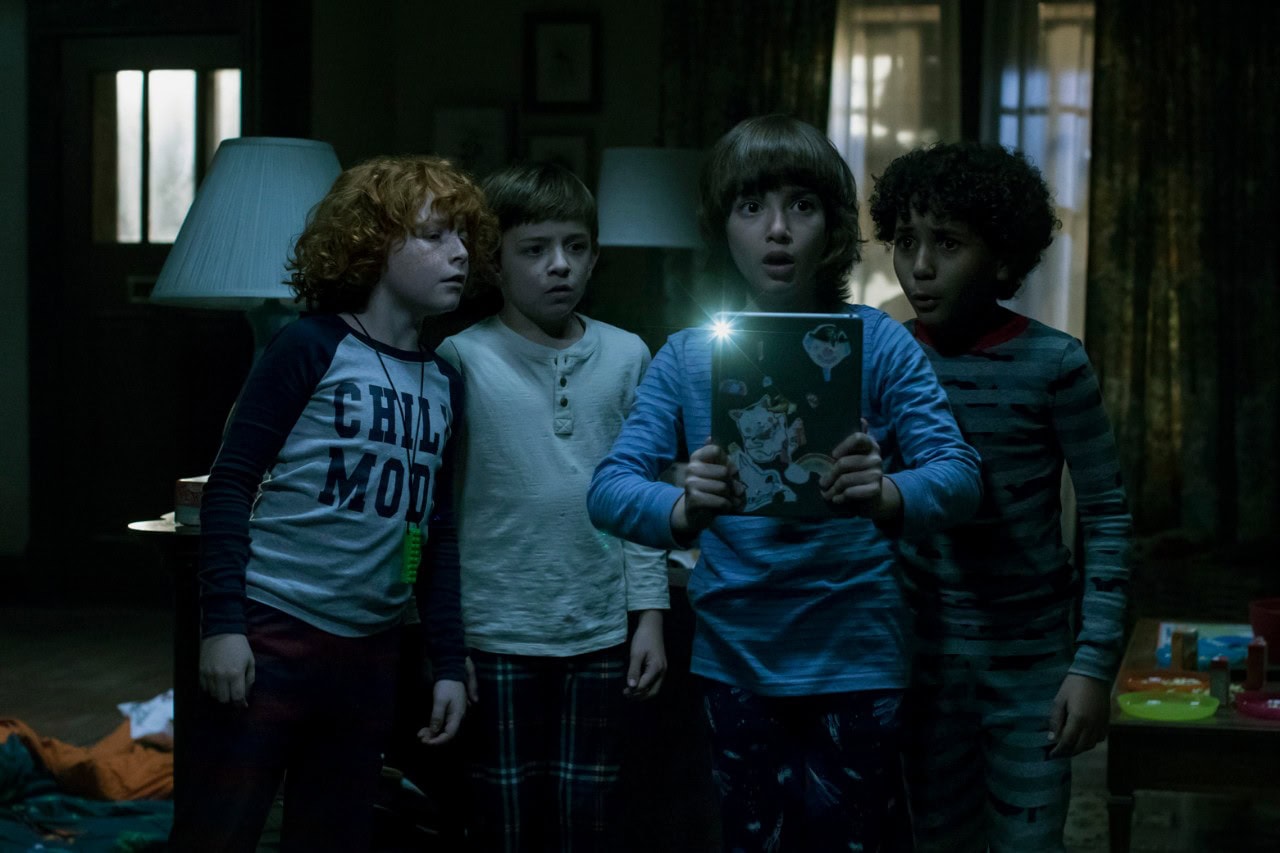
While it can be expected that high-concept horror movies will often be sewn together from the premises of recent genre successes, it’s much too easy to see the stitches in writer-director Jacob Chase’s Come Play. Conspicuously echoing Jennifer Kent’s The Babadook and Mike Flanagan’s Before I Wake, the film tells the story of a child haunted by a monster that only he can see—one awakened by a seemingly indestructible children’s storybook, and who serves as an allegorical embodiment of childhood trauma.
Chase introduces two new wrinkles to this formula: The first is that the monster’s home dimension is the electronic realm of smartphones, tablets, and the electrical system, and the second is that the child, Oliver (Azhy Robertson), has autism and is nonverbal. Come Play approaches Oliver’s disability empathetically, if heavy-handedly, showing how easily his lack of verbal expression ostracizes him from others: A group of boys at school led by Byron (Winslow Fegley) bully the kid; Byron’s mother, Jennifer (Rachel Wilson), is quick to presume that Oliver’s occasional fits are dangerous; and even Oliver’s own mother, Sarah (Gillian Jacob), struggles to understand his lack of communication as something other than coldness.
Oliver communicates with others using a smartphone app that offers him words and phrases, rather than letters, to choose from. The monster, unassumingly named Larry, makes contact with Oliver through his phone, interrupting episodes of the boy’s beloved SpongeBob SquarePants. A children’s e-book called Misunderstood Monsters keeps appearing on the screen of Oliver’s digital devices, claiming that the monster just wants a friend, and that he’ll be loosed upon the physical world once the story has been read all the way through. However, from the very beginning, Larry seems present but invisible without the aid of a phone camera, and is able to manipulate objects in the real world and endanger people’s lives. It’s a salient enough contradiction that, in its latter half, the film has characters hurriedly sum up the rules of the mythology based on some quite impressive logical leaps—lest we start thinking that the scares were conceived apart from internal narrative consistency.
A disproportionately tall, spindly, and perpetually moist gray something or other, Larry is a gene splice of the Babadook and the monsters from A Quiet Place. Although these influences are as apparent any other element in Come Play (Oliver communicates Larry’s presence to adults through creepily scrawled crayon drawings), the look of the monster is the film’s most effective visual idea. By the time he’s revealed in all his skeletal abjectness, though, Larry’s credibility as a menacing presence has already been undercut by the escapes-by-expeditious-cut that end virtually every scene of suspense. When the big confrontation comes, Come Play has already proven, despite its monster’s prodigious chompers, to be rather toothless.
In the end, theme takes too much priority over threatening atmosphere in Come Play. It’s hard not to be concerned about a particularly vulnerable child’s welfare, and Robertson’s performance as Oliver impresses, conveying the boy’s sensitive and perceptive nature without his ever uttering a word. But the film can only get so far on Robertson’s performance and its spectator’s protective instincts. What Come Play has to say about isolation in the digital age is certainly unmissable—one could also compare certain “haunted smart technology” effects to recent horror flicks like Stephen Susco’s Unfriended: Dark Web and Rob Savage’s Host—but on its own, having a message does not an effective horror movie make.
Since 2001, we've brought you uncompromising, candid takes on the world of film, music, television, video games, theater, and more. Independently owned and operated publications like Slant have been hit hard in recent years, but we’re committed to keeping our content free and accessible—meaning no paywalls or fees.
If you like what we do, please consider subscribing to our Patreon or making a donation.