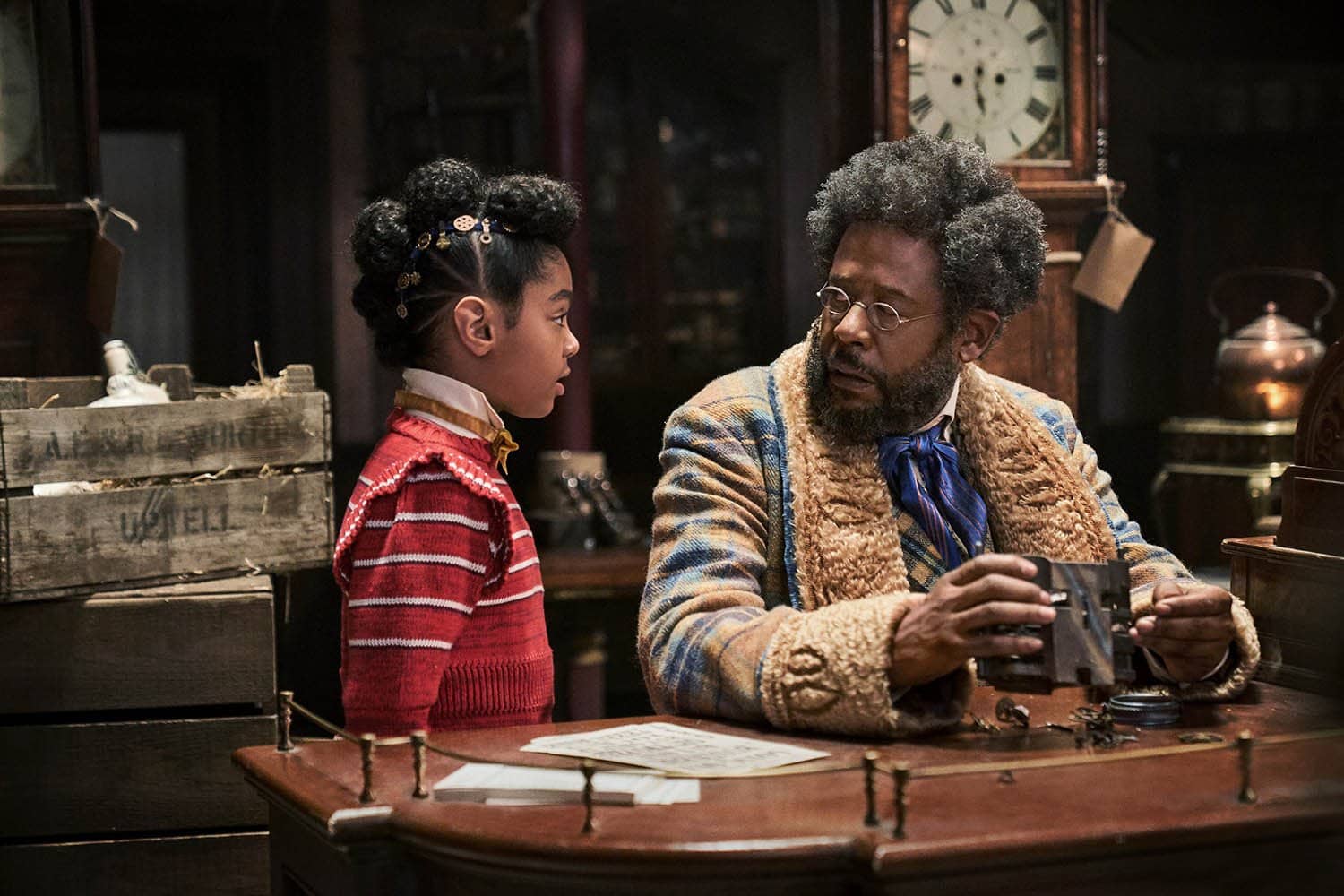
Writer-director David E. Talbert’s Jingle Jangle: A Christmas Journey abounds in steampunk-ish sci-fi sights, from a flying robot to a sentient Don Juan-inspired doll to a Willy Wonka-esque factory. But the scene that manages the most awe is a quieter nighttime sequence in which three generations of inventors—grandfather, mother, and young daughter—collaborate side by side as they rebuild a broken toy.
It’s not a coincidence that this entrepreneurial family is black, as Talbert dreamt up Jingle Jangle as a musical holiday film that would reflect young audiences who have never seen heroes who look like them in films like Elf, Home Alone, and A Christmas Story. Jingle Jangle’s pseudo-Victorian world depicts a diverse community in which race itself is never mentioned, but all the entrepreneurs, all the storytellers, and all the heroes are black. (All the shops in the streets are also named after black inventors.) While we’ve seen holiday films with encouraging messages of self-belief and dance numbers in the snow before, moments like that inventors’ vigil, a tender intergenerational portrait celebrating black ingenuity, transform Jingle Jangle from a familiar family film into—within the genre, at least—an indispensable one.
As Jingle Jangle opens, the revolutionary toymaker Jeronicus Jangle (played by Forest Whitaker in old age and briefly by Justin Cornwell in youth) loses everything when his impulsive, impatient apprentice, Gustafson (Keegan-Michael Key), makes off with the blueprints. Decades later, Jangle is withering away as a depressed pawnbroker facing foreclosure when his estranged granddaughter, Journey (Madalen Mills), shows up, eager to show off her own STEM-cultivated genius and join forces with her once-extraordinary grandfather.
Will Jangle invent something amazing in time to save his shop from the banker (Hugh Bonneville) looking to collect on a decades-old loan? Will Gustafson and the evil Don Juan Diego doll (voiced by Ricky Martin) succeed in stealing Jangle’s ideas? The tensions that drive Jingle Jangle’s distractible plot neither make much sense nor feel particularly high-stakes. And the film’s ungainly structure, proffering prologues within prologues (Phylicia Rashad plays a grandmother reading Jangle’s adventures from a storybook), sets up a slow start that delays the scene-stealing heroine’s arrival for half an hour. But Jingle Jangle’s songs are joyful diversions, as they illuminate character more pointedly and emotionally than the script.
They also feature a starry lineup of performers: Lisa Davina Phillip as a widowed mail carrier pursuing the aged Jangle with lustful riffs and a trio of backup dancers; the ever-energized Key as a charlatan salesman making a high-spirited musical pitch to prospective buyers (in a tribute to The Wiz, Gustafson and his employers are all clad in emerald green); and a vocally luminous Anika Noni Rose as Journey’s mother, who vows to make peace with her own father in “Make It Work,” a churning choral anthem and the film’s best song, written by John Legend.
The tweenaged Mills, in her film debut, boasts a bell-like, mature belt, a mischievous grin, and a canny mix of studiousness and spontaneity: Journey is as liable to start solving derivatives as to begin dancing in the street, and sometimes she does both at once. Following in the footsteps of Letitia Wright’s Shuri, Black Panther’s superhero teen tech innovator, Journey, in all her unmitigated engineering brilliance, ought to serve as a hero for any kid who dreams of building robots, solving theorems, or inventing something brand new of their own.
Even if Journey’s actual mathematical procedures seem suspect (“The square root of impossible is me,” she sings), Journey and with her nerdy, newfound pal, Edison (Kieron L. Dyer), succeed in making math and science seem pretty darn cool. And over a holiday season in which black girls will be able to count down, for the first time, to the day a vice president who looks like them takes the oath of office, the greatest gift that Jingle Jangle offers is an empowering world that looks less like invention and more like real life.
Since 2001, we've brought you uncompromising, candid takes on the world of film, music, television, video games, theater, and more. Independently owned and operated publications like Slant have been hit hard in recent years, but we’re committed to keeping our content free and accessible—meaning no paywalls or fees.
If you like what we do, please consider subscribing to our Patreon or making a donation.