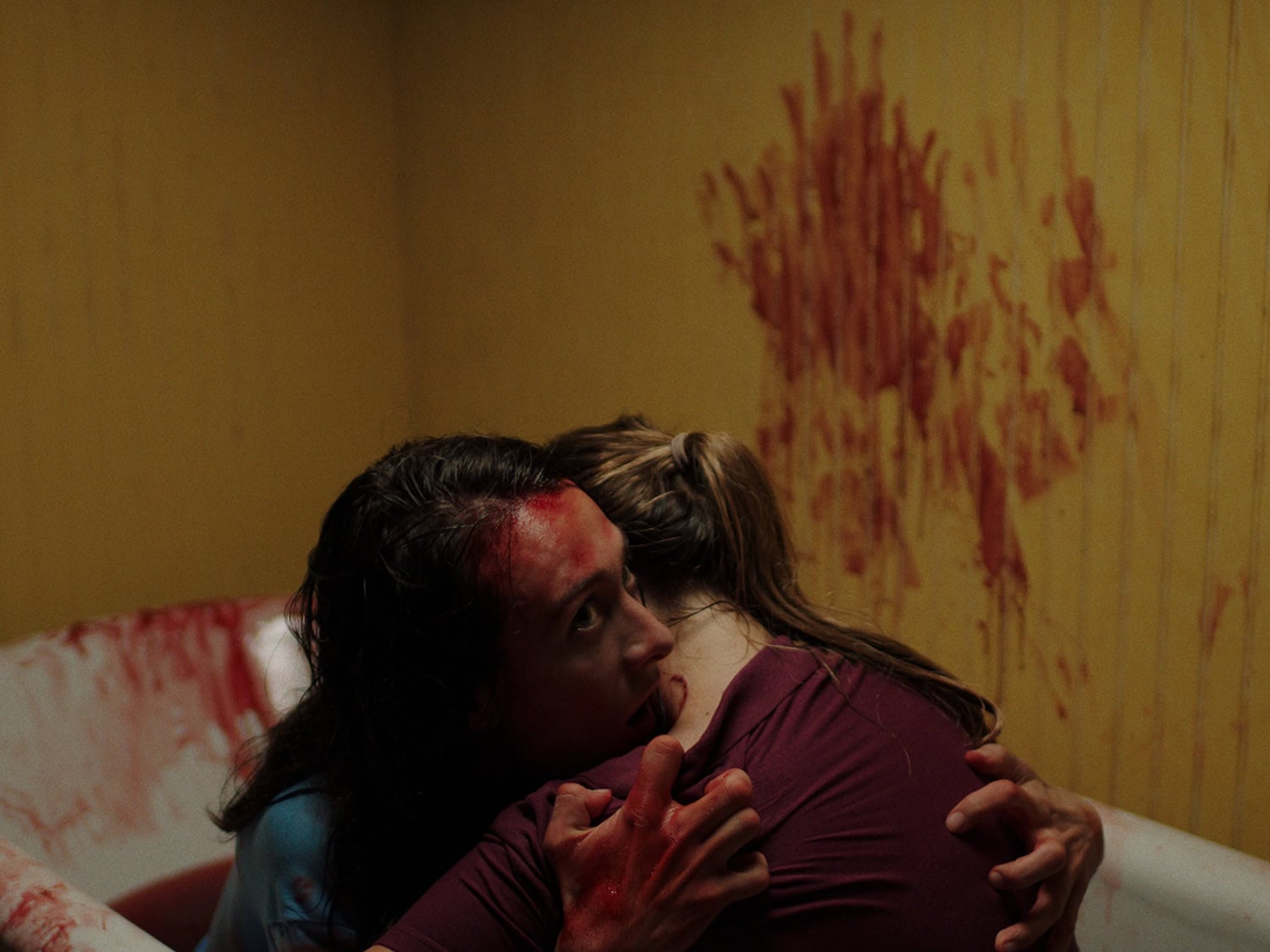
With his feature-length directorial debut, My Heart Can’t Beat Unless You Tell It To, Jonathan Cuartas strips away the tropes commonly associated with the vampire genre. Vampirism here is less a curse of a parasitic aristocracy in decline but refusing to die than it is simply a debilitating chronic illness, though the film isn’t without its class connotations. This is essentially a family drama in which one of three siblings, Thomas (Owen Campbell), happens to be a vampire. Or so we assume, given than he subsists on the human blood that his older brother, Dwight (Patrick Fugit), reluctantly collects for him, and keeps a nocturnal schedule, languishing in the isolation of the family’s stuffy suburban house, where he’s homeschooled by his domineering yet devoted sister, Jessie (Ingrid Sophie Schram).
More awkward than malevolent, Thomas harbors naïve dreams of venturing outside to make friends with others his age. Dwight and Jessie drain his victims out of love for their brother—love that, under strain, turns to an oppressive filial obligation. Shot in locations in and around Salt Lake City, a place hardly known for its vampiric associations, My Heart Can’t Beat Unless You Tell It To extracts an unexpectedly Transylvanian mood from its various settings. Behind a digital filter best described as pus-colored, its claustrophobic interiors exude a tone of putrefaction that’s nothing if not consistent, bordering on monotonous.
Insofar as My Heart Can’t Beat Unless You Tell It To is a horror film, its horror derives from the tensions between caregiving, co-dependency, and abuse, from murder treated as a duty rather than sadistic pleasure. Dwight cannot be the serial killer that Thomas’s survival demands, and as he sympathizes more and more with his victims, Jessie’s control over him begins to waver.
Too many films, regardless of genre, treat sex workers and homeless people as faceless, storiless fodder—inherent victims, there to be bumped off whenever a plot needs a cheap thrill to shore it up. My Heart Can’t Beat Unless You Tell It To is notable, then, for humanizing this bottom rung of society—a safe source of blood for Thomas precisely because it’s overlooked. Here, class re-enters the vampiric equation, and in fact, the entire film hinges on the development of a character that most films would treat as beneath consideration.
Tasked by Jessie with replenishing the blood supply for Thomas, Dwight lures a homeless man, Eduardo (Moises L. Tovar), into his truck with a breakfast burrito. Eduardo doesn’t speak English, nor does Dwight speak Spanish, but knowledge of each other’s names already forms the basis of a connection between them. Later, when Dwight goes to feed his hostage, he finds a photograph of a young man in Eduardo’s wallet. Dwight assumes that the young man is Eduardo’s son, maybe even his brother, but thanks to the magic of subtitles, the viewer learns more about Eduardo than Dwight is able to, as Eduardo explains in Spanish how he doesn’t even know the man in the photo, who was supposed to help him when he made it into the country. Flawed though it is, Dwight’s understanding of Eduardo’s story disrupts the routine of bloodshed that sustains a family, leading to the crisis at the film’s climax.
My Heart Can’t Beat Unless You Tell It To may invite unfavorable comparisons to Tomas Alfredson’s Let the Right One In, as they share a minimalist, atmospheric approach to the vampire genre. So much context is stripped out here that the characters, too, can tend to feel hollow, as we come to know their motivations but aren’t given enough to understand those motivations. And a few forced moments, especially one where Jessie sings along to the song that gives the film its title, disrupt Cuartas’s meticulously cultivated mood. But by turning a vampire’s conflicted caretakers into protagonists, and without losing sight of their victims as people with stories of their own, My Heart Can’t Beat Unless You Tell It To still manages to vividly diagnose a sickness of insularity endemic to middle-class America.
Since 2001, we've brought you uncompromising, candid takes on the world of film, music, television, video games, theater, and more. Independently owned and operated publications like Slant have been hit hard in recent years, but we’re committed to keeping our content free and accessible—meaning no paywalls or fees.
If you like what we do, please consider subscribing to our Patreon or making a donation.