Considering the unruly potential of its premise, Stephen Herek’s Bill & Ted’s Excellent Adventure is surprisingly innocuous. The 1989 cult film concerns two teenage California stoner-bro types—though they appear to be teetotalers—who dream of being rock stars. Bill (Alex Winter) and Ted (Keanu Reeves) have no talent or experience, as they’re addicted to the fantasies of fame, blissfully unaware of the work involved in the tradition of many children (and adults) with similar implausible daydreams. In the film’s best joke, we’re told early on that Bill and Ted will be revolutionary rockers and save the future, an idea that might cut to the wellspring of the deepest egos of many an actual rock titan.
To ensure the creation of Bill and Ted’s song, they must pass their high school history test (long story) and they’re sent hurtling into time by future emissaries to learn history directly from its architects. The two friends meet Napoleon, Billy the Kid, Sigmund Freud, Joan of Arc, and many others, but few jokes are spun directly off of these interactions. With a couple of exceptions (Freud spins a memorably naughty punchline), the legends are generally kept at a narrative remove, rendered vaguely defined passengers. It’s a glaring missed opportunity that was corrected by a far more inventive sequel, 1991’s Bill & Ted’s Bogus Journey, in which the dudes are sent to hell by evil doppelganger robots (another long story).
You could say that this innocuousness is the appeal of the Bill & Ted series, which offers up two likeable, lazy caricatures of slacker-dom who are divorced from all the danger and temptations of rock or even of ordinary post-adolescence. These are teenagers as children might imagine them, and Winter and Reeves have an authentic, singularly loopy rapport—though this sentimentality is somewhat at odds with the films’ frenetic, wearying pace, which implicitly promises rowdier payoffs. Which is why Dean Parisot’s years-in-the-making Bill & Ted Face the Music surprisingly arises as the most enjoyable entry in the series: Its slower, quietly melancholic tempo allows the viewer to savor the jokes and take them as they come.
A sense of settling is built into the premise of this film. Bill and Ted have cut several records over the years, but their musical careers burned out before they could write that existence-altering song. Cursed with the knowledge that they must write it, they’ve become strange has-beens who play a ridiculous and convoluted instrumental at a family wedding. Bill and Ted are also more codependent than ever. In a resonant joke, they’re always proclaiming their love to their respective wives, Joanna (Jayma Mays) and Elizabeth (Erinn Hayes), in the first-person plural rather than the singular. Bill and Ted, stifled by failure, see themselves as a singular drowning entity, and Parisot and screenwriters Chris Matheson and Ed Solomon (who co-wrote the first two films) allow this emotion to seep into the narrative casually and gracefully.
Notions of regret and loss bob up and down throughout the film. Rufus, the man from the year 2688 who introduced Bill and Ted to time travel, and who was played in the other films by the brilliant George Carlin, is seen here as a hologram introducing the phone booth-like time machine that figured so prominently in Bill and Ted’s earlier adventures. This poignant grace note is an homage to the deceased comedian as well as an acknowledgement that Bill and Ted’s youthful exploits have potentially added up to little more than trivia for the future age.
When Bill and Ted later time travel again to steal the revolutionary song from their future selves, whom they presumed wrote it at some point—another good joke—they confront various Bill and Teds of escalating dire straits. The unexpected payoff to this imaginative running joke makes for the strangest and most moving moment in the series: Bill and Ted confront their future selves on their death beds, speaking to the old men like fathers. Similarly, when they meet Death (William Sadler), a memorable character from Bogus Journey, they speak in regretful tones that are both dada nutso, considering the circumstances, and stirring.
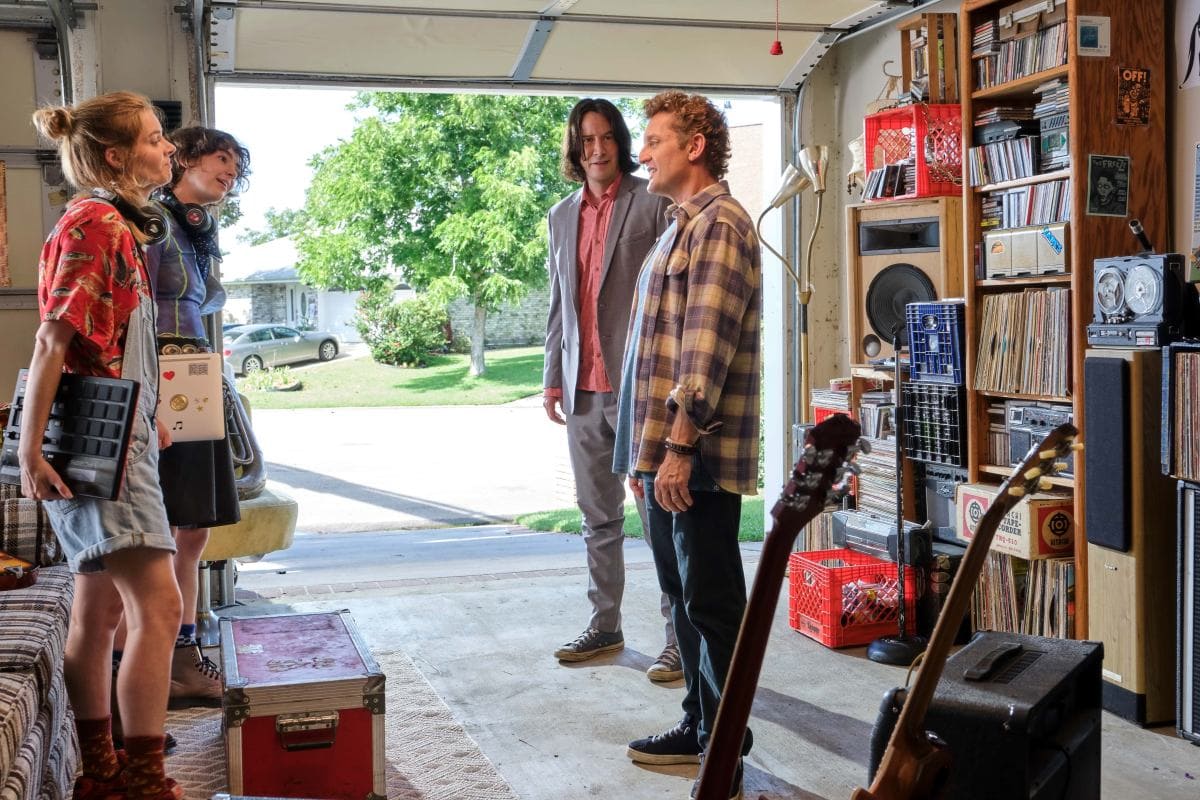
Parisot is at least partially responsible for informing another far-out comic adventure with startling pathos, 1999’s Galaxy Quest, which is a classic. Bill & Ted Face the Music doesn’t hit that film’s high notes; it’s mild but consistently pleasing, and it grows more likeable as Bill and Ted join up with their daughters, Thea (Samara Weaving) and Billie (Brigette Lundy-Paine), to pen the miracle song. The film is ultimately concerned with the reunion of families, biological and surrogate alike, which it links to the erosion of hope and community in the modern age. Even the historical legends are better utilized here, as there’s an especially lovely moment when Mozart (Daniel Dorr) and Jimi Hendrix (DazMann Still) connect through a jam session. It’s the sort of communion that suggests that Bill and Ted’s dreams of stardom, which have evolved into dreams of acceptance and expression, aren’t so stupid after all.
Since 2001, we've brought you uncompromising, candid takes on the world of film, music, television, video games, theater, and more. Independently owned and operated publications like Slant have been hit hard in recent years, but we’re committed to keeping our content free and accessible—meaning no paywalls or fees.
If you like what we do, please consider subscribing to our Patreon or making a donation.