
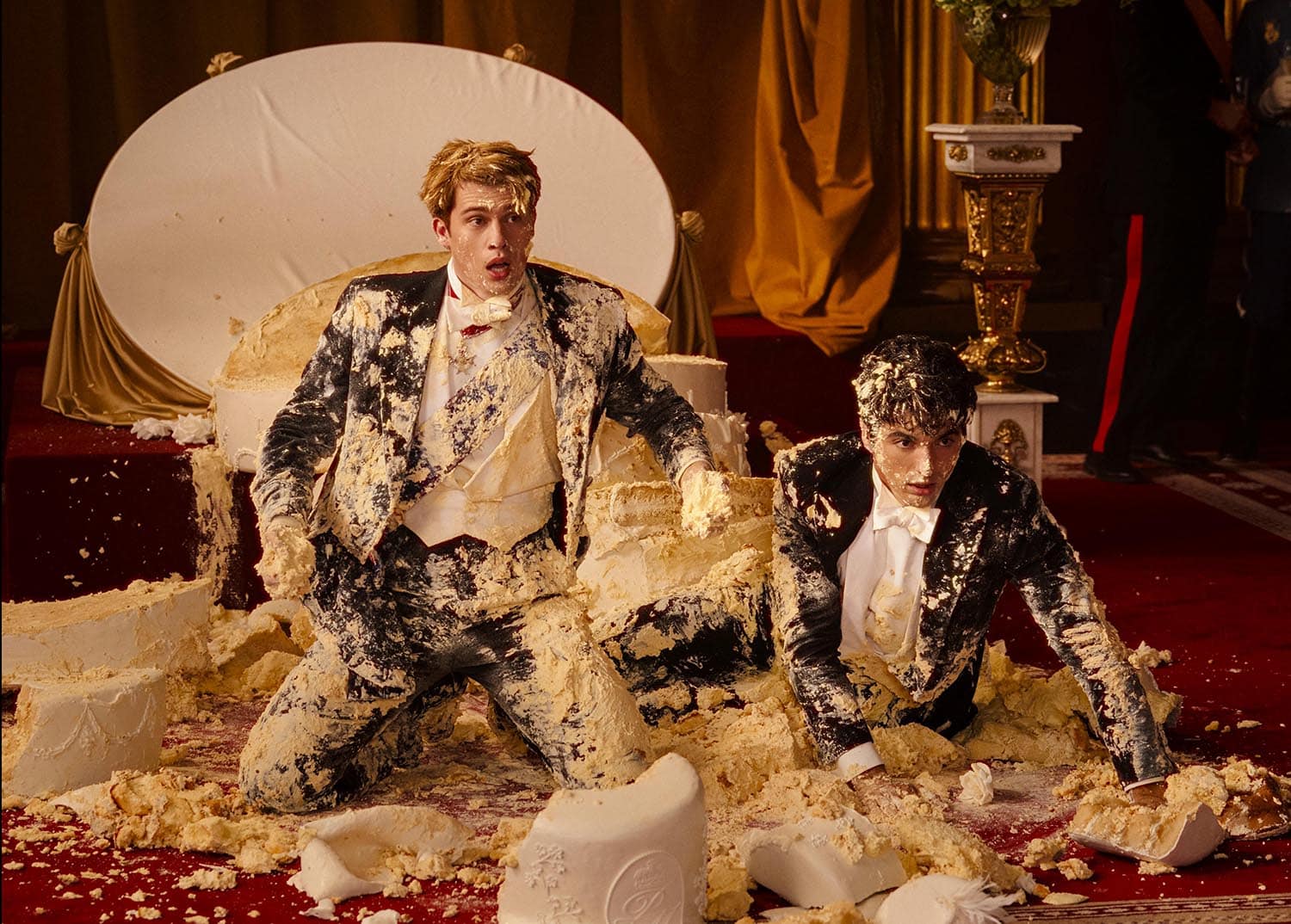
Perhaps unsurprisingly, Red, White & Royal Blue shares very little with first-time director Matthew López’s Tony-winning play The Inheritance. Both works address the social mores of young gay men from disparate backgrounds in the wake of a crisis, but where the characters in López’s career-defining play are processing the traumas of AIDS, the biggest hiccup in the lives of the film’s characters turns out to be a destroyed wedding cake.
No shade. (Okay, maybe a little.) Not every piece of art about gay desire needs to be rooted in trauma and internalized shame, and López’s film boasts a handful of sex scenes—between Alex Claremont-Diaz (Taylor Zakhar Perez), the son of the American president, and England’s Prince Henry (Nicholas Galitzine)—that will surely satisfy anyone who’s horny for representation. But everything around those scenes—the histrionic scenarios, the Sorkin-esque political idealism, the Gen Z-pandering internet humor—is too limp and lacking in texture to be stimulating.
From its use of green screen to capture throngs of people at Buckingham Palace to its overhead B-roll shots of Paris escapades, Red, White & Royal Blue is nothing if not artificial. The film is based on the book of the same name by Casey McQuiston, who came up with the idea for it during the 2016 U.S. presidential election and drew inspiration from HBO’s Veep and White House palace intrigue. But the pedigree that’s most apparent here is that of a pulp romance novel, only one that suggests a gay-themed love story as a sentient “vote!” sticker.
Despite its lip service toward “queer liberation,” as in a ham-fisted press speech by Alex that suggests a Hallmark-grade spin on the final moments of Charlie Charplin’s The Great Dictator, the film feels toothless. It seeks to give us an agreeably sexy and frothy romance, and Zakhar Perez and Galitzine’s chemistry facilitates that, even when the actors are awkwardly grabbing at each other’s faces as if they were attacking a hamburger. But the film also wants to make capital-B big statements about advancements in queer rights in erstwhile liberal democracies, which it can only conceive of doing by unironically praising British efforts at wildlife conservation in Africa and the determination of American Democrats to flip Texas blue.
For no apparent reason other than their mutual attraction, Alex and Henry hate each other. Both resent the other’s popularity in the press, and both believe that the other’s attractiveness has been greatly exaggerated. (The confidence with which these young men stare at each other as they strut around half-naked or dressed in supremely tailored suits handily gives lie to the latter belief.) Then, when the two tussle at the wedding of Henry’s older brother, Prince Philip (Thomas Flynn), and the royal wedding cake is destroyed, the American and British governments try to quiet the ensuing media storm (weirdly whipped up by Rachel Maddow), resulting in Alex and Henry becoming even more entwined in each other’s lives.

Why this faux pas is such a thorn in everyone’s collective sides feels perversely unmotivated, except perhaps for the fact that Alex’s mother, President Ellen Claremont (Uma Thurman, channeling Ann Richards by way of Foghorn Leghorn), is desperate to pass a new trade agreement that apparently has the power to sway her reelection campaign. Thus, Alex and Henry agree to publicly bury the hatchet, only for them to fall madly, secretly in love.
Though Henry is out to his younger sister, Beatrice (Ellie Bamber), he publicly curates an image of himself as a straight lothario out of deference to the crown’s conservatism. Alex, meanwhile, is closeted to his own bisexuality, with his only prior sexual experience with a man having been with a snake-like Politico journo, Miguel (Juan Castano). The way that López and Ted Malawer’s script obsesses over the various degrees of closeted desire, you’d think that both Alex and Henry’s defining characteristic was their confusion over who they want to be. In lieu of learning anything substantial about them, we hear, ad nauseam, about the difficulty of being yourself when you’re only known for sitting pretty, literally and figuratively, within powerful institutions.
Red, White & Royal Blue wants to use its comedic romance as a conduit to talk about the necessity of queer liberation, but it’s frustrating to see the mouthpiece for such a message be two uncommonly powerful people who are desperate, for most of the film, to hide who they are. (Just about the only thing that counts as nuance here is the aggressive attempt to accentuate the presidential family’s “middle-class roots.”) Further, the film’s direction and writing feel stage-bound, with the paramours often moving about the frame as if unmotivated, angling for their light and calling out their lines to some imagined audience in the distance.
For many, it will be refreshing to see this feel-good, made-for-TV romance with two queer characters at its center. But whatever sense of pleasure or reward there is in the sometimes sensual sight of two men kissing or touching each other’s stomachs in bed, post-coitus, does little to obfuscate that Red, White & Royal Blue is otherwise a slapdash slog that views the politics of the Oval Office and the British monarchy through rose-colored glasses. It’s a liberal fantasy that feels stuck in the 2016 vision of the future from which it sprung.
Since 2001, we've brought you uncompromising, candid takes on the world of film, music, television, video games, theater, and more. Independently owned and operated publications like Slant have been hit hard in recent years, but we’re committed to keeping our content free and accessible—meaning no paywalls or fees.
If you like what we do, please consider subscribing to our Patreon or making a donation.



Why not this fantasy? Would you rather movies where gay people always off themselves? Give us a break.
I enjoyed the film quite a bit. Yes, it’s weightless and about as deep as a kiddie pool, but the two leads do a great job of convincing me that their characters would go to the ends of the earth for the other. And the primary love scene was beautifully done (amazing chem between the two).
“Neolibral”? Does it have a lot to say about laissez-faire capitalism?
I think you meant straight up “American liberal.”
I guess it would of been better had one of the characters died of AIDS or some tragic end. Maybe you would like all gay stories to be self loathing hateful gay people who are never happy. GIVE ME A BREAK! I guess a charming story about two gay guys finding love doesn’t fit into your ideal of a good movie. I guess the movie CRUSING would be more to your liking where every gay person is murdered.