
In a crucial passage from a series of lectures he gave that would be published as Society Must Be Defended, Michel Foucault expounded on the concept of the imperial boomerang. Though the term was used and advanced by many political theorists and philosophers, most notably Theodor Adorno and Hannah Arendt, it was Foucault’s conception of the term that has stuck in the public consciousness. “[W]hile colonization, with its techniques and its political and juridical weapons, obviously transported European models to other continents,” he argued, “it also had a considerable boomerang effect on the mechanisms of power in the West, and on the apparatuses, institutions, and techniques of power…the result was that the West could practice something resembling colonization, or an internal colonialism, on itself.”
Yance Ford’s documentary Power acts as a piece of supporting evidence for what’s become known as Foucault’s boomerang. The film lays out in clear, if didactic, language the ripple effect of American police’s violent origins. For scholar Nikhil Pal Singh, who’s featured prominently among a slew of academic talking heads, those origins include the triumvirate of frontier-era indigenous displacement, the proliferation of slave patrols, and the development of a system to manage and maintain class order in the breaking up of unionized labor.
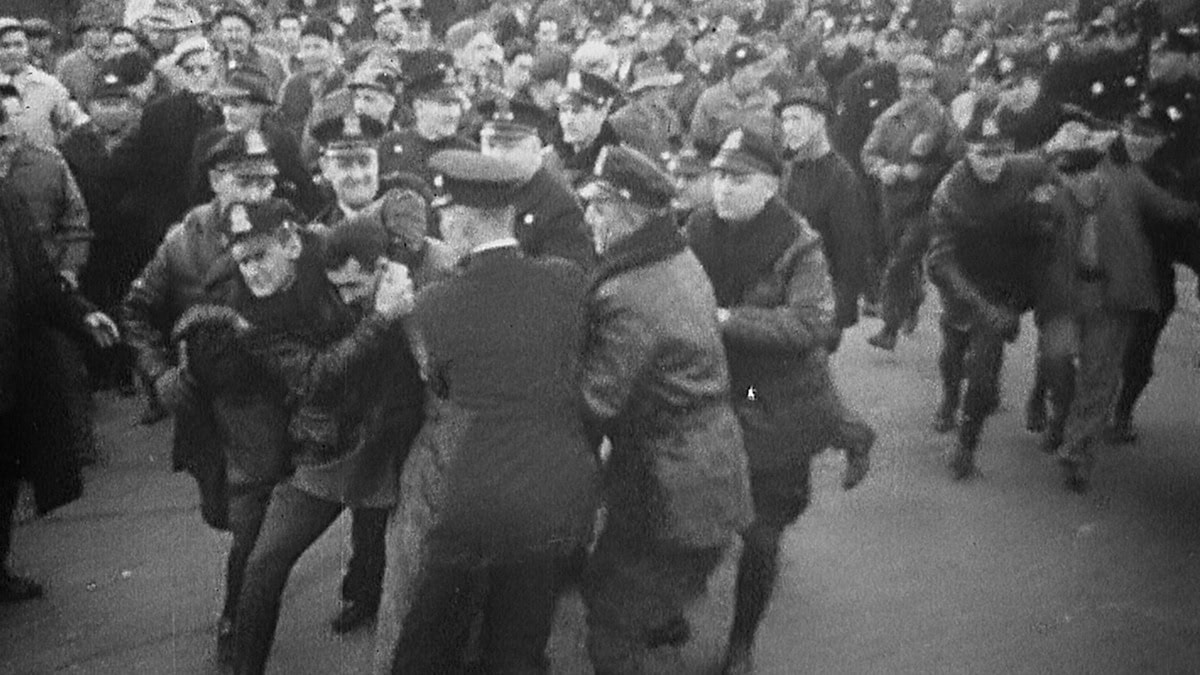
Ford interviews academics like Singh, Julian Go, Aaron Beckemeyer, and Michol Siegel, while occasionally giving voice to former police officers like Redditt Hudson, a co-founder of the National Coalition of Law Enforcement Officers for Justice, Reform, and Accountability. The film also abounds in footage of police brutality that exerts a numbing effect, effectively reminding us of just how normalized police violence has become, as well as depictions of that violence in media. Most notably, we see snippets from Charles Brabin’s 1932 film Beast of the City and a police documentary from 1970 narrated by Ben Gazzara. All of these elements coalesce into a damning argument against the escalating paramilitarization of the police force.
Throughout Power, Ford draws a startlingly clear line from the origins of modern policing as a slave patrol to its present-day iteration, in which carceral logic provides persistent cover for officers to do as they please. One especially trenchant thread focuses on how the police have only built their impunity over time: For one, the Kerner Commission report, published in 1968, detailed how Black communities were being over-policed, but its recommendations weren’t implemented and, ironically, resulted in a boom in police spending. Ford buttresses many of the interviews and sequences of archival footage with his own somber rhetoric, at one point asking if the “violence” which begat the police stays “in the past or move through time”—and it’s a question that the filmmaker allows to hauntingly hang in the air.
As a Black and trans filmmaker, Ford understands implicitly the disproportionate ways the police have targeted minority cultures, and in one particularly powerful sequence he shows us how whiteness has become a gift bestowed on people who have the benefit of masking their ethnicity behind the power of the badge. Over sequential images of Black people being brutalized by white cops, Ford has George Yancy, a Black scholar, explain how the racist philosophies of Immanuel Kant, Georg Hegel, and David Hume helped to create a structure of white supremacy that comfortably became pervasive in American policing.
Power is at its best when it collapses time and space to make its more esoteric concerns feel immediate and dangerous, as when a handful of the talking heads explain the legacy of August Vollmer, the first police chief of Berkeley, California. Vollmer’s experience in counter-insurgency abroad provided the groundwork for colonialist policing practices domestically.
As campus protests over university ties to the Israeli military and calls for a ceasefire in the Gaza Strip continue to intensify, we’re being increasingly bombarded with disturbing images of students and professors being violently arrested by police. That only makes Power’s central warning, that the untouchability enjoyed by police forces from Los Angeles to New York, from Minneapolis to Austin, is only ballooning ever more out of control, feel especially searing.
If, as Foucault argued, the boomerang of imperial power is bound to fly back and hit its own people as much as it hits others, imagining the future becomes an exercise in morbidity. As the film’s title suggests, though, perhaps power is as much in the systems that wield it as it is in the tools with which we secure knowledge of the truth for ourselves. The way Ford sees it, thinking about our relationship to police might is some kind of step toward needed change.
Since 2001, we've brought you uncompromising, candid takes on the world of film, music, television, video games, theater, and more. Independently owned and operated publications like Slant have been hit hard in recent years, but we’re committed to keeping our content free and accessible—meaning no paywalls or fees.
If you like what we do, please consider subscribing to our Patreon or making a donation.



“the escalating paramilitarization of the police force” implies that once upon a time the police in a country run for the benefit of capital were non-violent, friendly to the working class and would never even think of beating striking workers to death. The history of policing here in the UK as in the USA and elsewhere shows the present state of policing to be the norm not a degradation. Why was the world’s first police force (and the label is deliberate), the Metropolitan, created in 1829 by a former governor of the UK’s first colony, Ireland? In response to the Peterloo massacre of political dissidents, a full-time cadre of men was required who were, and are, trained and willing to use violence against any who threaten the power of capital, those in the working class who in the early 19th century rightly resented the relatively new imposition of industrial work for dismal wages in appalling conditions.
If this film concludes that policing in the USA is a problem mainly about racial identity rather than a class war, it will have failed.