It may be anathema, at least as far as storytelling conventions go, to betray the audience’s trust by blowing a narrative bubble only to burst it with the revelation that “it was all a dream,” but in Petrov’s Flu, director Kirill Serebrennikov builds a whole film around the systematic flouting of this rule. His adaptation of Alexey Salnikov’s novel obliterates the boundaries between memory and fantasy, between the banal absurdities of life in Russia before Vladimir Putin’s invasion of Ukraine and the hallucinations brought on by a 103-degree fever.
This blackly comedic fantasia follows the misadventures of graphic novelist Petrov (Semyon Serzin), his librarian ex-wife, Petrova (Chulpan Khamatova), their son (Vladislav Semiletkov), and a gaggle of Gogolian characters. There’s the frustrated novelist Sergei (Ivan Dorn), the alcoholic FSB agent Igor (Yuri Kolokolnikov), his drinking buddy the apoplectic philosopher Vitya (Aleksandr Ilin), the poets who meet for workshop at Petrova’s library, and so on. Petrov comes down with the titular flu in the days leading up to the New Year’s celebrations, subjecting him to memories of his Soviet childhood and another fever he suffered on New Year’s Day, 1973.
Though large chunks of Petrov’s Flu are composed of overlapping flights of fancy, so that it becomes near-futile to discern what’s literally happening, one scene in particular shows the seamlessness with which Serebrennikov transitions between levels of reality. This is when Sergei pays a visit to Hades, a publishing firm run by one of the poets in Petrova’s workshop.
A single tracking shot follows him through a warren of hallways to the editor’s office, where he drops off his novel manuscript. On his way out he tugs a cap over his ears and the soundtrack muffles—a cue that we’re tied to his subjectivity. He then turns around, as though he’s forgotten something, and heads back into the office. A New Year’s Eve party is suddenly underway, but Sergei pesters the editor into telling him what he thinks of the novel, and it becomes clear that a week has passed since he dropped it off, though there’s been no cut or transition to indicate the passage of time. He’s turned away with advice to attend the workshop and, on the elevator, bumps into his friend Petrov, who begins reading the manuscript.
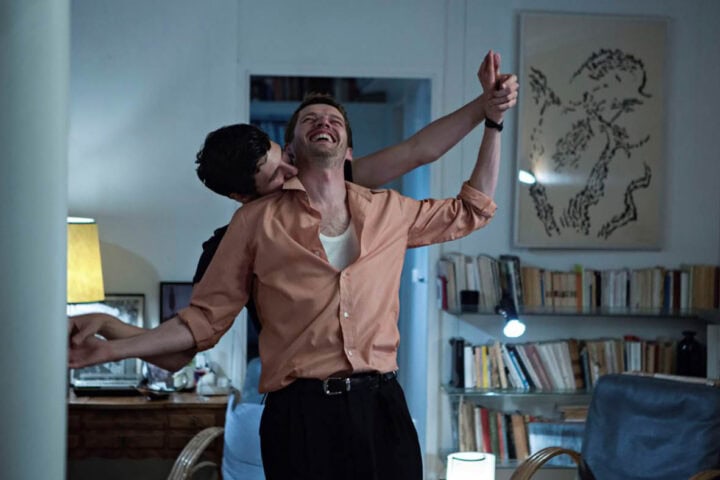
The same tracking shot continues without a cut, even as Petrov steps off the elevator into an auto shop and drinks a beer with the mechanic, Dimon (Evgeny Romantsov), before spraying him down with a hose. They begin to make out and Petrov pushes him off, stepping into another hallway where he throws down the manuscript in disgust as Sergei re-enters the frame. In this moment, it becomes clear that Petrov was reading a scene written from the second-person perspective and projected himself onto the character in the novel.

And the tracking shot keeps going for quite some time. This isn’t some Tarkovskian long take that attempts to show “real” objective time. Instead, it smears the separation between multiple scenes, flattening the hierarchy between levels of narrative. To lock the viewer into characters’ subjective perceptions, Petrov’s Flu bends or breaks the rules in all manner of similarly clever ways. Sometimes there’s nothing to hint when (or if) we’ve been let back out again.
Elsewhere, two sequences stand out visually for not evincing such seamlessness. The first of these is Petrov’s memory of his mother taking him to the New Year’s Day celebration in 1973, shot from the child’s point of view in a 4:3 aspect ratio and warm, nostalgic colors. At the party, he encounters Marina (Yuliya Pereslid) playing the role of Snegurochka, or the snow maiden from Slavic folklore. Despite her obvious distress, she feels his forehead and notices his fever.
The second, shot in stark black and white, follows Marina in the days leading up to this encounter as she falls in and out of love with various men. In keeping with the subjective, fantastical element, we see them naked, as she imagines them, even when they’re fully clothed. (The high ratio of male to female nudity in the film can be read as a thumb of the nose to the Russia’s homophobic policies.) That Serebrennikov devotes a solid 30 minutes to the tribulations of a character only tangentially related to Petrov becomes an act of touching sympathy. However skewed or fabricated these memories of Petrov and Marina may be, they intersect just enough to open a chink of light in the labyrinth of absurdism.
Serebrennikov, former director of the avant-garde Gogol Center until it was shuttered by the state in June of 2022, paints a none-too-rosy picture of Russia, or its Soviet past festering just beneath the surface. It would be a mistake to reduce Petrov’s Flu to a “pandemic film,” as it incarnates the disintegration of consensus reality, only exacerbated by Covid, that’s been a feature of Russian life for decades, what with a hollowed-out democracy, the onslaught of state propaganda, and post-imperial disillusionment and nihilism. This is a reality where Vitya’s idea—that state leaders be chosen by lottery, and that a vote be held at the end of their term to decide if they deserve to retire or be sent to prison—seems halfway reasonable.
Since 2001, we've brought you uncompromising, candid takes on the world of film, music, television, video games, theater, and more. Independently owned and operated publications like Slant have been hit hard in recent years, but we’re committed to keeping our content free and accessible—meaning no paywalls or fees.
If you like what we do, please consider subscribing to our Patreon or making a donation.