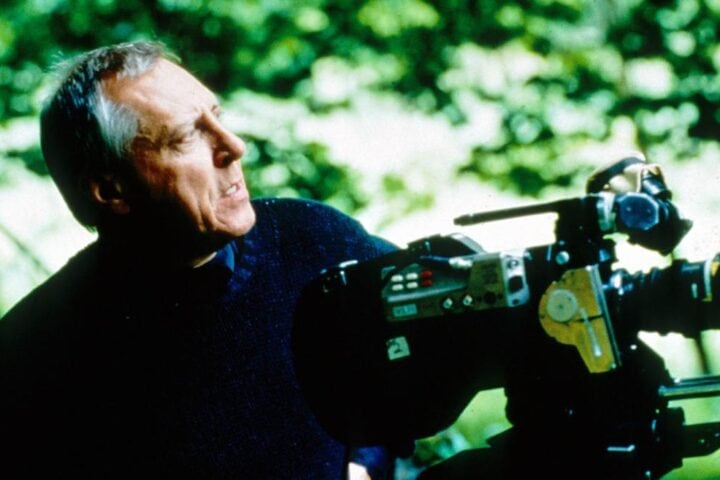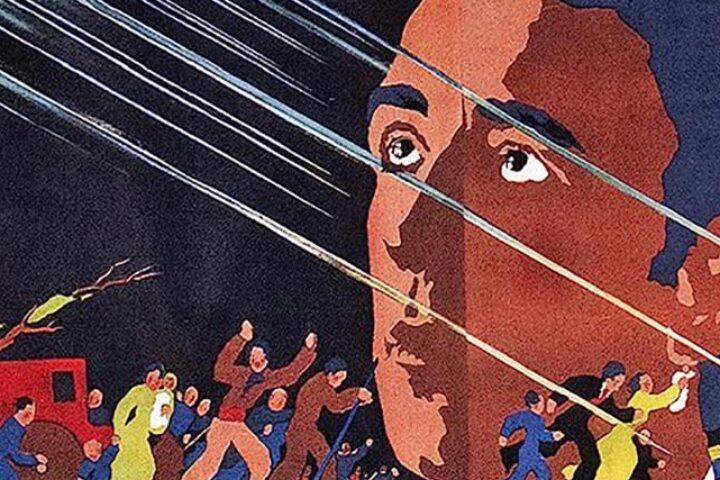

Peter Greenaway studied as a painter and worked for 15 years as a film editor for the Central Office of Information, the U.K. government’s marketing and communications agency, so it’s no surprise that his early films tend to prioritize visual and structural elements over their slender narratives. In fact, the earliest of his films often have no narrative at all. Intervals, from 1969, consists of footage of Venetian backstreets and alleyways accompanied by various sound sources (including stray snatches of Vivaldi) that lend each interval its own distinct tenor. This short also introduces an abiding Greenaway obsession: the abecedarian sequence (here a disembodied voice can be heard rattling off their ABCs in Italian).
Bucolic and beautifully shot, 1973’s H Is for House carries Greenaway’s preoccupation with alphabetical lists even further. Narrator Colin Cantlie, who provides voiceover work for four subsequent Greenaway films, articulates a series of increasingly improbable items that begin with the letter H, while a mother and her child, played by Greenaway’s own wife and daughter, frolic on the grounds of a country house. The same residence returns for the thematically darker Windows, from 1975, wherein sunny landscape shots accompany acerbically solemn statistics concerning 37 cases of defenestration, which are categorized not only by age, gender, and occupation of the deceased, but also by time of day and season of the year.
Water Wrackets, from 1975, contains some truly luminous images of lakes, bogs, and other waterworks, but the underlying speculative history of tribal rivalries and primitive beliefs delivered in deadpan by Colin Cantlie is quite difficult to follow, leaving the viewer high and dry in a morass of unfamiliar names and locations. On the other hand, 1976’s Dear Phone helpfully illustrates its absurdist tales of telephonic mishaps through title cards that display an assortment of scrawls and typefaces, complete with scratch-outs and insertions. And these texts, narrated by Greenaway himself, are intercut with shots of London’s famous red phone boxes.
Both A Walk Through H: The Reincarnation of an Ornithologist and Vertical Features Remake are mid-length films that Greenaway made in the late 1970s as a sort of dry run for his mammoth first feature, 1980’s The Falls. While diverse in terms of content, A Walk Through H and Vertical Features Remake are united by several features: voiceovers, again, by Colin Cantlie; music by composer Michael Nyman, who wrote the music for almost all of Greenaway’s subsequent films through Prospero’s Books in 1991; and the enigmatic figure of Tulse Luper, artist, author, and filmmaker—and thus a sort of alter ego for Greenaway—who turns up later in a series of installation films from 2003 to 2004 that detail the contents of his suitcases.
In A Walk Through H, from 1978, the camera focuses on a series of 92 maps (all drawn by Greenaway), while Cantlie’s punctilious narrator regales the audience with anecdotes about what he saw on his travels through the abbreviated land of the film’s title, how he obtained certain of his maps, his friendship with Tulse Luper, the soundness of Luper’s travel advice, and other increasingly surreal occurrences. Not for the last time in a Greenaway film, ornithology and all things avian play a considerable role in the lore and symbolism.
Greenaway’s drily mordant sense of humor and facility with poetic descriptions enliven the proceedings, which somewhat resemble Italo Calvino’s 1972 novel Invisible Cities, another fanciful travelogue. A Walk Through H is bookended by shots of an art gallery. When the camera zooms out at the end of our tour, we see that it’s described a circle around the entire gallery. Now the series is about to begin all over again, like a serpent swallowing its own tail.
Like The Falls, 1979’s Vertical Features Remake both mirrors and mocks the documentary form. The film purports to represent four attempts, sponsored by the vaguely defined Institute of Restoration and Reclamation, to assemble raw footage taken by Tulse Luper that focuses on the significant vertical features—trees, poles, and more—on display in a variety of landscapes. A handful of imaginary film theorists turn up to opine about the best way to reconstruct the footage, and according to their own pet notions. The results are then shown, each iteration revealing (sometimes slight) differences in shot grouping, editing rhythm, and musical accompaniment. Greenaway’s made-up historical material can be moderately interesting, but if his target is the tedium induced by structuralist films, the joke’s on the viewer, as Vertical Features Remake flirts rather successfully with outright boredom.
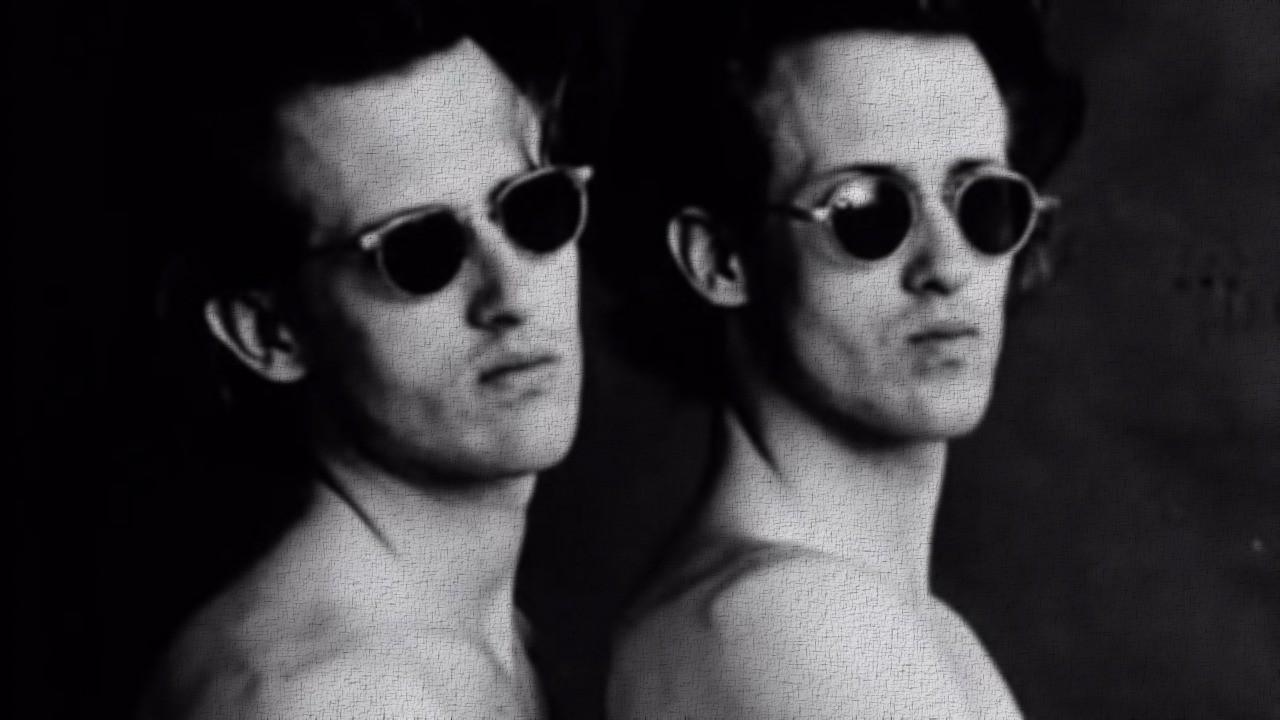
The Falls is an exhaustive, and at times exhausting, elucidation of 92 alphabetically arranged case histories of individuals whose last names begin with the letters F-A-L-L. As a result of exposure to the Violent Unknown Event (or VUE), these people have either contracted bizarre diseases, found themselves fluent in strange languages, or undergone bodily changes mimicking avian morphology. Across the film’s 195 minutes, Greenaway manages to pack in further references to Tulse Luper’s stories and films, gently parodies the BFI as the Bird Facilities Institute, and stunt casts the Quay brothers as twins Ipson and Pulat Fallari. The filmmaker also gets to indulge his twin passions: mythology (the fall of Icarus) and art history (the mysterious egg suspended above the Madonna in Piero della Francesca’s Brera Madonna).
Perhaps the most fascinating parts of The Falls occur whenever Greenaway goes full-on meta. He works in copious footage from his earlier shorts (even crediting Tulse Luper with A Walk Through H), a car crash involving a swan that prefigures 1985’s A Zed & Two Noughts, and an early appearance by Cissie Colpitts, the central figure of his 1989 film Drowning by Numbers. This Janus-headed quality of The Falls gives the impression that Greenaway’s films all take place in a shared universe. What’s more, various case histories start to link up and overlap, cross-referencing the causes and effects of their subjects’ lives and, on a couple of occasions, slyly suggesting that the VUE itself is a work of fiction. The Falls, then, comes to resemble one of those playful post-structuralist Oulipo novels like Georges Perec’s Life: A User’s Manual.
With The Draughtsman’s Contract, from 1982, Greenaway finally manages to impose a narrative on his abstruse historical material. The film is both a meticulously detailed period piece and a highly idiosyncratic riff on the Agatha Christie country house murder mystery that takes satirical potshots at conventional notions of property, patronage, and female entitlement. It’s set in the summer of 1964, a moment when British society was undergoing significant religious, political, and economic changes, the most relevant of which for our purposes was a law that allowed wealth and property to pass to be inherited by and through the female line.

During the opening candlelit dinner party, an arrogant draughtsman, R. Neville (Anthony Higgins), submits to the blandishments of Mrs. Herbert (Janet Suzman) and her married daughter, Sarah Talmann (Anne-Louise Lambert). He agrees to produce 12 drawings of the Herbert estates according to a contract whose terms are sexually disadvantageous to Mrs. Herbert. As Neville methodically sets about keeping up his side of the bargain, he notices abandoned objects—clothing, a ladder, a stray dog—that appear on the scene, and thus make their way into his drawings. Little does he suspect that they will become clues to his involvement in a murder plot. But maybe Neville should be a little suspicious, especially since, at one point, he gives Mrs. Talmann an object lesson in how to read a painting in the manner of an allegory. In this case, the allegory includes emblems of fertility, impotence, and emasculation.
Greenaway makes great visual use of the artist’s perspectival drawing grid throughout The Draughtsman’s Contract. It often provides a frame within the film frame, or else sets the limits of it. On a metaphorical level, the frame indicates the frame-up within which the two ladies entrap Neville. The visual grid returns with a vengeance in Greenaway’s next film, A Zed & Two Noughts, where it’s used as the backdrop for a series of scientific studies in decay.
In both The Draughtsman’s Contract and A Zed & Two Noughts, the grid marks out the picture into scientifically regulated bits, reminding us of the artificial nature of what they’re seeing. Greenaway’s need for rigorous control over the visual extends to his formal obsession with classical symmetry, balancing every shot in these two films with a vigor that rivals even Stanley Kubrick, so much so that one of the twins in the latter film will declare: “Symmetry is all.”
A Zed & Two Noughts is arguably Greenaway’s densest and most allusive film, organized around three major preoccupations. First there are his ecological concerns. The titular zoo stands as a barred prison for the animals, a negative Noah’s ark where they go to die and decay. Clips from David Attenborough’s epic documentary Life on Earth recapitulate the course of natural history, just as the stages in Darwin’s theory of evolution are ironically mirrored in the kinds of animals obtained by Oswald Deuce (Brian Deacon) for his studies in postmortem decomposition.
Then there’s the concept of twinship, which has cropped up before in Greenaway’s films, most noticeably with the Fallardi twins in The Falls, and the brutish Poulenc brothers in The Draughtsman’s Contract. But here Greenaway ventures fully into Cronenbergian terrain by positing that the disintegrating relationship between the once-Siamese Deuce brothers can be remedied only by rejoining themselves, and this a full three years before Dead Ringers. “Separation,” in the words of that film’s Eliot Mantle, “can be a terrifying thing.”
The third guiding principle behind A Zed & Two Noughts is Greenaway’s use of light. Cinematographer Sacha Vierny, who would go on to work on a number of later Greenaway films, conspired to come up with 26 different ways to light a scene, giving the film a highly distinctive look and color palette. In this regard, Greenaway’s desire for such baroque stylization, further emphasized by the persistent color coding of the set and costume design, brings to mind his most famous work to date, 1989’s The Cook, the Thief, His Wife & Her Lover.
Greenaway’s fascination with the use of light carries over into a sizeable subplot that centers on the Dutch artist Johannes Vermeer. Van Meegeren (Gerard Thoolen), the doctor who treats Alba Bewick (Andréa Ferréol), is named after a notorious Vermeer forger, while his companion, Caterina Bolnes (Guusje Van Tilborgh), shares her name with Vermeer’s wife. Greenaway’s passion for all things Vermeer also allows him to indulge another obsession that comes to the foreground in later films: staging a shot like a tableau vivant that recreates a famous work of art.
All of this is extremely cerebral stuff, but A Zed & Two Noughts isn’t without a mordant sense of humor, not to mention a bawdy delight in the transgressive. Here, “zoo prostitute” Venus de Milo (Frances Barber) tells dirty stories in the vein of Anaïs Nin for fun and profit. Most of these contain intimations of bestiality, as does the myth of Leda and the swan that’s mentioned over footage of the swan-related car crash that takes the lives of the Deuce brothers’ wives.
There’s definitely a sardonic aspect to the film’s ironic ending, where the rigors of the twins’ scientific studies are quickly undone by some pesky escargot. Death comes to the Deuce brothers due to the natural world’s brute intransigence. A Zed & Two Noughts is united with Greenway’s other films in its suggestion that nothing—not the graduated grid, the picture frame, the camera lens, or the alphabetized directory—can stave off the encroaching darkness.
The Falls, The Draughtman’s Contract, and A Zed & Two Noughts are now available on Blu-ray from Zeitgeist Films and Kino Lorber.
Since 2001, we've brought you uncompromising, candid takes on the world of film, music, television, video games, theater, and more. Independently owned and operated publications like Slant have been hit hard in recent years, but we’re committed to keeping our content free and accessible—meaning no paywalls or fees.
If you like what we do, please consider subscribing to our Patreon or making a donation.