Arnaud Desplechin’s Oh Mercy! exudes a loose and anecdotal rhythm that refutes traditional three-act plotting. Based on a 2008 documentary, the film follows a police precinct in Roubaix as it pursues various cases, and Desplechin is bracingly concerned less with any isolated crime or character than he is in conveying simultaneousness by seizing on stray details. There’s a sense in Oh Mercy! of the dwarfing mechanics of maintaining process amid chaos, which is rare for films and common of perfunctory crime novels
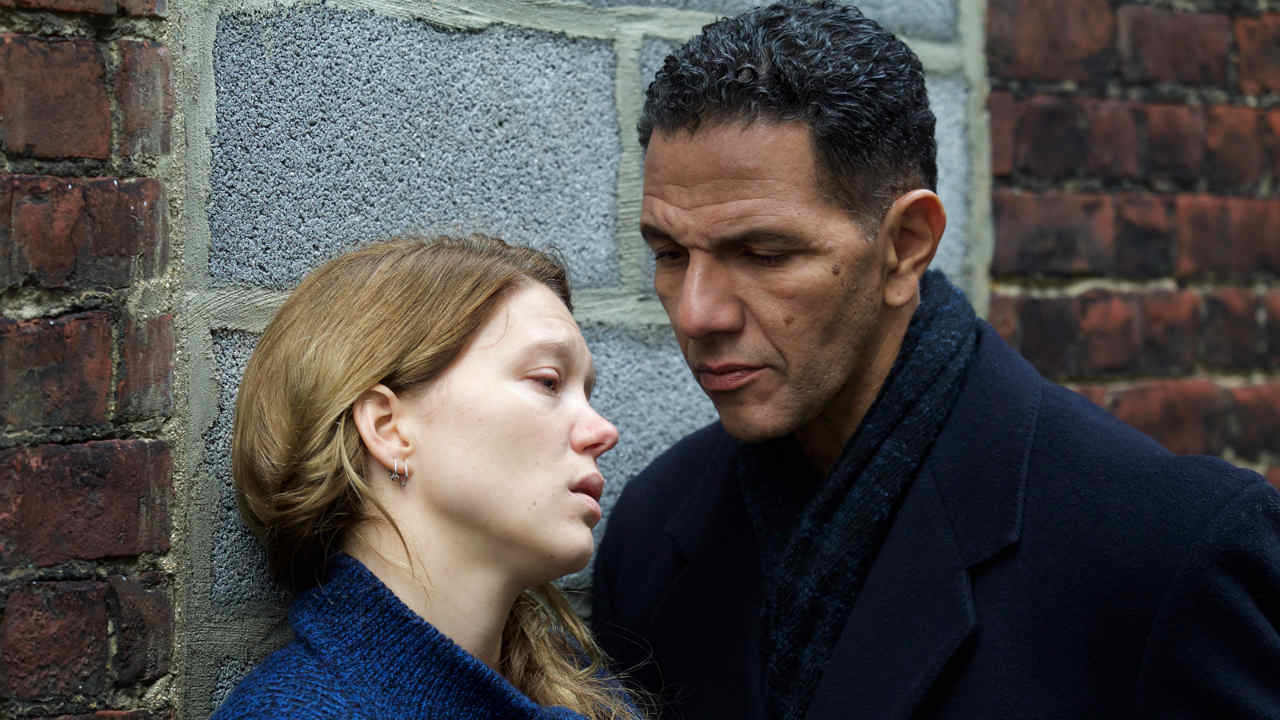
Before the authorities in Desplechin’s film can comprehend an act of arson, a serial rapist commits another assault in a subway. And before someone can make sense of that action, a girl runs away. Police officers drift in and out of the frame making vivid impressions, such as Benoît (Stéphane Duquenoy), a beefy man who specializes in sex crimes and balks at handling the subway case, wondering why a woman can’t be assigned to address the needs of the young female victim. And presiding over the madness is the police captain, Yakoub Daoud (Roschdy Zem), a quiet and dignified model of patience and sobriety, who must navigate nesting strands of social tensions, on the personal as well as the political level.
Oh Mercy! is a striking stylistic departure for Desplechin. By the standards of florid pseudo auto-biopics such as Kings and Queen and Ismael’s Ghosts, this film is an exercise in formal and tonal restraint. Desplechin has cited The Wrong Man as an influence here, and one can see the Alfred Hitchcock film’s docudramatic legacy in prolonged sequences that savor the particulars of, say, taking fingerprints, or of advising a suspect to shed all potentially dangerous articles of clothing, such as a belt or the cord in a hoodie.
Considering the hyperbole of many of his prior films, Desplechin evinces a glancing touch with showing how social tension and need inform law and crime. Daoud, for instance, is of Algerian descent, and his whole family returned to their homeland a few years back. This information is revealed pointedly yet fleetingly and allowed to hang in the air, though Desplechin and Zem, in a tough and evocative performance, dramatize how the character uses his outsider status to play the role of the sage and the alien. Zem also explores—though tossed-off looks and the elegant stiffness of his posture—the loneliness of such a state.
Desplechin doesn’t speechify in Oh Mercy!, but Daoud’s ancestry obviously evokes France’s role in the Algerian War. And the crimes that plague Roubaix underscore the modern crisis of French neighborhoods that are succumbing to poverty, as people flee or steal and kill as small businesses dry up. Roubaix is said here to be rife with neighborhoods that people with common sense should avoid, and, as the crimes pile up, Desplechin communicates an impression of police officers trying in vain to stave off a gathering storm. Oh Mercy! is set around Christmastime, and the holiday lights seem to mock the austere and ramshackle buildings. For the first half of the film, few crimes have any resolution, and Desplechin’s devotion to loose, unfulfilled narrative strands is poignant and daringly risks frustration.
Oh Mercy! is partially disappointing because Desplechin doesn’t fulfill the thrilling randomness of his conceit, as the film does settle on a “big case,” though even in this narrative certain textures are distinctive. For one, that big case—the murder of an elderly woman for pitiful, petty reasons that are realistic of actual crimes—bleeds into the earlier arson case, as the witnesses of the latter are the perpetrators of the former. Are the murder and the arson connected? Desplechin is also content to let that possibility hang.
As Daoud, Benoît, and others question Claude (Léa Seydoux) and Marie (Sara Forestier) for the murder, Desplechin reveals the police to be earnest and inventive to the point of courting authoritarianism, particularly Daoud, a brilliant empath who uses his outsider status to identify the bitterness, the poverty, the alienation, that have driven Claude and Marie to kill more or less for the hell of it, turning it against them in increasingly manipulative measures. Desplechin’s allegiance to The Wrong Man is evident here in the sheer obsessive length of these sequences, as the assorted interrogations of Claude and Marie are essentially the entire second half of the film. Like Hitchcock, Desplechin wants us to feel the suspects’ entrapment.
Unlike the Hitchcock of The Wrong Man, Desplechin fosters a conflicted, disturbing kind of double empathy: Daoud, largely a good man, becomes a debatably justified tyrant, especially when he handcuffs himself to Claude and questions her in a confrontation that has a sexual intimacy, and Claude and Marie, killers, are unmistakably tragic. The film’s master image is among the greatest images of Desplechin’s career: the women, recreating their strangulation of the victim for the police, briefly hold their hands together under the victim’s pillow. Here, Desplechin links unforgiveable violence with ferocious human need.
Since 2001, we've brought you uncompromising, candid takes on the world of film, music, television, video games, theater, and more. Independently owned and operated publications like Slant have been hit hard in recent years, but we’re committed to keeping our content free and accessible—meaning no paywalls or fees.
If you like what we do, please consider subscribing to our Patreon or making a donation.