Attendees of the Toronto International Film Festival receive countless reminders of Canada’s cinematic prowess. “This is Canadian content, and it’s time we take credit for it,” emphatically bellowed the late Christopher Plummer in one memorable festival pre-show bumper touting talent ranging from Denis Villeneuve to Ryan Reynolds. “Starting now.”
Two people who need no such reminders are Matt Johnson and Jay McCarrol, the co-creators of Nirvanna the Band the Show. These longtime friends and collaborators are committed to wearing their Canadian heritage on their sleeves. Since they started playing heightened versions of themselves in their web series in 2007, their characters have had a simple goal in mind: They want their band Nirvanna, which has no songs to its name, to play at the Rivoli in Toronto.
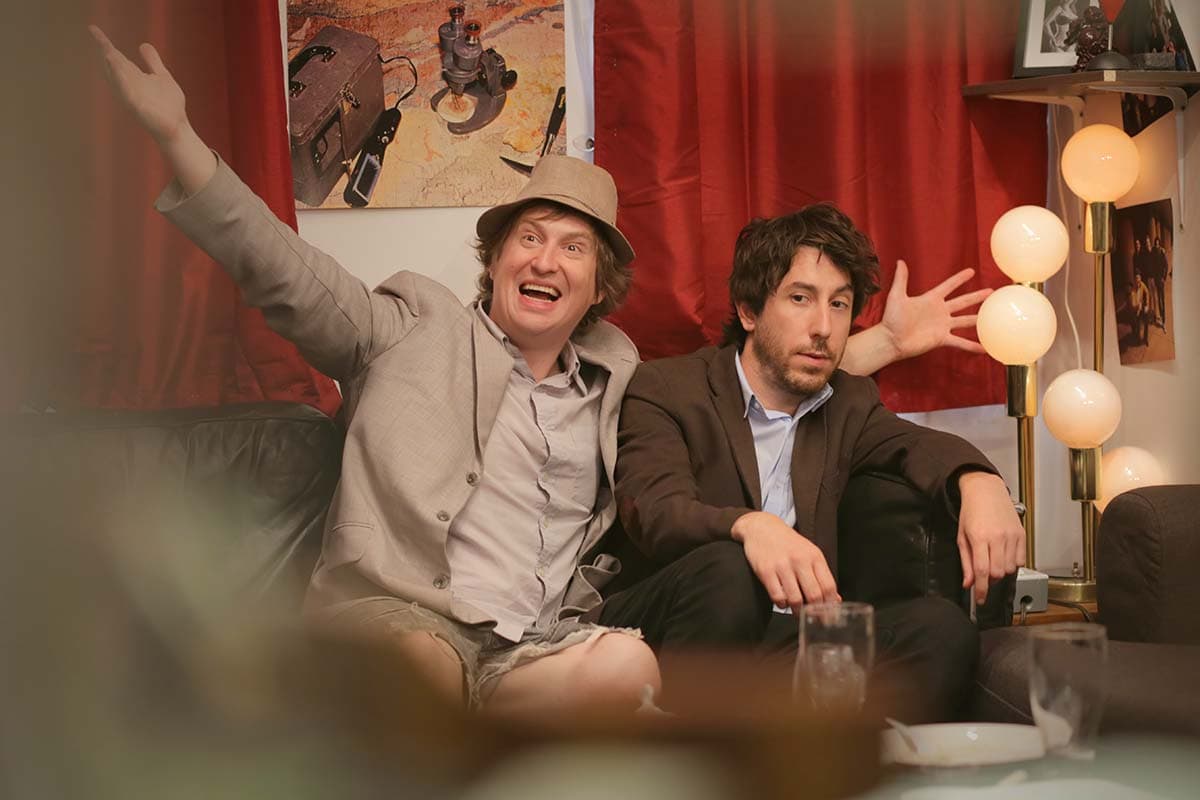
Though they’ve leveled up to a Viceland series of the same name and now to a feature theatrical film, Nirvanna the Band the Show the Movie, Johnson and McCarrol’s objective remains unchanged. Their Canadian modesty masks a work full of maximalist ambition, all of which is skillfully orchestrated by Johnson in his capacity as director. The duo’s alter egos time-travel back to their earliest days as aspiring musicians in yet another dubious attempt to book a gig at the Rivoli. Both before and after their RV takes them back to 2008, Matt and Jay pull off some of their wildest gambits yet here—including navigating around the past iterations of themselves.
I spoke with Johnson and McCarrol ahead of their film’s theatrical release. Our conversation covered the project’s Canadian-ness, how they incorporate everyday people into their work, and why modeling their story around Back to the Future proved so liberating.
Movie lovers are used to seeing Toronto on the big screen, but so rarely as itself. What do you hope people take away about the city from Nirvanna?
Matt Johnson: I hope they come to Toronto as tourists! Our big goal was to feature all of these huge tourist destinations so that when Americans see this movie, they’ll be like, “Oh, maybe I’ll give Toronto a chance.” I think it’s really tragic how few tourists come to this city, even though in my opinion, it’s got some of the best restaurants and things for tourists to do in the world. But it’s cold, it’s far away, it’s another country. We hope that it makes Toronto look extremely approachable, especially from a legal point of view.
And what about for locals? What do you hope that they see in the character reflected in the street life or in yourselves?
Jay McCarrol: When you show certain landmarks or places in a city that are featured as themselves, all of a sudden, you legitimize them. In a very simple way, it reminds you that you could be proud of it. When you throw something up on the big screen, there, it’s valid. It exists. We’re celebrating it. We just need to literally show it for what it is, and it gets celebrated. You don’t need to say this place is great. We just say this place is here.
MJ: Canadians and Torontonians get to be characters in this movie. I’ve always heard this refrain about the difference between New York and Toronto. If you’re a New Yorker, you feel like the city is there for you. If you’re in Toronto, you feel as though you’re in the way. The city is happening, and you’re trying not to mess with it. And, hopefully, this gives people the sense that Toronto is [their] city. They can feel as though they own it.
When I spoke to Jay Baruchel about your film BlackBerry a few years ago, he mentioned that the self-consciousness of English-speaking Canadian cinema needing to define itself was holding filmmakers back. Do you also feel that’s true?
MJ: I think that Jay is 100% right. There’s a self-criticism and almost a self-censorship that happens, which is a part of the Canadian psyche because we have a permanent younger-brother status. We’re always a little bit reticent to say how we feel or to put a stake in the ground. I think that defines our culture. Nirvanna the Band, in many ways, is two characters who have big dreams but also don’t really want to get in the way. So much of the movie is us politely moving through crowds of people and speaking to them in the most polite way ever.
Whenever we see people from out of town, we’re welcoming them, saying, “Hey, welcome to Toronto, how are you doing?” These characters almost can’t get over their British manners. You can imagine if they were Americans, they would just call the Rivoli and book this show on the first day. They would just be like, “Hey, we’ve got to play a fucking show!” While that’s definitely a tangible barrier for Canadian film where we as a culture have trouble asserting ourselves, using that in the creation of art and characters, or admitting it, is part of the recipe—at least for us. BlackBerry was about this, how these Canadians were so meek that they couldn’t assert this product on the world stage. All of a sudden, they get this guy who basically wants to be an American, and it totally changes the landscape of the culture and the country.
JM: And the company was personified as their change from Canadian to American.
Do you feel like there’s something shifting now with all the 51st state talk from Trump? It seems to have led to an assertion of Canadian nationalism, at least from my observation, that seems very different.
MJ: I don’t know, I remember during the referendum in the ’90s, there was a similar rah-rah Canadiana that was happening. I was just in Quebec City, and nationalism hasn’t gone any anywhere. That’s an unbelievably proud culture now, but spoken in the same breath as the separatism conversation, so clearly, they’re at odds at some level. At least for me, anyway, I’m in a bit of a bubble. I love Canada, and I’m not really exposed to people who don’t. The last time I remember it being this good was when the Raptors won [the NBA Finals], when [former Toronto Mayor Doug] Ford was going on Kimmel, that [Toronto Blue Jays player José] Bautista bat flip, and Drake was so big. That era also had a real Canadian cultural resurgence. I don’t think this is matching that at all, but whenever it happens, I’m happy.

How do you approach incorporating everyday people into the work when you’re shooting in public? Is it similar to “crowd work” in comedic performance, where you just have to learn to judge how far you can push cringe and confusion without dipping into condescension?
MJ: Maybe, but that’s happening subconsciously or unconsciously.
JM: We’re not thinking crowd work. Every single time we’re working with somebody on the street, they’re being pulled into our story if they want. They can walk away whenever they want, but if they start talking to us, they’re going to start to peel away the layers of what’s going on with us. We’re trying to do something, and they’re going to maybe be Canadian, help us, and start to chat. But we’re not, in the moment, trying to do any sort of tricks or up the cringe level. Sometimes, it feels that way because we’re exposing them to something ridiculous. But, at that point, all we’re trying to do is just stay very true to what our characters are doing and what we want. We’re trying to be funny. We just like real slices of life. We love it when people show interesting, vulnerable moments of humanity in just one little look or line. That, to us, is what’s so funny: when that meets a very sincere effort by these characters to try to get what they want.
MJ: Whenever something comes off as cringe or condescending, it’s because you, as the performer, have information that you and the audience share. It’s like you and the audience are in a conspiracy against the person who doesn’t have that information, and we never do that. We’re never trying to make a person on the street look foolish. If anything, it’s like the person we’re talking to and the audience are in a conspiracy. The audience almost wants to reach out and tell this person, “I wish you knew what I knew. Then, you’d be laughing the same way that I’m laughing at what’s going on here because these guys are so stupid they don’t understand that what they’re trying to do is impossible or unrealistic.”
How do you stay true to the original guiding light of the web series? Do you have prescriptive guidelines around what is and isn’t Nirvanna material?
MJ: It’s like what the court said about pornography. We can’t describe it, but we’ll know it when we see it. We shoot so much that when we watch the footage, it’s obvious. Typically, it’s not even us. It’s Curt [Lobb] and Bobby [Upchurch], the editors, are deciding what’s in and what’s not.
JM: We get protective with editing. Also, when we’re improvising our writing with ourselves, we’ve known each other our whole lives. I’ve always said that there’s a sibling type of thing where we’re able to use that sort of long-term shorthand. But, also, we’re trapped by holding each other accountable to our truest selves. One of the tricks that we found right away in the web series with what these characters are is that they really are extensions of us, or maybe slices of our most vulnerable selves and instincts. That’s what we found so funny: when we allowed some of those vulnerabilities to just clash. We know that those are rooted in very truthful, deep things about ourselves, and we hold each other accountable to still bear those for all to see. That’s when it is the most real, and that’s when we get into our most flow state of just vibing.
How did it feel placing present-day incarnations of yourselves opposite the 2008 versions? Did the older versions feel closer or further than you expected?
MJ: It’s funny, there wasn’t a ton of footage of me compared to Jay. I look at the young version of myself, and I really see the performance of it, but that’s not really what you mean. I think what you mean is what it’s like acting as a character in the same scene as the young version of us. And, in my mind, I really didn’t take it any differently than if we were just talking to somebody on the street because we’re just improvising against somebody. And in this case, it happens to be young me and young Jay that I’m improvising against.
JM: That was the most technical part, too, of the whole movie. We were hitting some really specific targets of how to make that whole sequence work.
MJ: We were quite fun! The thing is, it’s not like this footage came out of nowhere. Speaking for myself, I’ve been in every movie I’ve made, and so I always have to see myself. After The Dirties, I created such a distance between me and this persona that I’m playing. It’s not like I view this as a different person, but I think it is different than if, say, you were at somebody’s wedding, and they played footage of them when they were twenty years old. They’d be like, “Whoa, that’s crazy how much we’ve changed.” Because I’m dealing with it all the time, it’s like watching a kid grow up. All of a sudden, they’re an adult, and you’re like, “Where did the time go?” You don’t feel the salient landmarks in the same way.
How were you negotiating your story’s relationship with Back to the Future? You’ve spoken about it being a framework that was helpful so you could then riff and improvise off of it, but was there ever a worry that this would box you in?
MJ: I never think that you’re limited by restraints like that. I actually think it’s the exact opposite. Especially young filmmakers make the mistake of thinking that having infinite options makes you freer. It only makes you infinitely anxious about what you pick. Having a box with clear lines—in this case, it was Back to the Future—made it so that we could flourish. It was amazing. It was like having a box within which to grow a garden. Everything, all of a sudden, seemed in its place. Within each of those tiny narrative beats, we could expand so much.
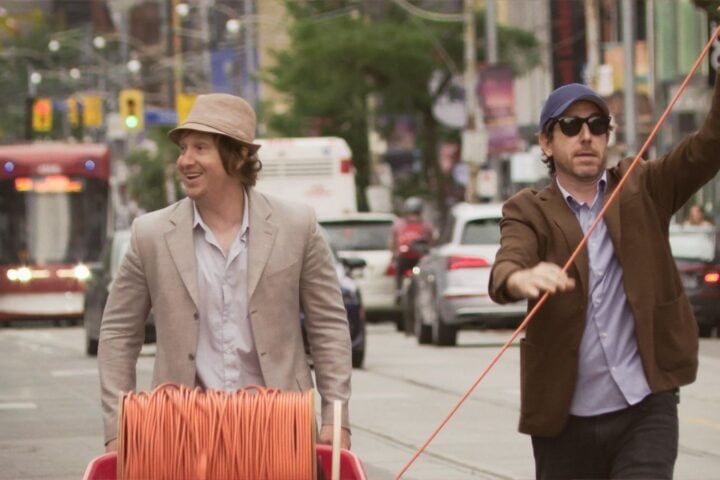
I’ll give you an example. At the end of Back to the Future, Doc Brown is running with his cable to plug it into the DeLorean. But then, it’s too short, and he gets pulled back. He’s like, “Oh no!” Then, the electricity goes through his body. Well, here’s this super simple beat. It’s a technical beat dealing with the physical length of a cable trying to get to a destination. We’re recreating it verbatim, with no plan other than to do it verbatim. But when we do it, all these people are watching. Now, I’m talking with these French women, and they’re coming over and using this walkie-talkie with me. By staying within the boundary of the story, we wind up being able to expand in all of these other directions that we never could have imagined.
Because of the way we’re approaching filmmaking, the more clichéd and rote we can be in terms of our plotting, the more weirdly original it comes off when you watch it. Yes, this is beat-for-beat Back to the Future, but I’ve never seen Back to the Future like this before. It makes that undergirding invisible because you’re not paying attention to that; what you’re paying attention to is just what these characters are doing in the moment.
JM: The scaffolding and structure of choosing something like Back to the Future, if you establish that’s what your boundaries are, then, especially when it comes to comedy, the deviation is where all the fun is. You calibrate a zero for everybody so that they know on their media-literate level where the deviation is and where you can color outside the lines. That’s where we can have the most fun.
Since 2001, we've brought you uncompromising, candid takes on the world of film, music, television, video games, theater, and more. Independently owned and operated publications like Slant have been hit hard in recent years, but we’re committed to keeping our content free and accessible—meaning no paywalls or fees.
If you like what we do, please consider subscribing to our Patreon or making a donation.