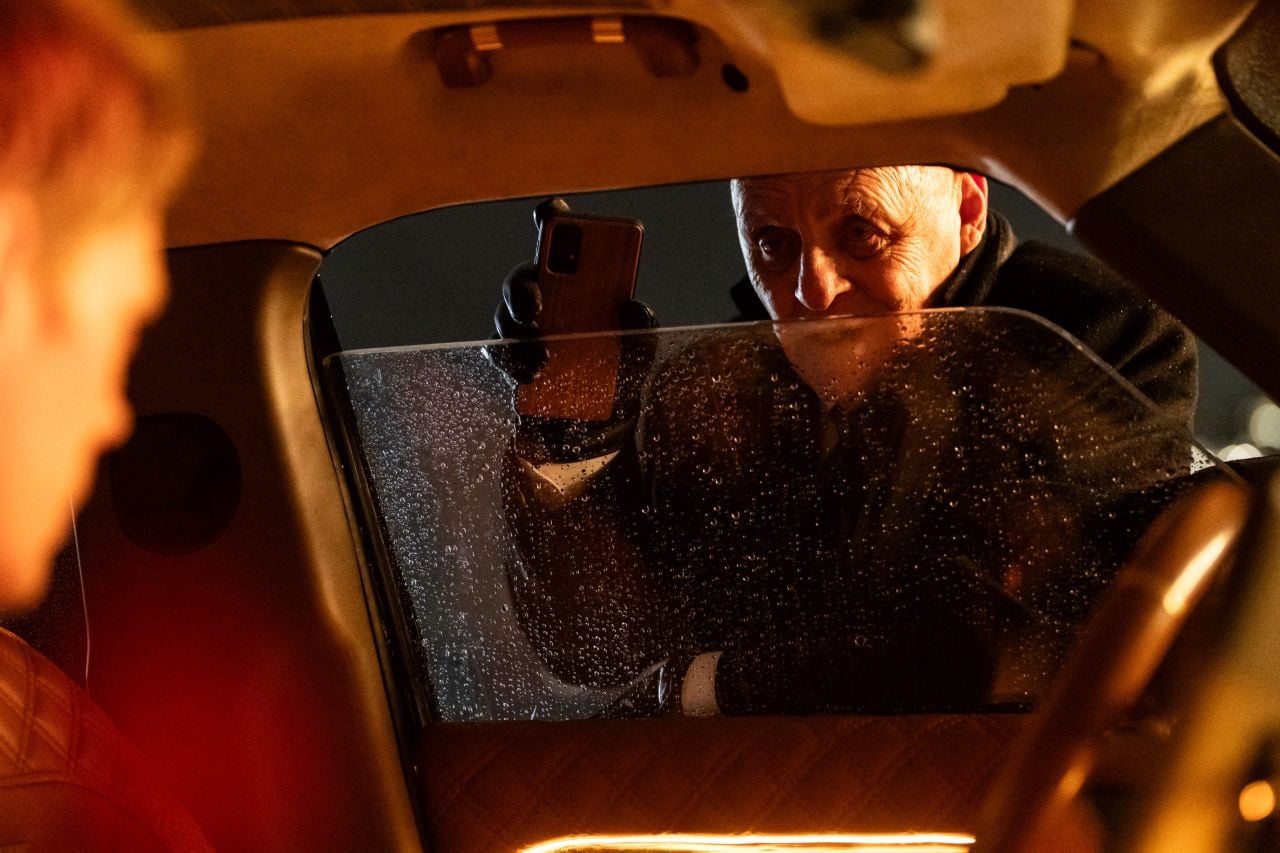
It doesn’t take much effort to see the allegorical meaning of David Yarovesky’s Locked. William (Anthony Hopkins) is a cancer-stricken billionaire whose grief over the murder of his daughter is equaled only by his vitriol for the poor and a younger generation that he believes is taking more than it gives back. He has so much money that he “can’t keep track” of it, so why not spend it on a rigged luxury vehicle with the purpose of luring would-be thieves?
Enter Eddie (Bill Skarsgård), a wayward ruffian desperate to prove to his ex-wife that he can be a responsible parent to their young daughter (Ashley Cartwright) and who becomes the latest victim of William’s Venus flytrap on wheels. Eddie isn’t one of the people who killed William’s daughter. He’s just a random guy who happened to choose the wrong car to loot, which he does because he needs $400 to pay for the repair of his van. So while it’s tempting to think of William as the Jigsaw of the billionaire class, Saw’s big bad is at least more inclined to draw distinctions.
William speaks to Eddie through the screen on the car’s dashboard, revealing that he’s made his beautiful car into a moving cage. The seats can be used as tasers, it’s soundproofed with a barrier that prevents any cell service or WiFi connection, and the windows are bulletproof. The particulars are believable enough, but in toto, this contraption has been clearly sprung from an only-in-the-movies imagination. When, in an early logic-defying scene, Eddie tries to shoot his way out of the car and the bullet bounces back in such a perfect fashion that he ends up piercing his own calf, you may be excused for thinking you’re watching a Wanted sequel.
To be sure, Locked has its pleasures, especially when the filmmakers use the inherent claustrophobia of the central setting to their advantage. There’s a certain excitement to the dynamic sense of standstill that Eddie is left in upon trying to rob a car only to find himself stuck inside a prison, and while Skarsgård doesn’t have to try too hard to earn our sympathies for his character, he’s committed to bringing us alongside Eddie to the brink of desperation throughout the man’s attempts to escape. But even at a slim 95 minutes, Locked becomes tedious fast, and in large part because of the obviousness of its themes.
Of all the torture that Eddie endures, perhaps none is more grueling than William’s endless droning about how awful poor people are. Throughout, William expounds a cartoonishly right-wing political philosophy to the absolutely uninterested Eddie: that the younger generation doesn’t understand hard work; that the poor are vile creatures sucking on the teat of taxpayers; that everyone in America is given a fair shot and so those that try to buck the system are leeches who deserve to be taught a lesson, or even killed, by the wealthy, and with impunity.
Yarovesky and writer Michael Arlen Ross may very well believe that the ultra-rich are toying with the lower classes for personal gain, even scapegoating them for society’s problems, but you may think otherwise given the film’s wild aesthetic detours. Locked’s opening sequence, for one, sees EDM blaring over a weirdly vintage-looking montage of derelict neighborhoods and Black Lives Matter signage that practically oozes distaste for the needy and social activism.
Some of the shots that dot this opening are just of people existing, though those people are also clearly experiencing homelessness. The threatening insistence of these images paint a confusing picture of the filmmaker’s sympathies. William’s character is indisputably villainous, but the portrayal of those he hunts—desperate people on the fringes of society who have been economically starved—casts the entire enterprise in a confusing haze of cynicism.
Since 2001, we've brought you uncompromising, candid takes on the world of film, music, television, video games, theater, and more. Independently owned and operated publications like Slant have been hit hard in recent years, but we’re committed to keeping our content free and accessible—meaning no paywalls or fees.
If you like what we do, please consider subscribing to our Patreon or making a donation.