“It’s been so many years, we’ll see what comes out,” Lily Gladstone lightheartedly quips at the start of our conversation about Killers of the Flower Moon. This April marks five years since Martin Scorsese’s film began production in Oklahoma. And we’re a little less than three years removed from Gladstone’s whirlwind journey tied to the release of the film, from its Cannes premiere all the way through awards season.
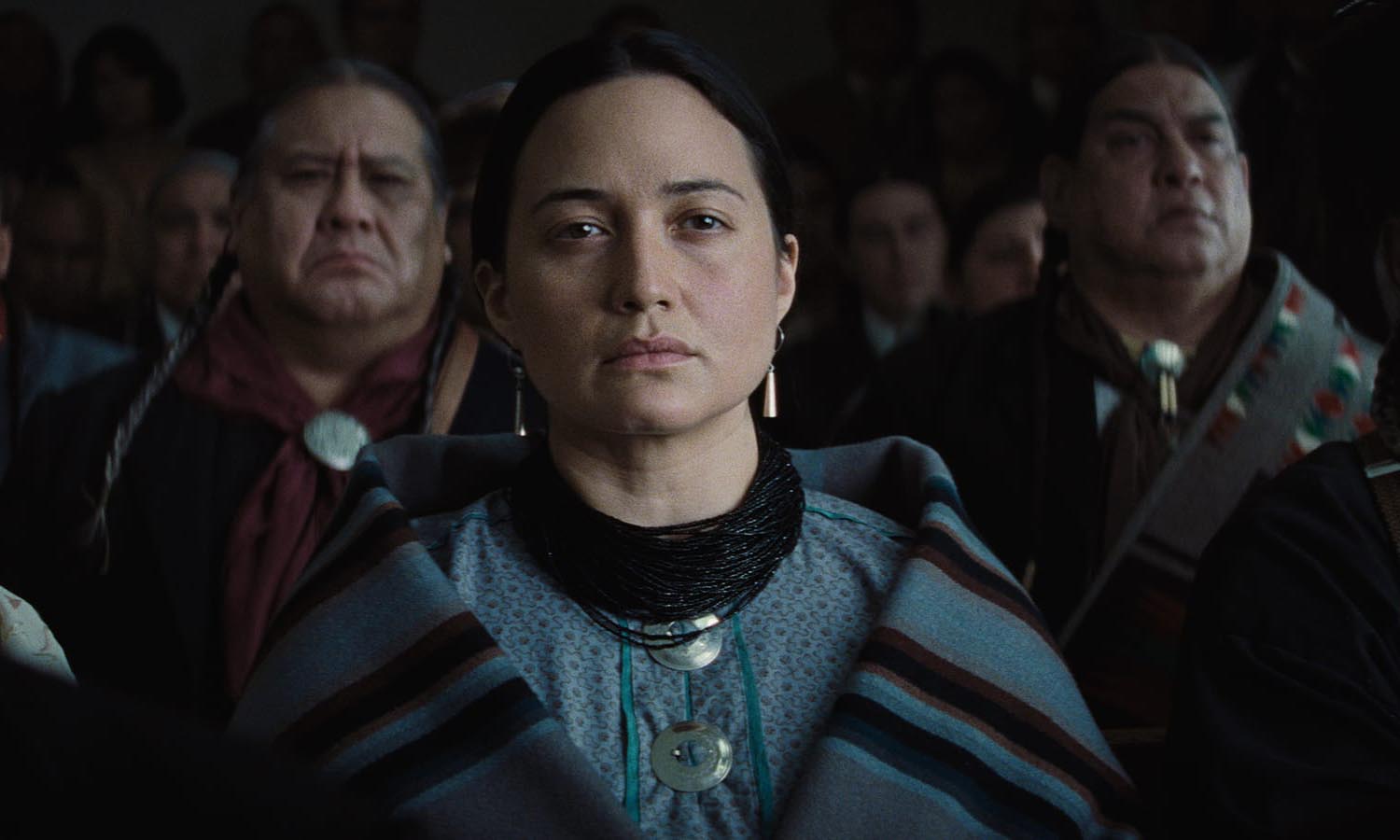
Gladstone’s deeply intuitive and embodied portrayal of Mollie Burkhart, the Osage woman who outlasted the attempts of outsiders to poison her for her land rights, earned her prizes from the Golden Globes and Screen Actors Guild, as well as an Academy Award nomination for best actress. Now, with Killers of the Flower Moon having been added to the Criterion Collection, Gladstone can perhaps speak more clearly than ever on both the impact and continued resonance of the film and the intimate details of building her character.
Scorsese and co-writer Eric Roth’s reworking of David Grann’s book of the same name shifted the focus away from the founding of the F.B.I. against the backdrop of the Osage murders in the 1920s. The heart of the film instead became the mercurial love story between Gladstone’s Mollie and Leonardo DiCaprio’s Ernest Burkhart, her husband and attempted murderer.
The character’s knowledge of and participation in the plot on her life became a flashpoint for conversations about female and Indigenous identity alike. Gladstone explains that her duty was always to stay true to what’s known about the real Mollie Kyle, while allowing the ambiguity to illuminate the larger power dynamics and structural inequality that permit the physical abuse and financial exploitation to her and the Osage tribe at large.
I spoke with Gladstone shortly after Criterion’s physical release of Killers of the Flower Moon hit shelves. Our conversation covered how Thelma Schoonmaker’s editing shaped the film’s central relationship, why learning the Osage language was so central to unlocking her character, and what she still carries from her experience playing Mollie.
You mentioned feeling like you held Mollie closer to you as a character. I’m not sure if getting out of a character is as big a task for you as getting into a character, but does Mollie stick with you even more as a result?
I spent the premiere of the film, which was during the actors’ strike, sitting next to her. I was at her grave site in Oklahoma the night of the premiere. That’s actually the first time I’ve said it; I didn’t want to make a big deal of that. But that, in a lot of ways, was almost a pass-off. I had a conversation with Kelly Reichardt when we were making Certain Women on our last day of production. She was saying production is the best part of [the filmmaking process]. It’s when it’s still yours as an artist. Eventually, it goes into the world, and it becomes the audience’s. It gets further and further away from what it was to make it.
And it was a weird thing, knowing that I was holding this human being who lived through so much more than the film could even show, knowing her granddaughter and great-grandchildren. Still, now, a lot of my very closest friends in the world are Osage, and I go back often to visit. But just knowing that this real person was going to be thrust into the world as a character in a film to be critiqued really haunted me. It was very strange hearing Mollie spoken of as a character, because she was such a real person that I had to get to know, with lots of years in between when we both walked this earth. I had the opportunity to go to Oklahoma during the premiere instead of to L.A., obviously, and it just felt like the right place to be.
It wasn’t saying goodbye, but maybe even symbolically building something that was more sacred around Mollie as a person than Mollie as a character. After that, I went through what I normally go through. This is culturally informed by where I grew up with the Blackfeet, and I think it’s just a good practice for people to have. I called myself back, as I think there’s pieces of yourself that linger in significant experiences, and Killers of the Flower Moon was way more significant an experience than just any old film. Partly because of the process of “creating the character” and getting to know who this woman might have been. I had to call Lily back out from that land, out from that story, and back to myself. Sure enough, it was wild having to talk about Mollie as a figment, as a character, as a moving avatar on a film screen in a wonderful, beautiful, incredible film that’s had a lot of real-world community-building impact and in the Osage Nation. But nonetheless, I think of that conversation I had with Kelly a lot.
Thinking about how the film changed from production, you’ve mentioned that Scorsese would sometimes shoot a scene from all sorts of different angles or dramatic intentions. Is there anything that surprised you in the final cut about how he and Thelma Schoonmaker put together a scene?
Not terribly. Honestly, there was such a close collaboration with Thelma and Marty. In the first week of filming, we were still very much surfacing and etching out what this Ernest-Mollie relationship looked like because it was a mystery to everybody, including their descendants. Anybody who would have experienced what their dynamic is no longer [alive]. But there were stories—talking about their kids being fun, loving family, all of that. Because of locations, other actors, schedules, and just the nature of a film production, we didn’t shoot sequentially. We had to take scenes deep from the narrative before we really cracked what that dynamic was.
The particular scene I’m thinking of is one we shot as the last scene after a long day: Ernest telling Mollie in the kitchen that [her first husband] Henry Roan is dead. She’s visibly pregnant, and also advanced in her illness, but the concoction is being withheld for the time being while she’s pregnant. Leo and I stuck to the text, but we shot that scene in a multitude of different ways. Some more combative than others, some where Ernest was a bit more demonstratively evil or clueless. It was trying to find that, then the various levels of Mollie’s trust and love for him, and the levels of whatever the relationship that we may have dug up with Henry would have been. But when you’re in a scene, and it feels like the right one, you just know it is.
So I had a feeling that when we hit the scene, the [take] that felt the most natural to me, I guess I had a sense of what the shape of the story would be. Thelma, being as sharp as she is, and Marty, being as collaborative and close [to her] as he is, both noticed something together. And then, as that story progressed, Thelma was the one watching the footage and really seeing what was working for her. Then, she was asking and kind of directing behind the director, the hand behind the hand, in a lot of ways. Marty would come back and say, “Thelma said, ‘This works, and this doesn’t,’ so we’re going to start working in this direction more.”
That really informed what the rest of the film was, even though it was a scene that we had to reverse engineer. I think we shot that one just a day after the first date scene at the dinner table. I’ve worked with a couple of other directors on various projects who work hand-in-hand with their editor, and I hope I see that more. It really is a beautiful process to have your editor, who’s keeping an eye on the whole story, in your ear while you’re telling it. Otherwise, you feel like you’re wandering around in the weeds a little bit.
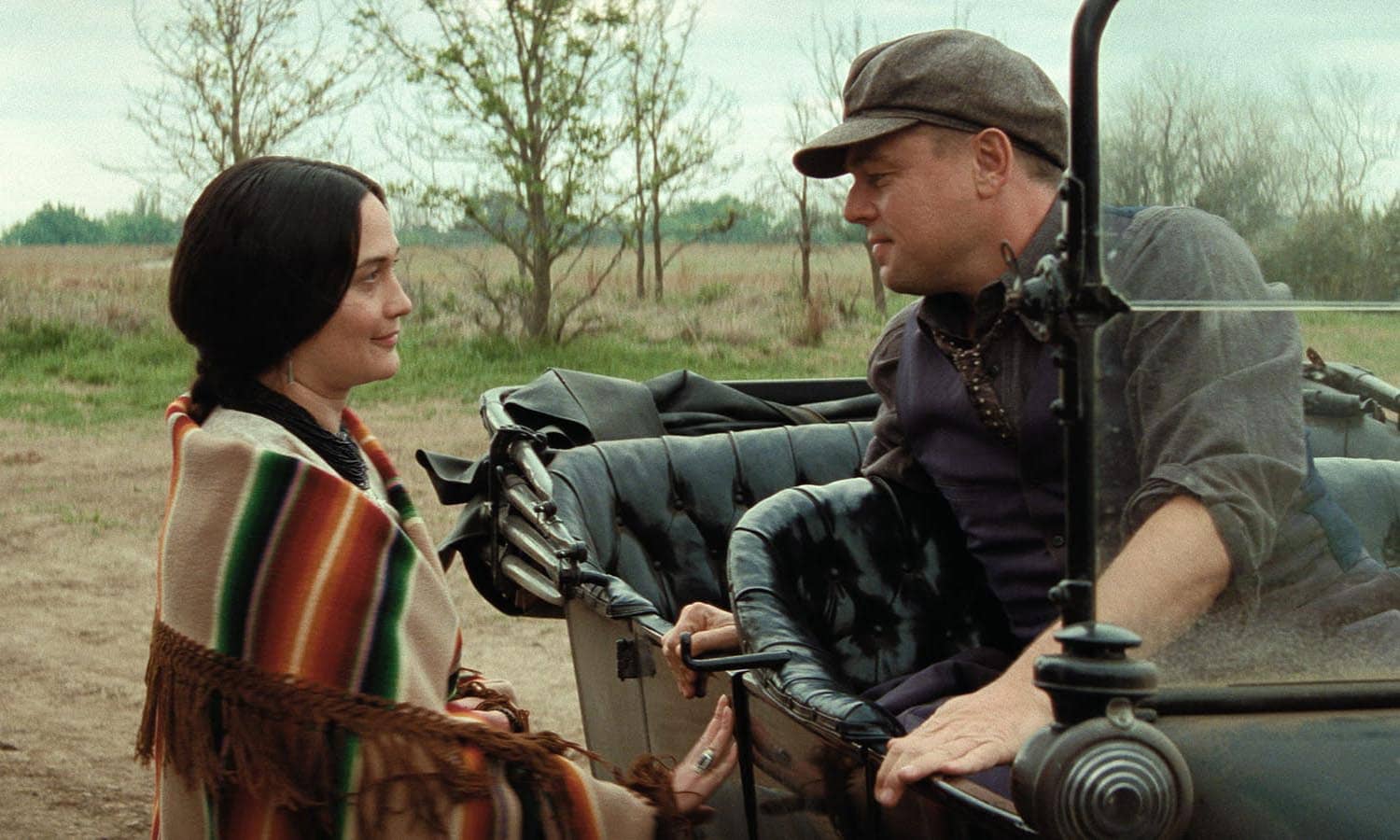
As you’ve described Mollie, the character feels trapped between two archetypes you wanted to avoid: someone who dumps a lot of exposition to inform viewers outside the community and the stoic Native. Not that the role was defined in negation, but were those guideposts that did shape how you found her?
Because it was such a huge opportunity, the responsibility lay with the real person. The truth of what was going to work in the scene was going to lie with the realness of what it could have possibly been. But the whole thing was such an opportunity to have a conversation about Native representation. Having the representation is just opening the door to the whole world of it. But the way that we’ve been portrayed has [impacted our] lives, the way policy is shaped, the way public opinion is formed, the way that we’re seen as either incompetent, enemies, or bloodthirsty and noble savages, and they only like us when we’re quietly fading into oblivion. It was a real chance to undo some of that harm that Hollywood has done.
I was so grateful that the women who were cast to fill out the family, the Kyle sisters, showed that diversity of who we are and who we can be. Each sister had their own way of being in the world. You’ve got very bold, fan-favorite, funny moments with Anna [played by Cara Jade Myers]. You’ve got the modern dress, the giggliness, and a bigger portrait of who Native women are and who Native people can be. William Belleau’s performance as Henry Roan, I think, added a lot of shade and nuance to another character that could have been a trope.
It was nice when that trust was earned. I’d heard Tantoo [Cardinal, who plays Mollie’s mother] had put it at one point that everybody was a bit punch-drunk at that point because the experience, particularly for our elder Native actors, having generations of doing that [without trust], was really wonderful when we could collectively just explore and be actors.
For me, I knew there was so much tied to the way that we were portraying our characters. There was so much to reference in film history, and I knew what this would be for this point in history for natives and film. But I could also just be a woman who was in love, a woman who was grieving, Mollie herself. It would have been a disservice to play her any more maudlin or extroverted. The way that she was described, she was a stoic person. So it was [about walking] a line. What’s behind the stoicism? What’s behind all of these different tropes that we’re used to being spoon-fed, and how do we avoid them or play the reality of what that is? How do we make this human being translate? It was a lot of things to juggle.
You discovered Mollie a lot through the Osage language, which was different than the physicality with which you normally approach a character. Did this experience change your process moving forward?
With Fancy Dance, there was a lot of language work. While there was certainly a lot of the acting school tool belts of unpacking the processes with Mollie, it was kind of inherent in picking up the language. Getting the language right required a shift in where my resonance was, where my articulation was happening, and the way I held my shoulders. I noticed that I felt most like Mollie when I was speaking Osage because that’s what surfaced her voice. Osage is such a nasal language for women. For an actor like me, who—as one of my old voice and speech teachers told me—has almost no presence of nasality in my voice, which is uncommon for women, finding the words and getting the words right with that tone landed in a way where I could feel Mollie differently. With film, particularly, those micro physical cues, that almost undetectable character fascial work, really lets you live in a character.
We shot a lot more Osage than was in the film. That may be one thing that I was expecting to see, because I put a lot of time into working with my language instructors, both Chris [Cote] and Janis [Carpenter], to rewrite a lot of the lines that I did have from English into Osage. There were whole scenes that I did in Osage, and whether or not that showed up in the film, it informed Mollie’s internal life. She [spoke] Osage [as her] first language and learned English very young, but there’s always this passing through of how you put it into English that also lent itself to layering metaphors of how she was speaking in the scenes that were already written.
It’s the actors’ dream: You can say one thing and mean three things with one line. But that’s also the process of thinking through multilingual communication. Anyways, I got to experience that just a little bit with Fancy Dance, but that was a two-week process of a crash course in the language, rather than several months of steeping in the worldview.
I interviewed Andrew Ahn, your director on The Wedding Banquet, and he told me several instances of you making the character your own in everything from making Lee Duwamish to suggesting the character’s late-night eating at Dick’s. Did commanding such a large presence in the making of Killers of the Flower Moon empower you to act more like an author on later sets?
“Empowering” isn’t quite the right word anymore. It was the biggest exercise in just accepting that that’s your job as an actor. You tend to your corner, and you fill it out as much as you can. You’re given, like, “Okay, this is what we’re eating for dinner tonight,” and there are a million different ways to make a recipe. So you have to be incredibly proactive in how you do that, and in the order of operations. Because, at the end of the day, everybody’s going to eat what you’re putting on the table. Hopefully, it doesn’t get just thrown into the bin, which happens to a lot of actors, too. That’s when the edits can be shocking. It’s like, “Where did that scene go?”
But working with Marty was just so honest. It was so close to what the creative process was when I was first exploring myself as an artist with other actors. Nobody really knows what you’re going to get, so you need everybody 100% invested. Watching Leo work, maybe 20% of the ideas he has end up in the character and the film, and he has absolutely no bones about exploring everything. He doesn’t care if it’s the right or wrong choice; it’s a choice. It’s out there, and you can play with it. It’s something that was really liberating, more than empowering.
The penultimate scene is one that I think about constantly, in large part because it doesn’t try to answer the question it raises about how we sanitize the pain of Indigenous communities into a palatable story. But for you, what does it mean to break out of this cycle of turning tragedy into mythology and see the justice that we crave on the big screen reflected in reality?
Maybe the frustration of not seeing it on screen lights a fire to course-correct. This is something I’ve explored with a lot of different things I’ve done since then, particularly dealing with grimy worlds of “true crime,” which is just real events that happen to real people. You have to explore the balance of why it happened. It’s there, the intrigue of how it happened, which is probably the more tawdry part of what that genre’s fascination can be.
But the “why,” I think, is the most important. If we can look at society, look at these imbalances that we have, learn these characters and love them, and see what their obstacles and options are, you know, it makes for compelling, important storytelling. It gives you another avatar for having big conversations that are a little bit more difficult when they’re lived experiences. It’s the gift of having empathy, having a moment of seeing things through somebody else’s perspective and experience, and maybe feeling what some of those obstacles are yourself and applying them to society. It might be a valuable thing to watch again, since the history of where we’re at in the States has changed so much in the two years since it’s been out. I’m probably gonna pop in my Criterion copy sometime this weekend and revisit it myself.
Since 2001, we've brought you uncompromising, candid takes on the world of film, music, television, video games, theater, and more. Independently owned and operated publications like Slant have been hit hard in recent years, but we’re committed to keeping our content free and accessible—meaning no paywalls or fees.
If you like what we do, please consider subscribing to our Patreon or making a donation.