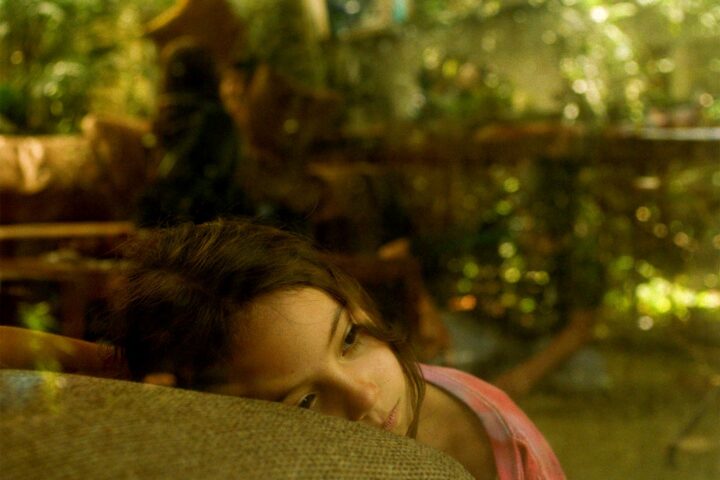
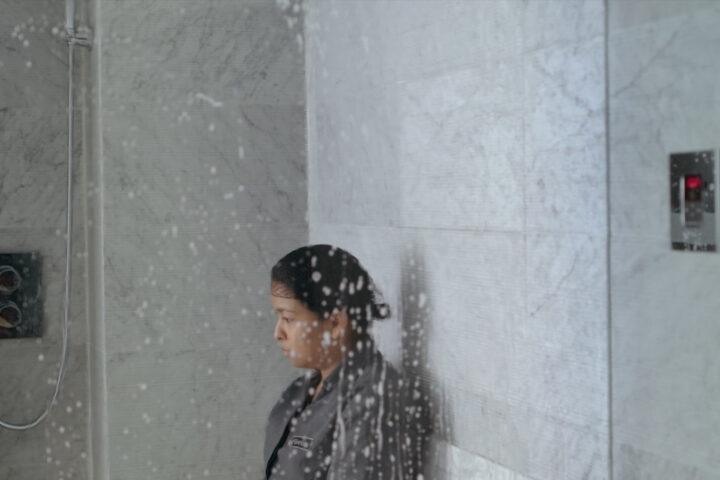
Pressure often mounts on directors with a breakout debut to double down on what made their first feature so acclaimed. Lila Avilés, on the other hand, ran in the opposite direction. Her debut feature, 2019’s The Chambermaid, follows a quiet hotel housekeeper in Mexico City from an austere remove as she strives to improve her station in life. Avilés’s follow-up, Tótem, leans into chaos by capturing the rambunctious energy of a family over a single day as they attempt to prepare for a big celebration.
And yet, the two films, aesthetically different as they may be, feel of a piece with one another. Be it through a claustrophobic close-up or from a sterile long shot, Avilés always brings us into an emotional communion with her characters’ innermost thoughts and desires. She’s comfortable operating within paradoxes, such as the central one at the core of Tótem: the birthday party thrown by a family for the ailing Tonatiuh (Mateo García Elizondo) that functions more like a living funeral for him. But Avilés aligns us with the young Sol (Naíma Sentíes), so the audience experiences events primarily through organic feeling rather than intellectual understanding.
I spoke with Avilés before Tótem’s stateside theatrical release. Our conversation covered how she adapted her style to serve the story, why it’s important to be in touch with a collective consciousness that extends beyond just humans, and what working with a new cinematographer lent to locating the languages and codes through which a family communicates.
You have a very eclectic background. Were there any particularly unorthodox experiences that prepared you to make Tótem?
It’s a taboo with second films: “What’s she going to do next?” What was nice with Tótem is that since I made The Chambermaid, somehow, I knew this film was going to be the second. This film comes from [a place that is] super personal. I was a young mom, and my daughter was everything. No parties! I’m happy it gave me a lot of maternal-ness, even if I didn’t want it. It’s like, “Okay, you’re an adult. Go!” I could understand filmmaking through that role. When she was seven, my daughter’s dad died. Somehow, yes, as parents, you’re not always the best. You’re not perfect. But since I was a mother, I always think about paying attention. Maybe I will make a mess, but I know that I need to see her as she is and to have that kind of objectiveness. I changed a lot from the real story, but I remember I was watching her a lot trying to think what she was thinking about. I like that essence and tried to bring it to Tótem.
Tótem is largely but not exclusively told from Sol’s perspective. How did you find that balance of situating us in a child’s way of seeing the world but providing information that she’s not able to receive on her own?
[No one is] alone [in the film], [as they’re] part of this structure that makes life more wild and magical. It’s friends, it’s family, it’s animals. When you’re in [the midst of] this process, it’s not so easy, but it’s nice to be in communion with that unique relationship. Everyone in their own family, even if it’s a small family or just you and your dog, maintains a relationship and a code. It’s your language, an inner language in your own house. It’s nice that we’re not alone. We’re in this [realm] of collectiveness. We need others, and we need to ask for answers. Sometimes, families communicate, or families don’t communicate at all.
You’ve described the shooting of Tótem as a play. How did you balance the creation of an environment for spontaneity with the need to capture certain story beats or ensuring technical elements like focus and framing remained correct?
The goal of every single scene is to catch the feeling that [the characters] are alive, not that they’re acting. Obviously in the first exercises with Naíma, [who plays the] principal character of Sol, [I had to say] “No, don’t watch the camera!” Since casting, I had this feeling that [Naíma and the camera] would match. It was tough to achieve that almost documentary spirit—that the [actors] are there as themselves. But also, it was a nice balance with the other characters that helped a lot. Everyone was so engaged [with making] the film that we started being like a family. It’s a matter of being present and trying not to manipulate. As a director, you say, “I think [the film] is going here.” Sometimes actors can be stubborn, but sometimes they are super open and confident. When that happens as a director, I think that’s so beautiful. It’s like a Cassavetes film: You can see it when people feel comfortable and they’re alive on the screen.
Does your theatrical background influence the way you block the actors? It feels so natural in your films, especially in Tótem.
I guess it helps. Theater has its own language and codes that could be [feigns a serious voice] super theatrical. What’s nice about theater is the link and relationships [between audience and actors]. There’s no barrier. It’s joyful to be there. I didn’t rehearse as much as I wanted, but [we achieved] a feeling when you start being open. It’s nice, like a good trip. These good trips have an energy where you start talking [to each other], and it’s a balance of joy. It’s unlike trips where it’s, like, “Okay, I don’t want to see you again. I want to return!”
How do you approach filming a space and understanding the geography of where you shoot? You’ve made two single-location films, but the way you show us the space is very different.
It’s funny, I love with [making] a second film that you think, “Oh, I have a style!” When I was going to film Tótem, at first I thought, “I don’t want to move the camera like The Chambermaid.” What I sense is that it doesn’t matter. What was beautiful about filming Tótem is that in the first moment [of filming], I just put the camera [in a stable position] and I didn’t feel it. I needed to catch that fluidness, and it was nice working with [cinematographer] Diego Tenorio. He came from a film that was super Tarkovsky-like, where everything was about the mountain, the tree, and the light. In this film, I invited him [in] and said, “Okay, Diego, it’s all about people. We need to put the attention on them.” The story is more important than me making a statement. You need to catch the better, common-sense way to feel it’s nearer to you.
Was Diego also bringing the thinking about shooting the film more in close-up? It’s striking how you’re getting the same emotional effect as The Chambermaid, but Tótem frames the intense moments in the film so differently.
At first, I wasn’t moving the camera. But [from] the first moment, I knew that I wanted to be super near [their faces]. What was nice about the first exercises with the camera was the actors felt safe and enjoyed the camera. For me, it’s important that actors feel comfortable. Obviously, let’s create beauty in the frame, but it’s more important to catch [the actors in] that essence. With Diego, it was a beautiful match because we pretty quickly felt on the same path and [sharing] energy. He’s a wonderful cinematographer. We also spoke a lot because I wanted this feeling of light and shadow, almost like celluloid you can touch.
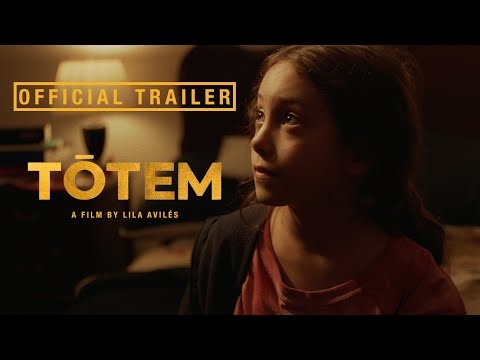
Did that influence the aspect ratio you chose to shoot in? The boxy frame feels like it’s giving more impact whenever you’re shooting in close-up.
Yes, from those first talks with Diego, [we determined] it was better to go near. All films are intimate when they come from the heart, even if a lot of things are happening or they have bigger scenarios. It comes also from something deep and near. But with this film, I wanted to go in. Not only [showing] intimacy but what’s going on. It’s like good talking. Sometimes you will only “blah blah blah,” but in families or with friends, there are those moments where you’re thinking, “Ah, now I’m really talking!” or “This is really happening!” I wanted to go near. It was about a special day, and this is unique not only for the family but for Sol. You change, and that was important for me [to convey]. There’s biological death that one day is going to take us, but there are these other deaths that are more spiritual or part of our personality. Somehow, something changes like the snakes [shedding their skin].
You introduce us to the creatures who also occupy the space as you’re introducing the characters. Does that land belong to the animals as much as the humans?
Yes, there’s an essence that we cannot forget. Returning to the essence of a house, it all starts with ourselves. Everyone in their work says they want to achieve this for the world or for themselves, but it’s nice to have this relationship [with the Earth]. We know there’s a collective consciousness, but as humans, we think that we’re on top of it all. I guess it’s a matter of presence, of paying attention to others, of being respectful to others. It’s like traveling: When you travel, you’re more open and paying attention to all the details because you have more time. You’re on that frequency. But I guess we need to remember all the time that you need to be on that frequency. Normally, we would [only] pay attention to cats or dogs, but there’s much more!
Even if you don’t take as supernatural a stance as the woman with the burning loaf, do you believe houses have spirits?
That bread in Mexico is super particular. A bolillo means a lot of things in Mexico. Even when there’s an earthquake and people are out in the streets, they give bolillo to the people because it takes away fear. It’s also kind of a joke. When you’re in those moments that are hard, you always want to [think] it’s all your in [your] hands. Maybe he’s going to live now because we all want to live. In Mexico, there’s a long variety of that kind of stuff. [laughs] Everything is possible in Mexico! There are people who do that to make money, but there’s a lot of shamanism with people who come from very ancient rituals. It’s that paradox that makes it so funny and unique.
In Tótem, we can often hear noise from another room bleeding over into the scene you are shooting. Were you planning out what was happening in the house all through the movie even if you didn’t shoot those scenes?
That, I love. I did it in The Chambermaid, and I also did it in Tótem. I love it when you pay attention to what you hear. You don’t need to see everything. Families can be chaotic and have their own mess. Like sometimes in Zoom meetings, the kids come in and start shouting. Those sounds are part of it, and, for me, that’s nice. You imagine a little bit more as a spectator [through sound]. Even if you don’t watch, you can imagine.
Did you find the different settings affected the way you directed the performances? The way people behave at home is very different from the way they act at work.
The goal was to catch that relationship within families. You spend a lot of time in toilets and kitchens. Good parties are always in the kitchen, no matter what’s going on outside! The kitchen will be the sacred place. It’s nice to catch those codes and the relationship between the sisters that’s so unique and has its own language. That’s something nice about big families: Everyone has their own personality. [Capturing them] is an exercise of patience.
Toward the end of the films, Sol in Tótem and Eve in The Chambermaid have what feel like dissociative episodes that break the realism you’ve cultivated so thoroughly. What brings you back to this stylistic rupture?
I don’t intellectualize it so much. It’s a feeling I know I want to catch or achieve. But what’s beautiful about being a filmmaker is you’re in the film when you’re in production. There are some things you start to understand. It’s like therapy, [because] it’s something you start to comprehend. I have a lot of communication with my co-producers while I’m shooting. Obviously, I won’t ask things like, “Oh, bring an elephant tomorrow!” I won’t do that because I’m also a producer. Cinema is kind of a mystery, and it’s nice to be present to catch what the character is asking you. It’s wild. You want to get to the finale, but it’s also an exercise of going together with a character as a filmmaker. I love that. I don’t know if it’s going to happen in the third or fourth film, but that’s the energy. I think it’s the most vibrant part of being a filmmaker.
When you make films that are this stylistically different, does it make you want to keep pushing your style? Choose one thing? Mix the two?
Doing Tótem, it was so beautiful to be open. As a filmmaker, I want to try a lot of stuff, like not maintaining [the camera] in the same place. Sometimes the more you want to change, the more [you remain the] same. But I want to try different things. I don’t like horror films, but I [won’t] say no [making one]. Maybe it will put me in another place because I don’t like it.
Do you think any of what you’ve learned from shooting more spontaneous scenes in Tótem will help with the documentary you want to make?
I would love to do a documentary. As a spectator, I love documentaries so much. I would love to achieve a different process and have the flexibility to [operate] my own camera. Maybe I would go wild by myself, and maybe for the next one, I’d want to have a lot of people with me. Let’s see.
After making Tótem, how does it change your idea of what a Lila Avilés film is?
Even if I change so much, I will always pay attention to acting and people. I can change and do different styles, but my goal will be to try to catch that essence [of actors]. That even if it’s in another language, you can feel it as a spectator. I will know better in 10 years!
Since 2001, we've brought you uncompromising, candid takes on the world of film, music, television, video games, theater, and more. Independently owned and operated publications like Slant have been hit hard in recent years, but we’re committed to keeping our content free and accessible—meaning no paywalls or fees.
If you like what we do, please consider subscribing to our Patreon or making a donation.