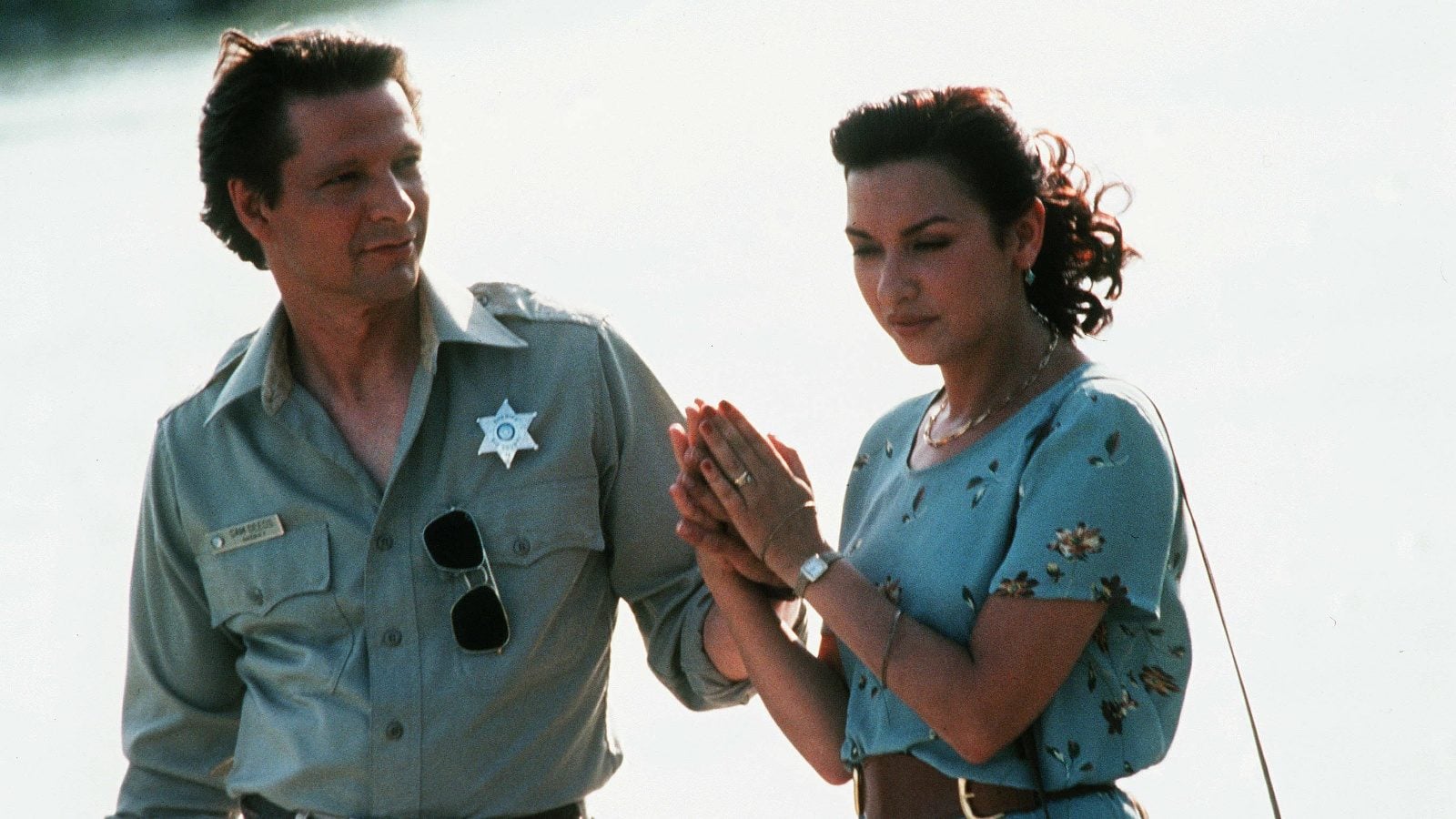
“Forget the Alamo,” says Elizabeth Peña’s Pilar Cruz at the end of John Sayles’s 1996 neo-western noir Lone Star. After the unexpected discovery of a body unravels the countless fictions propping up a Texas border town’s unstable status quo, Pilar’s defiant statement casts off the weight of mythology altogether. And yet, with that memorable bit of closing dialogue, the legend of Sayles’s film had only just begun.
As indicated by the film’s induction into the Criterion Collection, Lone Star isn’t something so easily cast aside or forgotten. Sayles’s sprawling film fuses western iconography with the thrilling structure of a noir-like mystery as Frontera’s sheriff, Sam Deeds (Chris Cooper), probes the decades-old death of a man who once held his office. The investigation brings him into contact with an intergenerational and multiracial group of individuals who all have distinct reasons for putting up their blinders to the true nature of the past.
In retrospect, Lone Star represents a high-water mark for American indie cinema in the ’90s. And nearly three decades on, it feels as vibrant and vital as ever to discussions of national and regional identity. Simply talking about it in the past tense, especially as Sayles continues crafting stories for page and screen, draws the same type of arbitrary border that the film decries.
I spoke with Sayles before Lone Star’s Criterion release. Our conversation covered how the film speaks to the present political climate, its use of flashback, and what elements of the story’s various conflicts carry resonance beyond the Texas-Mexico border.
What does this film mean to you in 2023 given the trend toward Americans seeing borders as something to be identified and closed?
Many borders aren’t marked in various places around the world. Then there are borders that are mined, and there are walls with barbed wire—I think, at the Berlin Wall. They’re a human construct, and sometimes there’s a natural thing like a river, mountain, or coastline that, “Well, this, this makes sense to put the line here.” Other times, it’s absolutely just the politics of who beat who in a war or something like that. They’re symbolic as well as real. The Texas-Mexico border is more real than it used to be because there’s a wall there. Eagle Pass, where we shot, there was not a wall. There was a river you could cross the river and get in trouble…or get away with it. You could also pay a dime and walk through a turnstile to go have a drink in Mexico and do the same on the way back. The Mexicans could do the same, go to Walmart, and go back.
But the symbolism has gotten more important. And as the country gets more polarized, there are people who say, “Well, I may or may not care about people from Mexico coming up here and working. And maybe eventually some of them will want to become citizens or not. But a lot of people do. And I think I’ll get votes if I support building a great big wall.” The border serves symbolic and political purposes, as well as just saying, “The rules are here on this side, and they’re different than [those on] the other side.”
That symbolism transfers into the classroom scene where the parents are fighting about history being taught. It felt like a precursor to what we’re seeing right now in the fights over textbooks.
That’s a scene that could happen in many states today. In some states, it wouldn’t happen because the government has mandated how history has to be taught. If you teach what actually happened, you’ll lose your job as a history teacher at a state college or public school. History is a story. It’s in the word: story. And it’s a story sometimes that people want to believe about themselves, whether it’s true or not, so it becomes a battleground. People fight over history. They fight over, “Oh, you’re gonna make us take the stars and bars down from our state flag just because of slavery and you’re pissed off about it? What about our proud Confederate heritage?” This is something that people have been fighting over forever.
While I was writing the movie, the former Yugoslavia was breaking up into ethnic pockets, and people were talking about stuff that happened in the 13th century. They weren’t there; they just got the story from their side that “they stole our land” or “[they] slaughtered a bunch of people back then.” There might be some truth to it, but in the 800 years between then and now, not much of it is that accurate anymore. It’s a story that they’re holding as part of their identity and part of their animus against other people. A lot of what I was thinking about when I was writing and making the movie was when are legends, which are part of how we define ourselves, useful? When do they get to be part of the problem? What can we do when they become destructive? Sometimes, at the end of the movie for Sam and Pilar, you have to say, “We’re going to make our own separate peace. We’re not going to be able to change that legend. But we’re going to walk away from it. We’re not signing up. We’re moving.” They’re not going to stay in that town.
How much of Lone Star do you see as being specifically Texan as opposed to something that’s broadly American or human?
I think a lot of it stands for not just American history, as there’s some stuff that’s very Texan about it. The Alamo was a very specific war, and it has a specific history. Anglos were invited into that territory, basically, so that there would be more people to fight against the Comanches. They got there, and they realized, “Oh, there’s a lot of possibilities. We’ve got all this land now, but we can’t get rich unless we have slave labor, and Mexico has outlawed slavery. How dare they do that? We want to be free to own slaves like the people in the United States do, so let’s make a Republic where slavery is legal. We’re willing to fight for that.” At the same time, there were Mexican people in that area who didn’t like Santa Ana, who was the president of Mexico at the time. So there were Mexicans inside the Alamo fighting against the Mexicans who would come up from the South. There’s a complexity to Texas history that most people don’t know.
And then, for years after, [there was the] Texas War of Independence, the Mexican-American War, and even the Civil War. There was [even] a war between the Texas Rangers and Spanish-speaking people. They were known as the rinches, and they were like your worst enemy. It was a little bit like, in most cities with a big Black population, their feeling about the police department. [They felt], “These people, I have to assume they’re my enemy until they prove different.” And both sides felt that way, like, “We’re in a guerrilla war against those people in those uniforms or against those people in that neighborhood.” Texas has a very specific history on that border. And, because of that, the politics aren’t the politics of just today. They’re also the politics that go all the way back to the days of the Alamo.
I can assure you most of that wasn’t covered in my third-grade Texas history class in the big city of Houston.
That was true of the history I was taught in New York. It was a very celebratory and simplistic history. As I got older and more things were available to me, it was like, oh my God! First of all, that’s a more interesting history. Second of all, it’s not as celebratory as I thought it might be. And thirdly, there’s stuff that they just flat-out lied to us about. I don’t think you have to be from Texas to have felt like they left an awful lot out when they were teaching us state history.
How do genre or other film influences enter into your writing process? Those precedents feel considered but not necessarily in the text themselves.
When you make a movie, you’re assuming most of the people who go see it have seen other movies. In fact, they have seen many movies! And if you’re writing even close to a genre, they’re going to have a genre experience and some expectations. For instance, in Unforgiven, it works because he’s Clint Eastwood. As you’re watching it, he’s falling off his horse and doesn’t seem like he can hit the broadside of a barn. When they start kicking the shit out of him in a bar, and you’re going, “Oh my god, don’t do that. Don’t you know who that is? You know in the last reel he’s going to turn into Clint Eastwood!” They may need a couple of stiff drinks before he does it, but the movie works because of all the movies he’s done before. With a different actor, it’s like, “Well, how does he all of a sudden get good at this? He was such a bumbler before!” Well, he’s Clint Eastwood, and we know that. We have that experience as an audience.
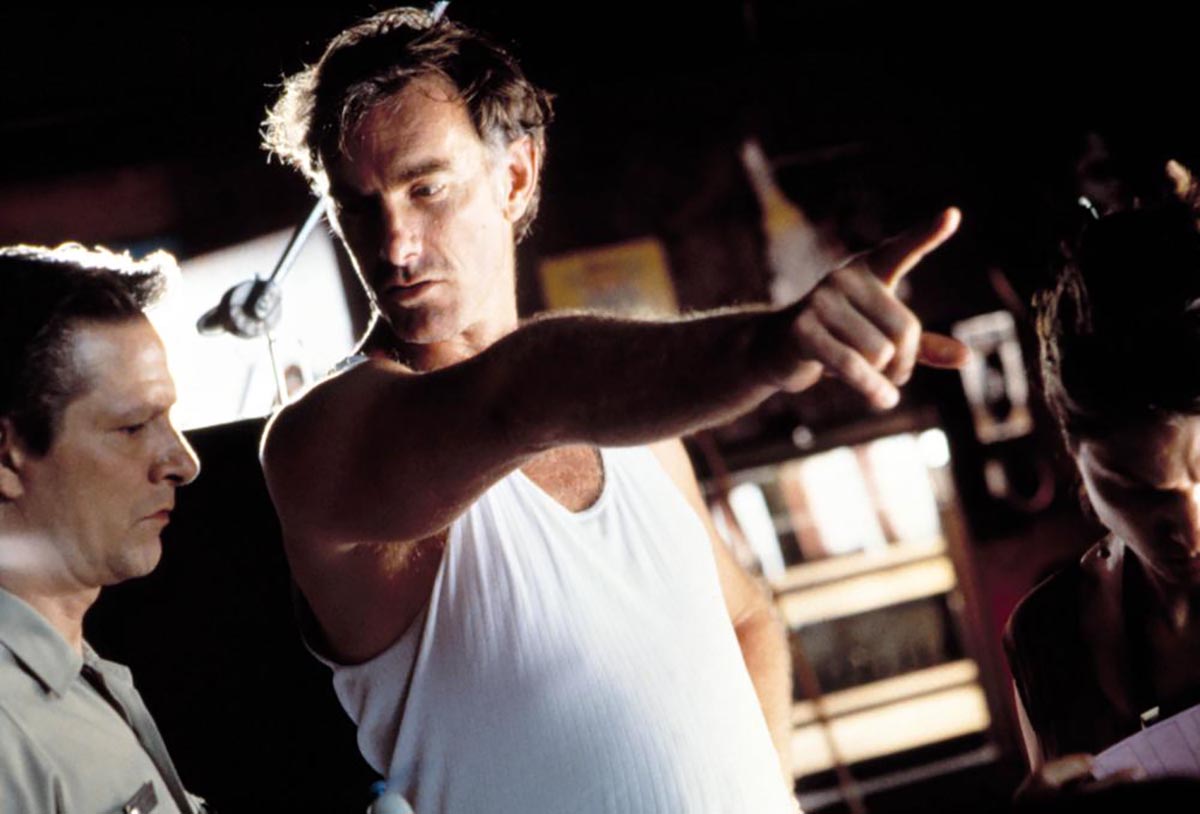
Matewan has more of a western structure than Lone Star does, even though Lone Star literally has guys with cowboy hats and stuff like that. But I shot it widescreen. There’s a kind of sheriff thing, a man’s got to do what a man’s got to do. [Among the] movies I was thinking of when I made it is Marlon Brando’s One-Eyed Jacks, which is kind of a father-son thing where [Brando’s character] ends up romancing the daughter of his former criminal partner who’s Mexican-American. And John Ford’s The Man Who Shot Liberty Valance, which is about what’s legend and [whether to challenge] it or not. Those precedents are ones that I had, and I assumed that many of my audience would have those precedents as well.
That doesn’t mean that you have to follow the genre! That’s what Sergio Leone did. He said, “Well, I love westerns, but what if they didn’t shave? What if we saw them sweat? What if they’re all kind of some kind of bad guy, but we like one of the bad guys better than the other bad guys? There’s a line that he won’t cross. There’s no good guy cowboy, there’s just an aw-shucks kind of guy.” When you’re working with genres, first of all, you have to be aware of them and what people’s expectations are. And then, if you go away from those expectations, you have to lay a lot of groundwork so people will willingly go where you want them to go.
How did you conceive the character of Sam Deeds? As sheriff, he’s very much an establishment figure, but he’s also got a little bit of that rebel in him like the figures you made movies about for Roger Corman.
He’s a guy who, because he rejected his father, did not grow up wanting to be the sheriff of Frontera, Texas. His marriage broke up, and he came back. They wanted him to take over as sheriff, and they [thought], “Oh, he’s Buddy Deeds’s kid, he’ll win no matter what he is! He doesn’t even have to talk, and he’ll win. He doesn’t even have to go into a debate, he’s such a shoo-in.” So he’s kind of drifted into this. And what I talked to Chris Cooper, the actor, about is why. He has this unresolved thing with his dead father, his legend of a father. Even before this body is found, he’s searching in this place—these people who knew his father in a way that he didn’t know him. One of the things I said to him was, “Every scene where you’re going out to get evidence, and you’re doing that detective thing of saying, ‘What happened on the night of July 14, 1957?,’ really what you’re asking is, ‘You knew my father, what kind of human being was my father? Was he of as much of an asshole as I think he was?’”
He’s hoping they say, “Yeah, he was awful. You’re right to have had problems with him.” Instead, he finds this much more complicated truth, which is, “He was a mixed bag. He was cheating on my mother, but there’s a reason that he took this money from the county and gave it to Pilar’s mother. There’s a reason for these things, and some of them are good reasons. He wasn’t that bad. He was a complex guy, but there was a really good side to it. Probably at the time, he was about the best sheriff you could hope to have in Frontera. And I can’t live up to that. I’m just not that guy. I don’t like being sheriff that much anyway.” What I talked to the two leads about is: You’re not going to stay in this town. You’re going to stay together, but you’re not hanging out in this town. Too much history, too much weight!
You’ve described taking a mosaic-like approach to screenwriting from your background in writing novels. How does setting the tiles, to extend the metaphor, work? Are you thinking about individual character journeys before the overall structure, or are they inseparable?
They kind of come at the same time. In the case of Lone Star, I knew that at the end he was going to discover that his father hadn’t shot the sheriff. But I didn’t know who had, so my first draft ended 10 pages earlier. It was like, “And then Sam goes and finds out who shot Charlie Wade.” I had some of the structure, but then you start feeling: What’s this community? Who are the groups in the community? Who’s going to be our entree into that community?
I wanted there to be an African-American community, and the only places near the border where there’s a sizable one are on army bases. There’s a bunch at Fort Sam Houston and Fort Huachuca, which is on the Arizona-Mexico border. The Buffalo Soldiers were stationed there for a while, so there’s a history of Black soldiers in that part of Texas. There’s a history of Black soldiers being treated so badly that there were revolts where they went in and shot up a town. For a long while, we had no Black combat soldiers because the racism was so bad there. They were killing soldiers if they were African-American because they couldn’t deal with Black men carrying guns and wearing an American uniform. So I wanted to get that history in there. I knew the Mexican-versus-Anglo thing was important. There’s even a Native American history there.
I wanted to get all those things, so who are the characters and how are they connected? And are they connected in the present, or both in the present and in the past? Then you start to get ideas. The mosaic is to tell a story, but there’s a technique I read about by Allan Dwan—a director who worked both in silent films and talkies, made things like Sands of Iwo Jima, and worked in a lot of genres. He’d draw a ring and put the names of all the characters around it, and then started drawing lines between the ones who had connections or scenes together. If he found somebody who only had one line, he’d say, “Well, can I either eliminate that character or glue them in a little bit more?” I tried to do that kind of thing where eventually it’s like a knot. There are a lot of connections between characters, even if on the surface, they say, “I don’t have anything to do with those people. That’s them; this is us. There’s a border that separates us.” Well, the border is pretty porous. Especially when you go back in history, the border is very, very porous.
On the note of connections, I was riveted by the scenes in which you’re maintaining continuity of space but not time, upending the stylistic conventions of a compartmentalized “flashback.” How did you conceive and execute these?
For me, one of the main things a cut does is say, “This is one thing here, and on the other side of the cut is something else.” It’s like a border. The action has moved on, we’re in a different place, and time may have [passed]. I wanted to do transitions between the times as the stories are told. As people say their story about Buddy Deeds, [he’s] not really gone. There’s a quote from [William] Faulkner in one of his books, “The past is never dead, it’s not even past.” People are still carrying this. They’re who they are because of stuff that happened back then. There’s no line between then and now, so I didn’t want to cut. I wrote them that way, and then I designed that shot so that we could go from the present day back to 1957 without a visible cut or transition.
And they were fun to do! The crew gets into it as the actors run around behind the camera. Definitely for the audience, [they] make you feel like, “Oh, I don’t hear a harp sound. We’re not doing a dissolve or anything.” Very often, I do one where you might start with Sam Deeds and then go into the story in the past. When you come out of it in the same shot, he’s there again, but maybe in a different place than he started. Maybe even a different location. We’re in his head as he’s hearing the story. And when we come out of the scene, there he is again, and there’s not a cop. He just went through the same story that we went through. So, in a way, we start seeing it through the teller’s point of view. But it’s also Sam imagining it, and when we come back to him, we realize that’s what he knows now. He’s had that same thing that we have.
I’m so struck by you ending the film at the dilapidated drive-in movie theater. Beyond the history of what it means in Sam and Pilar’s relationship, is it at all a complimentary statement on the erosion of the town’s fiction and mythology?
It’s the place where they were together last, and it’s the place where they were separated bodily from each other. But it’s also a blank screen, and it looks dilapidated, like something from the past. But they’re looking at it as if there could be a new story out there. I wanted that feeling for them. These are people who have had this very strong link in the past. Is it possible that something new could be projected on that screen with both of them in it? It’s like one of the first scenes that they have where they start talking real to each other, and they’re walking along the Rio Grande. That’s what’s there: this thing that’s part of what’s separated them.
Lone Star is now available on 4K UHD Blu-ray from the Criterion Collection.
Since 2001, we've brought you uncompromising, candid takes on the world of film, music, television, video games, theater, and more. Independently owned and operated publications like Slant have been hit hard in recent years, but we’re committed to keeping our content free and accessible—meaning no paywalls or fees.
If you like what we do, please consider subscribing to our Patreon or making a donation.