
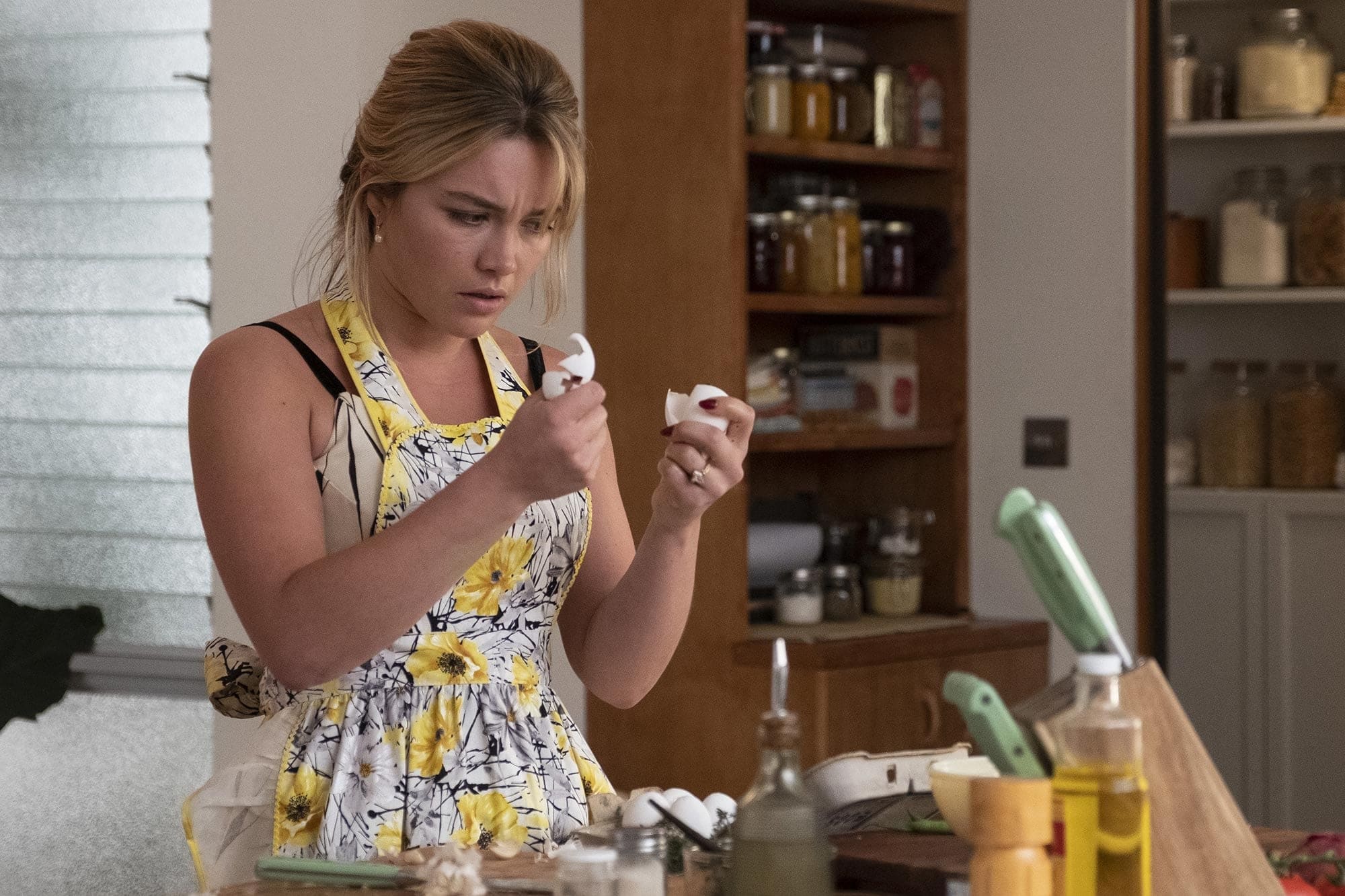
Olivia Wilde’s directorial debut, Booksmart, was a likable enough, if enervatingly simplistic, coming-of-age comedy with no real aesthetic vision. The filmmaker’s follow-up, Don’t Worry Darling, attempts to blend numerous genres at once, from psychological thriller to domestic melodrama to, well, that would probably be a spoiler. But Wilde doesn’t effectively harmonize these distinct genres, which is made all the more frustrating by Katie Silberman’s script repeatedly telegraphing the twists that are meant to keep turning both the characters’ and audience’s understanding of events on its head.
The film concerns Alice (Florence Pugh), a housewife who lives in marital bliss with her husband, Jack (Harry Styles), in a 1950s town called Victory in the California desert. The land is owned by Jack’s employer, the Victory Project, which has brought its staff and their spouses to live in this oasis of irrigated and manicured lawns while working on top-secret engineering projects. Every morning, Jack heads off to work with a full stomach from a perfect breakfast and returns that evening to dinner on the table and his glowing wife all but begging him for sex.
From the outset, it’s clear that something is off about Victory’s glossy, hyperreal suburban utopianism and denizens. But Wilde doesn’t bother trying to escalate a sense of unease, as the film is instantly blaring at viewers blatant signs of distress that are largely conspicuous for their indebtedness to Get Out. These take the form of bursts of hallucinatory visions that startle Alice out of her bliss, and Don’t Worry Darling’s sole Black woman with any dialogue, Margaret (KiKi Layne), gives an early warning that everything is all wrong with a terrified speech that’s practically a mirror copy of LaKeith Stanfield’s petrified outburst in Jordan Peele’s film.
The sheer amount of foreknowledge that the script gives away at almost every turn ensures that there’s no compelling sense of escalation throughout the film. Instead, the plot is structured as a deliberate repetition of Alice’s daily routine even as she breaks from her blinkered contentment as soon as the audience is introduced to it. By making it clear from the jump that these characters are part of an experiment and their lives are hollow illusions, Don’t Worry Darling leaves the viewer to idly study the window dressing erected around this non-mystery.
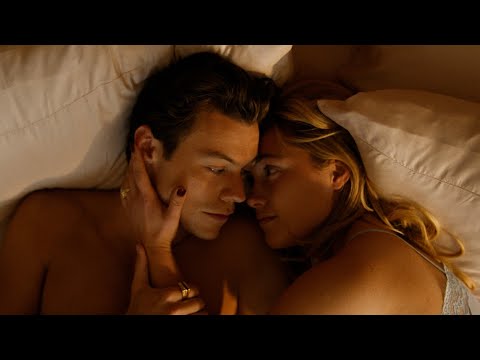
Pugh makes the most of this lopsided presentation, bringing to bear the same anguished paranoia that propelled her work in Midsommar. Surrendering to the fact that she has nothing meaningful to tease out, the actress focuses on capturing the terrible double fear of those who know something is wrong that no one else will acknowledge: the fear of being manipulated but also the terror of being seen as crazy for speaking up. Chris Pine, who plays Victory’s svengali-like leader, Frank, likewise does compelling work when he drops the character’s thin façade of pleasantry around Alice, his plastered-on smile suddenly sinking into a predatory sneer.
Unfortunately, Pine only appears sporadically, leaving Styles to do the majority of the heavy lifting opposite Pugh. Styles, who turns in a performance of awkward cadences and stilted emotions, isn’t the first musician whose stage charisma hasn’t translated to the movies, but even the stiffest pop star tends to have a basic sense of presence, of being familiar with how to position their body for the camera. Styles, though, moves around as if in discomfort and delivers his lines in a voice stuck between an American accent and his natural British one. Even a subsequent revelation that casts Jack’s strange mannerisms in a new light fails to impart a sense that Styles’s baffling performance is consciously multilayered.
Matthew Libatique’s camera often captures Jack and Alice in close-up, with the visual shorthand of the paranoid thriller contained in her anguished tears and his increasingly hostile response to them. At every turn, the film makes the same basic point about idealized patriarchal norms, to the point that when the full truth of Victory is revealed, the sheer absurdity of the details is undone by the sense of inevitability that comes with their didactic thematic reinforcement.
Don’t Worry Darling has the swing-for-the-fences ambition that should have at least made it a noble and compelling folly, but its repetitiveness frustratingly undercuts its grandiosity, rendering the whole film tedious. Instead of following Pugh’s lead and sinking into Alice’s emotional maelstrom, Don’t Worry Darling uses that performance as yet another meaningless flourish illustrating ideas that have been articulated exhaustively and far better elsewhere.
Since 2001, we've brought you uncompromising, candid takes on the world of film, music, television, video games, theater, and more. Independently owned and operated publications like Slant have been hit hard in recent years, but we’re committed to keeping our content free and accessible—meaning no paywalls or fees.
If you like what we do, please consider subscribing to our Patreon or making a donation.



I will decide for myself. I do not trust your opinions.
How many five dollar words did you put in. What a difficult and biased read.
Of course this review was written by a man. To any women reading this – watch the film.