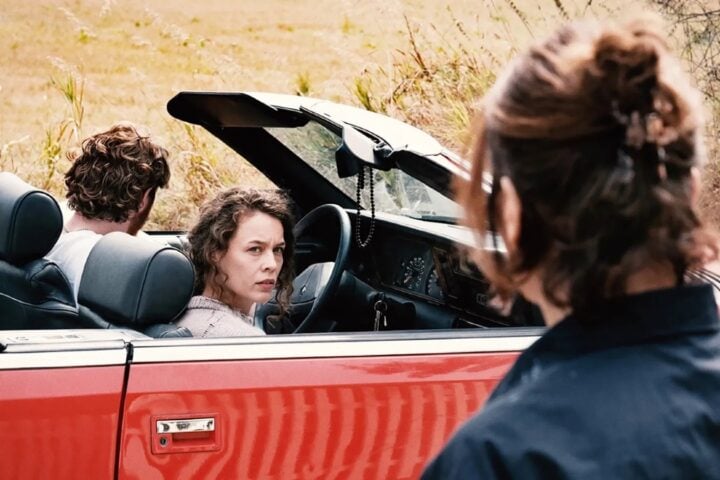
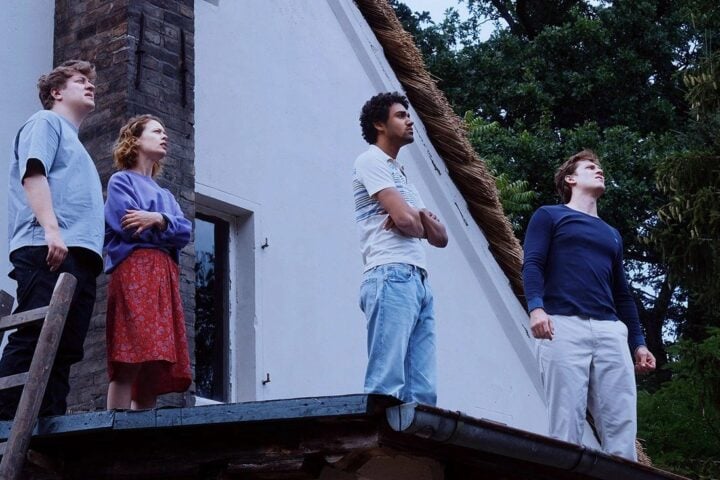
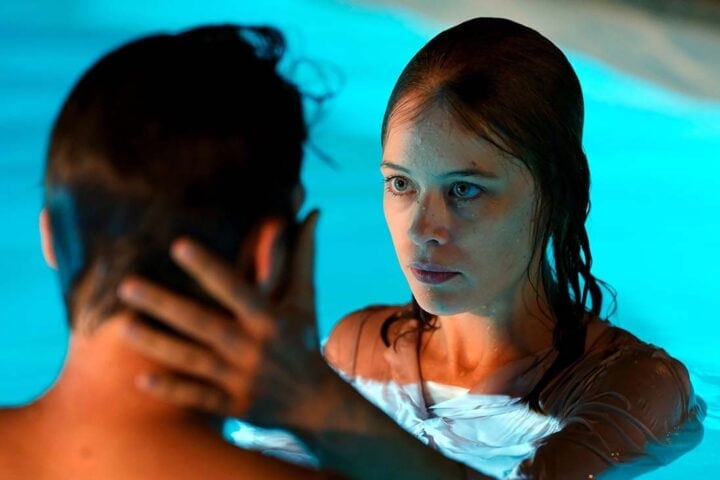
“Do you see anything that’s happening around you?” urges Paula Beer’s Nadja to Thomas Schubert’s frustrated writer Leon in writer-director Christian Petzold’s Afire. As he strives and struggles to complete his second novel, which bears the ludicrous name Club Sandwich, Leon puts on his blinders to both the interpersonal dynamics of the youthful coterie assembled at a Baltic Sea cabin as well as to the forest fires raging inland. If there’s any temptation to conflate Leon’s writer’s block with Petzold’s own position outside the film, Nadja’s exhortation ought to clear up some of the confusion.
Petzold has long stood at the vanguard of the loose filmmaking collective known as the Berlin School. Along with his academically minded peers, he seeks to look at how Germany’s turbulent history ripples through contemporary German life. Rather than craft cinematic fantasies, flattening those tensions into digestible conflicts as the nation’s mainstream exports often do, he’s examined the refractions of that past through the lenses of myth, genre, and narrative.
Afire feels like Petzold’s most contemporary work to date—and that’s true not only because it features a cast composed of young people seeking self-actualization through escaping on a summer getaway. The film feels acutely aware of the complexity of human interaction between the house guests and adroitly responsive to shifts in mood. Petzold creates this microcosm of restive German youth with a clarity that Leon can only dream of achieving with his own novel. Equal parts droll and dramatic, Afire represents an exciting expansion of Petzold’s tonal palette as he notches another entry in his planned trilogy around the elements.
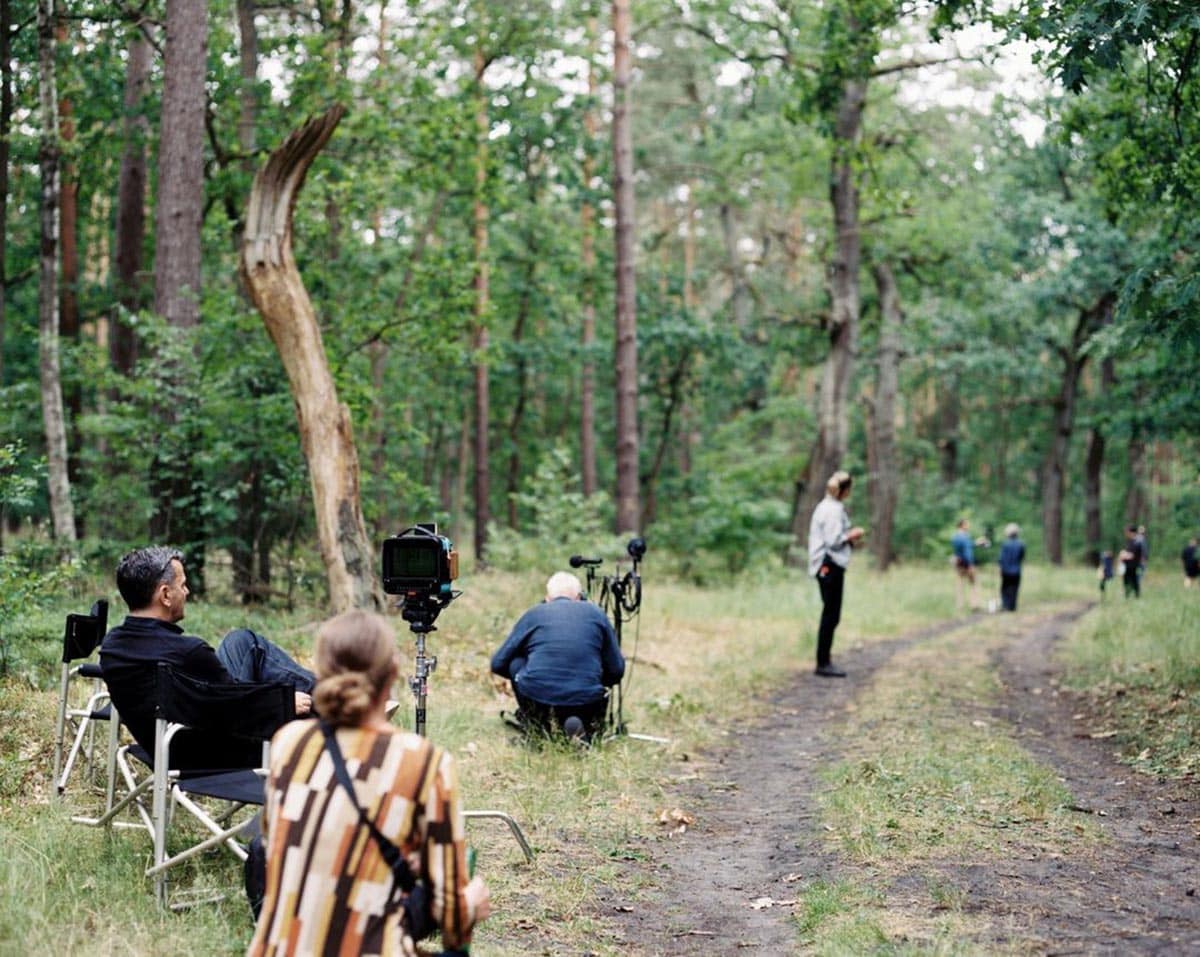
I spoke with Petzold at the Criterion Collection’s office in New York City ahead of Afire’s theatrical release. Our conversation covered how the film relates to German history, why he veered toward screwball comedy rather than dystopian storytelling, and what elements of his own artistic inclinations appear through the characters in the film.
Your work, as well as that of the Berlin School, has long been at odds with the German cinema’s identification of the national threat coming from the past. Afire seems to locate the tension in the present and future. Is that just a practical choice for the story, or part of your larger thematic exploration?
This film [takes place] in the eastern part of Germany on the Baltic Sea, mostly. This was the sea of desire for the German Democratic Republic’s people. It’s a very boring sea, but it has a fantastic coast. One of my favorite movies in the German cinema is Nosferatu by Murnau, which is set not far away from where we shot Afire. I’m from the West, but my parents were refugees from the East. I always thought about the eastern part of Germany but never wanted to live there. My parents left the German Democratic Republic not because they hated communism, but because they loved Elvis Presley, cars, music, and clothes. Me, when I was 13, 14, or 15, I went back to the place my parents had left. I always thought this communistic part isn’t so bad.
In Afire, there are some traces of East and West. For example, the names. The lifeguard’s name is Devid [played by Enno Trebs], with an “e” and not an “a.” People from the German Democratic Republic desired the United States of America after the Wall was broken down. They all bought Nissan cars as if they were living in Pennsylvania or something. And they gave their children American names, but because they can’t speak English, they had to change “David” so nobody thought it was a Jewish name. You can find this name only there.
Were the fires taking place in a specific region or direction in relation to the characters in the film?
Nothing to do with West or East. The fires are coming from capitalism!
Prior to the pandemic, your plan to follow up Undine was with a dystopian story. But you scrapped that project after spending several weeks bedridden with Covid-19. Do you feel like any of those strands of thought still made it into Afire?
At this time, I was very tired of dystopian stories. And I think most of them are fascist stories. It’s as if there’s a desire in our society like [the one that] Travis Bickle [voices when he says], “Someday a real rain will come and wash all this scum off the streets.” I have a feeling that in most dystopian movies, and the series The Walking Dead, they like that everything’s gone. Democracy, the complex world, the discourse…everything just wiped away and you need a tabula rasa. This is fascist thinking, not only from the right but also from the left. Pol Pot in Cambodia—it’s the same. Destroy everything and rebuild it. Cinema wants to make the world into a studio where everything can be made into clear, clean new stories. I think dystopia stories have a little bit of this, and I thought to myself, “Our world, with our complexity, our desire, our bodies, our youth, our wishful thinking, and everything, is such a fantastic world. We have to fight for this world, not make a tabula rasa.” Therefore, I changed myself.
You once said that you wanted to make something like a screwball comedy. Do you feel like Afire scratched that itch? You have the cross-class relationship of Felix and Devid and the inverted gender dynamic of Felix and Nadja.
That’s right! I must say, yesterday on the plane to New York from Berlin, I had to go to the restroom. So, I got up from my chair, and then I saw all the monitors. Everybody was watching movies, and most of them were watching a movie with Julia Roberts and George Clooney, Ticket to Paradise. I wanted to know why because I hadn’t seen it. On the monitor, the little advertisement says it’s a modern screwball comedy. There are screwball traces in this movie, some very good lines of dialogue, but it has nothing to do with the screwballs I love.
I love Howard Hawks, Leo McCarey, and Preston Sturges. In their era, the cameras were big and reality is far, far away, but there’s more reality inside of those movies than in the movies nowadays. I was totally disappointed by Ticket to Paradise because nothing was real. Everything was scripted. These two fantastic actors can’t fight with words. This is something you can find in screwball comedies: They’re fighting with words, and this is the seduction of the work.
When we started rehearsals for Afire, we had a three-day seminar three weeks before shooting. The first day was a cold reading where I’m talking with the ensemble about why I’ve written the film. On the second, we watch movies. And the movies don’t have anything to do with the subject of our movie but something to do with the morality. The first movie we saw was What’s Up, Doc? by Peter Bogdanovich, and the other was Some Came Running by Vincente Minnelli. Why? Minnelli has something to do with cinema, being an artist/author, and also the class story. It has people from the upper class and a soldier from the working class who’s a writer.
[With regard to] What’s Up, Doc?, I said to them, “This is something I want to do.” We have Ryan O’Neal’s character, who’s boring. So why is she falling in love with him? Because this is someone she hadn’t seen in her life before: a guy who’s not interested in the world. It’s her task to open him up to the world. This is also love. It’s not about liking her thighs or lips or something but thinking [he has] to be open to life. What she’s doing with him in What’s Up, Doc? is fantastic. [The car chase] is the best pursuit scene I’ve seen ever seen in my life.
You waited to make Afire until your actors weren’t having to comply with onerous Covid-19 protocols, yet the sexuality in the film is all heard, and quite annoying to Leon. How did you come to settle on this representational style? Is that at all a sublimation of pandemic lockdown repression?
There are two things [that I was thinking about]. I was in Turkey after a forest fire. Totenstille is a German term for death silence. I don’t know if this exists in the English language. My children often asked me what’s death silence, and what’s silence. I would say that silence is when nobody’s talking but there’s one bird there, the wind is there, and suddenly you hear the TV set far away. But in dead silence, there’s nothing. They can’t think [about] what nothing is. And when I was in this burnt forest one or two months after the burning in Turkey, it was a dead silence. There was no wind, no birds, no insects. Nothing. It gave me a dystopian feeling.
[The second thing is] sexuality. [laughs] I hate to see bodies in motion during sex. I never believe it. I always see the actors. In Germany, because of Me Too, we have intimacy coaches. There are people who say, “Take your right hand to her left breast. Okay, thanks.” You can see that effort of all the actors to make it real. I hate what they’re doing with their eyes, and I hate how they try to go as far as they can to the margin. And you don’t need it for the story.
So I said to my actors that we just need to hear [their characters having sex]. They said, “Oh, no problem!” On the day we took the microphone into the bed, and Paula and the two guys had to lie down, it was very hard for them to produce the sounds. Because you hear the lying. A liar like Trump, he looks like what you hear. I wasn’t in the room, but they told me later that they closed their eyes, took themselves by the hands, and [went] on a journey of sin. When pornographic movies were made in the ’70s, they never made them with microphones. They used ADR [recorded by] professional actors in Los Angeles or San Francisco [for the imitate sex noises]. These [voice] actors could do it, but for these characters, it was very hard. I liked that it was hard because it shows me that it costs something. It’s precious.
The writer’s block portion of the film isn’t necessarily drawn from autobiographical frustration, but are there other elements of Afire that are? Things like Felix’s comments about the framing and context of his photography feel tempting to read as self-reflexive.
There’s a sequence I like very much in a very old Wim Wenders movie Alice in the Cities where the main protagonist, a photographer, and a girl are sitting on a plane. He takes a Polaroid photo out of the window. You see the wing of the plane and clouds, and she shows the Polaroid to her. And she says, “It’s fantastic. It’s great.” And when he asks why, she says, “Because it’s empty.” This is something I always remembered, [as well as] the Japanese photographer Sugimoto Hiroshi, who makes photos of the sea. I love them because they’re empty.
Yesterday, the first thing I did [after getting to] my hotel was cross Houston Street, go down to the Hudson River, and sit down on a bench because I love to be in front of something that’s empty. I was surrounded by commercials, advertisements, and cars, so you need this emptiness. This was my idea. I must always have ideas that I can talk about with the actors so that they can make the ideas their own. Langston Uibel understood what his character was looking for immediately: the emptiness, the people in the moment of emptiness, and what kind of relief is in the emptiness. It’s important because the novel Leon is writing is bad. One of the photos must be better than 200 pages of his bad novel. It’s important to have a good photo of the sea.
You’re a student of film history whose work is often enhanced by the conversation it enters into with other films: Phoenix with Vertigo, Transit with Casablanca. Is there an ideal double bill with a classic film for Afire?
There’s something of a correspondence with Éric Rohmer’s La Collectionneuse. And an American movie I saw a few years ago, The Myth of American Sleepover. It’s one night, so it’s not the same. But it’s in the neighborhood. If cinema is a town, they are from the same street.
Translation assistance by Margaret Keppler
Since 2001, we've brought you uncompromising, candid takes on the world of film, music, television, video games, theater, and more. Independently owned and operated publications like Slant have been hit hard in recent years, but we’re committed to keeping our content free and accessible—meaning no paywalls or fees.
If you like what we do, please consider subscribing to our Patreon or making a donation.