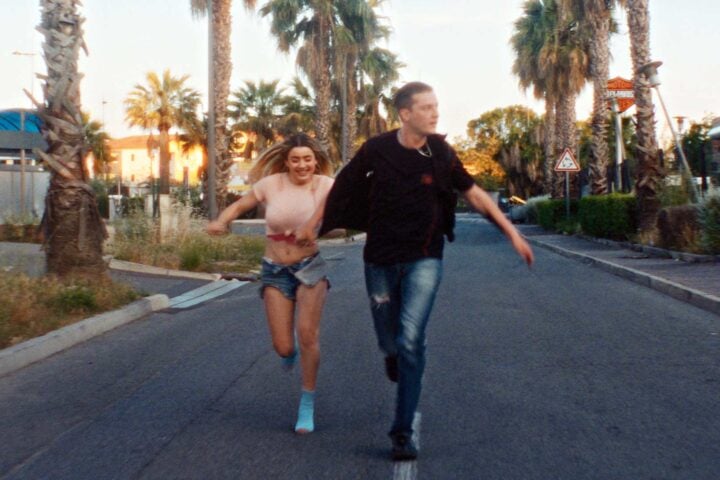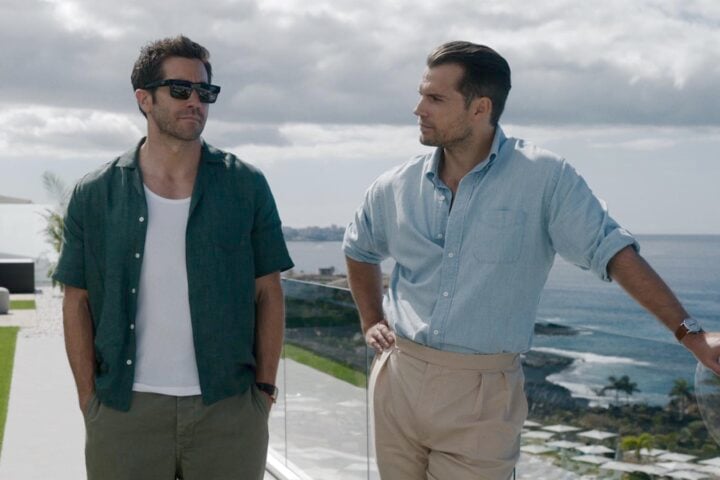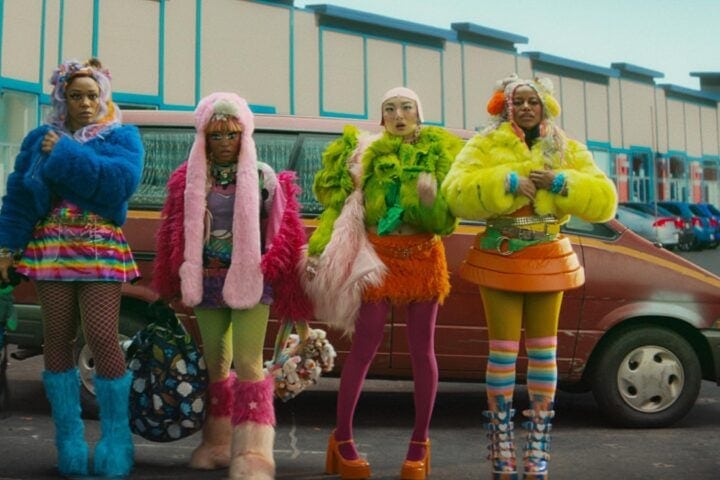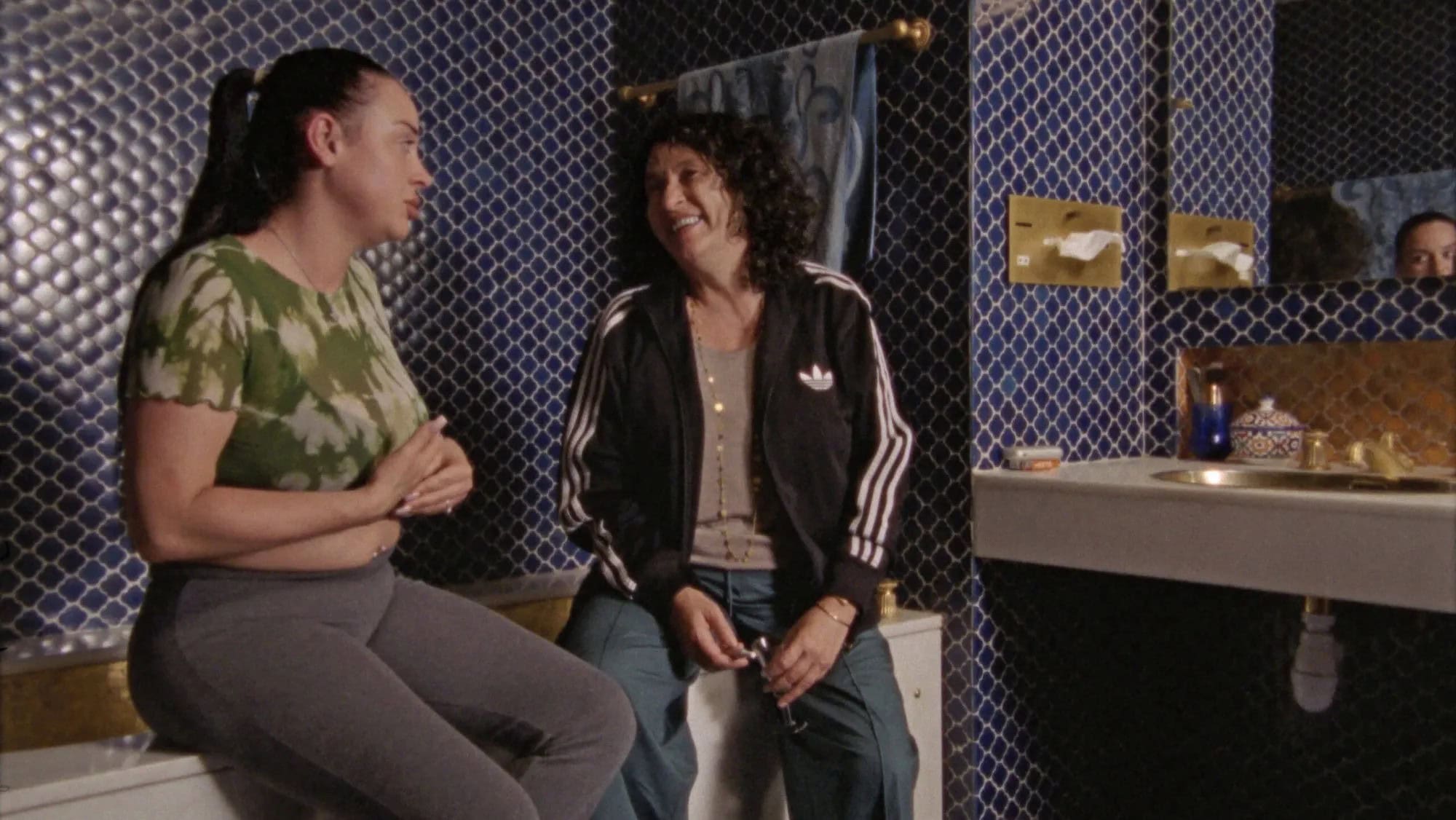
Lila Pinell’s narrative feature debut, Shana, playing in the Directors’ Fortnight at this year’s Cannes, revolves around a twentysomething with no filter, endless chutzpah, and nonstop boyfriend problems. From the film’s disorienting opening—in which Shana (Eva Huault), who appears to be the only white face in a diverse group of friends, storms out of a game involving werewolves—we’re thrown into the day-to-day life of a one-woman, slow-motion train wreck, as Shana approaches every delicate situation with hurricane force.
As Shana rides in the backseat of a car with her mother, Yolande (Noémie Lvovsky), and grandmother, Marie (Geneviève Krief), up front, the issue of dating is broached. “A piece of advice, avoid Arabs,” Marie breezily states. To which Shana bluntly responds, “You know you’re being racist. And you’re Arab.” When the elder woman protests, Shana simply charges right on: “Myriam, born in Morocco. You speak Arabic, you eat couscous. Stop inventing your life.”
Soon we’re at a large family seder, where Shana, seated across from her mother, loudly wonders why she’s whispering and “looking my way.” Turns out, Yolande doesn’t approve of her daughter’s mouth—specifically her lip injections. Again, a showdown ensues as the older woman warns about the dangers of cosmetic surgery, citing scientific studies she’s been following. But Shana’s not having it, and isn’t afraid to let the whole Passover table know. “What do I give a fuck about your shit BBC documentary?” she cries before exiting abruptly.
But what begins as an unassuming dramedy about a short-fused Zoomer who doesn’t give two fucks slowly reveals to be something far more consequential. In fact, a trusting shorthand built over nearly two decades between Huault and Pinell, who cites the Coen brothers’ A Serious Man and the Safdie brothers’ Uncut Gems as influences, allows the filmmaker and her fierce leading lady to ultimately make some excitingly unexpected leaps. By the end, Shana has become an anthropological exploration of sorts, encompassing everything from ethnic identity (and denial thereof), to racism and classism, to domestic violence, as well as the many uncomfortable truths that, if left unspoken over generations, might just emerge in a primal scream.
“Primal” could likewise describe the quite believable sex that is the primary source of communication between the protagonists of Pierre le Gall’s Flesh and Fuel, another feature directorial debut premiering at Cannes, this one in the Critics’ Week sidebar. Alexis Manenti delivers a rivetingly inscrutable performance as Étienne, a dedicated truck driver with a penchant for joyless encounters with anonymous men in forests and at gray roadside stops.
A middle-aged masculine guy in a historically misogynistic profession, Étienne seems to fit in well with all his colleagues, including the few women who are starting to become accepted behind the wheel (and at dispatch). Indeed, social norms are changing, and one gets the sense that even the macho old-timers tend to prioritize hard work over issues of gender or sexuality. As for nationality, well, that’s an entirely different story.
And while Étienne isn’t really in the closet, he likes to keep his personal life private. For other than the sister (Julie Duclos) and nephew (Marius Vogel) he rarely has time to see, the road is his everything. Why he prefers nonstop travel and fleeting sexual connections over lasting relationships is a mystery—and one that Bartosz (Julian Świeżewski), a sunny, Polish immigrant trucker he first meets at a cruising spot that gets raided by the police, would like to unravel.
Thus, the viewer joins Étienne on a physical cross-continental journey that consists of never-ending pickups (in both senses of the word) and deliveries, and of schedules that must be followed with utmost precision. In addition, we’re likewise privy to Étienne’s emotional trek as he pines for hook-ups with Bartosz, his openhearted opposite. Unfortunately, Étienne is often only able to see the foreign laborer on his smartphone screen, or through the window of his truck’s cab as the two pass one another on opposite sides of a highway divider.
Le Gall, who embedded with a French trucker and traveled to England, Italy, and Switzerland as part of a world-building process, has called Flesh and Fuel “an anti-road movie,” noting that the “road doesn’t inspire dreams—it confines and offers no sense of freedom.” While that may be true, every highway also has its exits, and love can compel one to take a different route.
The Cannes Film Festival runs from May 12—23.
Since 2001, we've brought you uncompromising, candid takes on the world of film, music, television, video games, theater, and more. Independently owned and operated publications like Slant have been hit hard in recent years, but we’re committed to keeping our content free and accessible—meaning no paywalls or fees.
If you like what we do, please consider subscribing to our Patreon or making a donation.