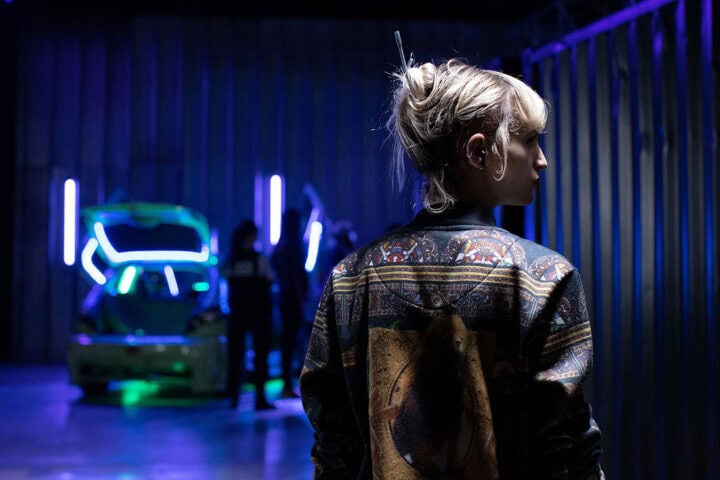
“The present came to a halt,” Bertrand Bonello writes in an ode to his teen daughter in his experimental feature Coma, “leaving us with the past and the future.” Much of this subtitled text refers to the specific circumstances of the film’s creation during the pandemic. Yet the French filmmaker’s follow-up, The Beast, which was developed before Coma but shot afterward, feels like a natural extension of his fascination with the scrambled perception of time in a digital era. In Bonello’s time-warping adaptation of Henry James’s 1903 novella The Beast in the Jungle, the present day is the Paris of 2044, where landscape and character have been warped by advances in artificial intelligence.
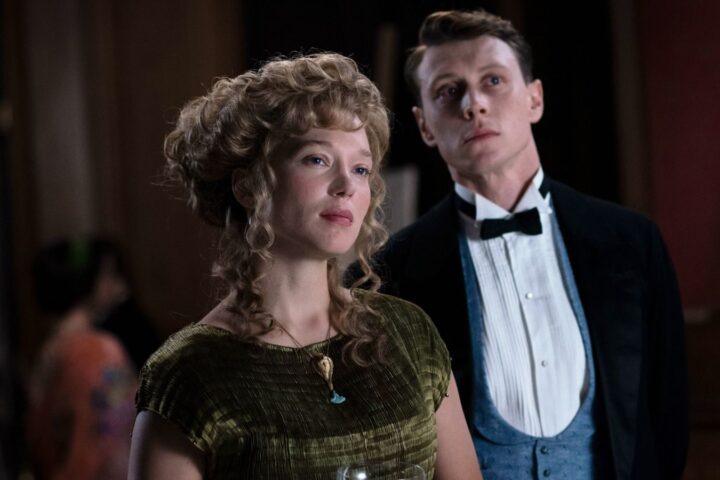
What’s evergreen, as a repeated aural motif so often reminds, is the twisted relationship of fear and love between Gabrielle (Léa Seydoux) and Louis (George MacKay). Bonello gives us a glance at two of their past dalliances as Gabrielle prepares for a process to cleanse her emotional memory. In 1910, on the eve of the great Parisian flood, it’s Gabrielle whose marriage stifles them from following their amorous connection. In 2014 Los Angeles, it’s Louis who stands in the way of their happiness as his timidity toward the opposite sex curdles into the violent terror of incel-dom, recalling real-life murderer Elliot Rodger.
As their drama plays out across time, Bonello pushes the plasticity of the form. His confident toggling between genres, styles, and tones complements the complexity of the narratives and themes that the film explores. Whatever the present can be said to be, The Beast embodies it.
I spoke with Bonello in New York as he prepared to present the film’s local release. Our conversation covered his understanding of time and the self, his relationship to technology and A.I., as well as his changing ideas about what represents a cinematic image.
I remember Elliot Rodger among America’s mass shooters not so much because of the words of his manifesto. But because he was a kid in the shadows of Hollywood, I remember his final video because it had a remarkable sense of aesthetics—even shot in this gorgeous beachside magic-hour lighting before he commits this horrible massacre. Was that tension something at all that influenced your choice to center him in the story?
Ten years ago when I discovered the videos, besides what happened after—the fact that he killed girls and the psychopath stuff—I was very impressed by them. The words he uses, the mise-en-scène, there’s something very soft in the tone of the voice. That made him even more scary. It’s not like Jack Nicholson in The Shining. This craziness was just even more crazy because you couldn’t see it. The guy looked normal. I kept that in mind and was very, very impressed by that.
In my chat with George MacKay, he mentioned Louis had to be American because of our culture of high achievement. What interested you about that wider context?
In 1910, Gabrielle is the one who’s afraid of love. I wanted to swap the characters for something more contemporary. And, in a way, incels are afraid of love. They just don’t admit it to themselves. It’s something unconscious. What they say is: “They don’t want me, I hate them, I’m gonna kill them.” But maybe before that they say, “They don’t want me, but I cannot abandon myself.” And, for me, I found it very modern to go through this [archetype] to talk again about the fear of love. So that’s why I thought Elliot Rodger, Los Angeles, and America.
The film is dedicated to the memory of Gaspard Ulliel. Does that memory linger at all in the character of Louis?
I guess there was the ghost of Gaspard in the shoot. In the exhibition in 1910 at the beginning of the film, there were a lot of portraits of him. But I never thought, “George is doing this this way, but what would Gaspard have done?” For me, George made the film possible again because he was something else, and that’s it. But, of course, I was thinking about Gaspard all the time.
Did his passing lend a metatextual element to the character? In some ways, it’s a literalization of the idea that another, different self is out there but tied to what we can see.
The most challenging thing was not to make three films, but to make one film, and not to make three simple female and male characters but one character. That’s to say that the George or the Léa of 2044 must be the addition of the one in 1910, the one in 2014, and even some more we do not see. Take a very precise example: Just before arriving in L.A., in the doll factory, she’s about to say yes, but she says no. Then they die. Then they arrive in L.A. and George says, “No girl wants me.” That’s the unconscious memory of someone who said no.

I asked George about this idea: Could you play 1910 Louis knowing how 2014 Louis was going to act or how 2044 Louis was going to act? Can you reverse the cycle of time and let the future influence how you think about the past?
[chuckles] What did he answer?
He gave an example of how Gabrielle touches Louis’s hand and it triggers something unconscious but said he couldn’t act in a deterministic way as if knowing what happens in the end determines what happens in the beginning.
That’s a good answer.
Did you think about it similarly?
In 1910, I was thinking about it as the present for them. And, of course, in 2014, I was thinking that they had lived in 1910 before. It was good we had shot [1910] already. So, yes, I was trying to put some…not memories, because they don’t have the memory of that, but some signs of memories [they would later recognize from 1910].
George talked about how the character of Louis highlights whether or not we have some core or essence as people—some people might call it a soul—that would hold true no matter our circumstances. How do you feel about that?
For me, they’re the same character, but they’re changed by the periods. Léa in 1910 is trapped in the convention of the period. And what becomes George in 2014 is also the same character as he is in 1910, but he’s twisted by the period. So I believe in that. I believe also that we’re built with things that we do not know—ancient traumas we’re not aware of but are inside us. It’s not believing in past lives. It’s something else.
Do the characters exist in a continuity in between the time periods we see? In the final scene, Louis mentions they listened to Roy Orbison’s “Evergreen” when it first came out.
Yeah, we missed an episode, the one in 1963!
You’ve described The Beast as akin to a documentary about Léa Seydoux. Is that different from the Jacques Rivette quote about how every film is a documentary of its own making?
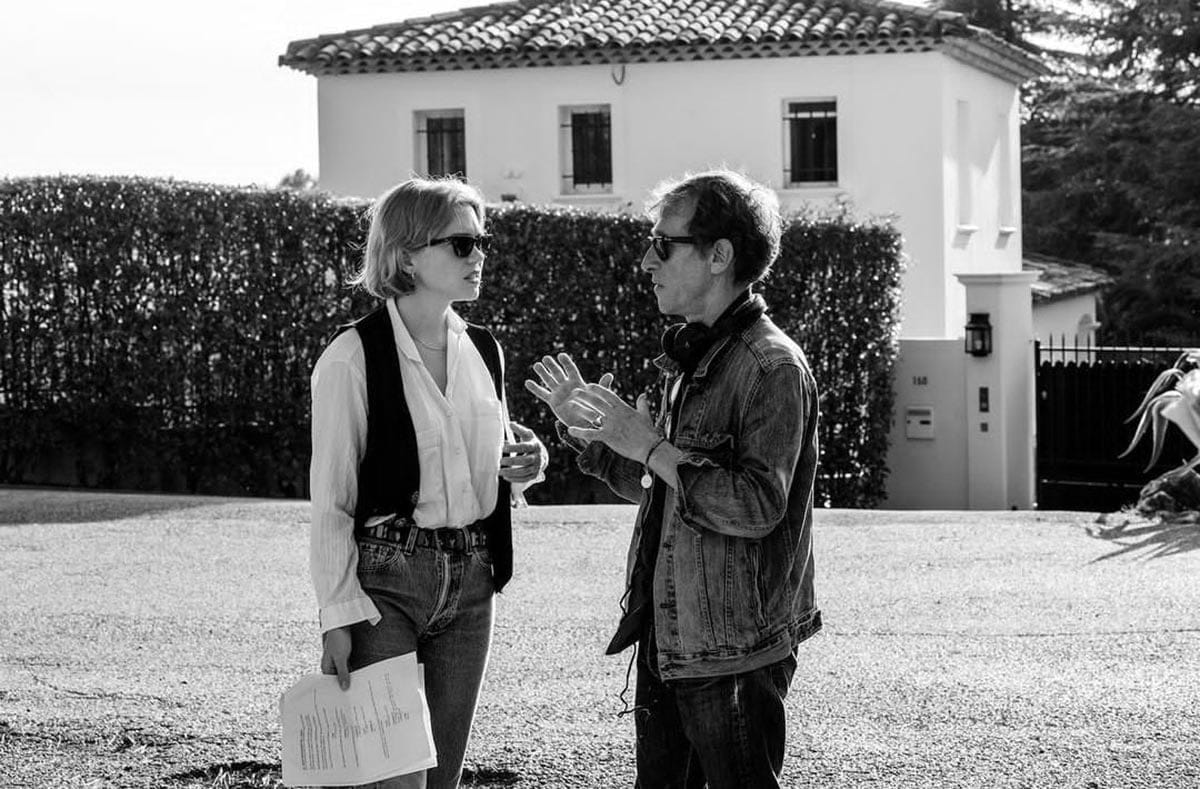
I meant that, and a little plus. The film is two hours and 25 minutes, and she’s [in it] from the first shot to the last shot. It starts with me talking to her on a green screen to say, “Okay, are you ready? Let’s go.” The camera is always on her and trapping her.
Was the nature of their preparation—Léa more spontaneous, George more studied—something that echoed their characters’ dynamic of star-crossed lovers?
I have to adapt myself to the actors. Some actors want psychological explanations, some do not. Some actors want me to talk a lot, some want three words. It’s my job to adapt myself to them.
How do you manage that practically when you have two actors with a different process? Do you have to work with them individually?
It was okay because George was very generous. Even with the fact that Léa wasn’t really prepared and didn’t know what to act [when she got to set], he was an amazing partner. What’s the most difficult is when you have someone who’s very good on take two, and then [their energy] goes down, and someone is going up take after take.
What role do you see the internet playing in shaping our experience of time?
I see it as a tool. A tool is something that’s fantastic if you can use it in a good place for good reasons…and if you are the master of the tool. But when the tool is the master of you, that becomes freaky. It’s sometimes what happens.
What was the genesis of the image search scene? That was the scariest moment to me—this idea that Louis exists across time, and she seemingly doesn’t exist at all.
Everybody’s Googling themselves. If you Google your name and you do not exist, it’s something freaky. It’s small, but I really like this idea.
Do you Google yourself?
Sometimes when a film is released, but you shouldn’t do that. Because if you search for shit, you find shit. I don’t do it all the time.
What were your design considerations for the 2014 portion? While it might ostensibly look like the present, you’re very consciously positioning it as the past.
I don’t know what’s more the present, 2014 or 2044. We’re in between the two. But, of course, there’s some vintage stuff. But for the rest, it’s two lonely people: one in front of an iPhone, one in front of a computer in our house where she’s alone. But there are so many windows that she’s not alone. Everybody can see her: the neighbor, of course, the owner. And, for me, I was just searching for this kind of atmosphere.
Does that tie into the larger nature of what it’s like to live in a very online culture where you’re being watched all the time?
Yeah, I guess so!
Part of the reason why you wanted to set the film in 2014 was to have it take place before the start of the #MeToo movement. Why was that such an important dividing line that you wanted to be on the other side of?
Well, it doesn’t excuse Louis Lewanski today to do these videos. But making them in 2014 or making that in 2021, for example, isn’t exactly the same.
You mentioned 2044 might be a little bit closer to the present, at least in how it feels like to live right now. Do you feel like we already exist in the A.I. era of filmmaking?
It’s a good question. Even if I’m playing with ChatGPT for filing scripts, I did just for fun “write me a script like Bertrand Bonello.” And five seconds later, you have four pages of story, which isn’t stupid. It’s not what I’m going to do, but, of course, it’s quite freaky. It’s okay for me, but thinking about people who are 20, how are they going to use that? Again, if it’s a tool, and you are a master of the tool, it’s great. If it takes over, because it’s so easy, it’s freaky for humanity.
On a broader level, do you think that A.I. ethos has taken over our minds? What ChatGPT and all these models do is provide the median or average expected response. A lot of what we see in filmmaking, to some extent, is already kind of the byproduct of the fear of anything that is outside of the norm.
Yeah, but you know that in three years, they’ll be a million times more powerful. More powerful doesn’t mean more memory. It can be more transversal. It could bring some mistakes, it could bring some sensibility, it could bring some poetry.
Do you fear that future?
Well, it’s difficult not to fear the future. I think the relationship between technology and humanity is one of the big questions.
Do you think these tools are changing the way that we fear the unknown future? The Beast is about the timelessness of fearing what you don’t know. Is this a new way to express an emotion that has existed throughout time?
I mean, when I was [writing] about 2014, it’s only 10 years ago, but so many things have changed because of technology. So I can imagine in 10 years…I mean, I cannot imagine. I cannot.

There’s a fascinating motif running through The Beast of digital noise and destabilization of the image. You talk about intimate and collective catastrophes living side by side, so is this image pointing to a larger crisis of cinema?
There’s something I really think about: What is an image of cinema? We’re surrounded by thousands of images everywhere. An image of cinema has to be something special. It’s not, on one hand, beautiful images, and, on the other, YouTube. Either in Coma or The Beast, I tried to use some images that are around us and make them become images of cinema also.
Are Louis’s videos cinema, by that metric?
I hope these iPhone videos become like a real cinema image, the way I structured the film and I put them in.
Did Coma expand the way you thought about the kind of images that could be cinema?
Yes, we had some problems with Léa’s schedule, so we postponed the film for a year. And my producer said, “Do a short.” I said, “No, I’m going to do a feature with the budget of a short.” I did Coma because I felt I needed that freedom. And, of course, there was a relationship between the two films. Not in terms of subject, but in terms of form and going from one world to another.
Did making Coma impact the shape that The Beast ultimately took?
I think it gave me some technical answers.
A dominant mode of consuming cinema today is to try and “solve” a movie to get an answer. Is that something you’d want viewers of The Beast to do?
Well, not [to get] an answer. I mean, I hope when you get to the end of the film there’s no lack [of understanding] in the story. But I always prefer a film that, when the audience leaves, they have questions, not answers. That opens something much more than it closes something.
Do you build a film like this with the idea that people will view it again and have a different experience catching things along the way?
I mean, everyone who has seen this film twice—and it happens quite often with journalists—told me they liked it even more than the second time. Of course, you’d like people to see your film several times. But you’re happy if they see it once!
Since 2001, we've brought you uncompromising, candid takes on the world of film, music, television, video games, theater, and more. Independently owned and operated publications like Slant have been hit hard in recent years, but we’re committed to keeping our content free and accessible—meaning no paywalls or fees.
If you like what we do, please consider subscribing to our Patreon or making a donation.