In Benediction, British cinema’s laureate of self-loathing, writer-director Terence Davies, sets his sights on Siegfried Sassoon, the gay English poet and writer whose antiwar verses brought him great acclaim in the aftermath of World War II. It’s a film that’s both elliptical and caustic, a rhapsodic portrayal of an upper-crust milieu in which words are wielded like weapons by people who might otherwise be pariahs.
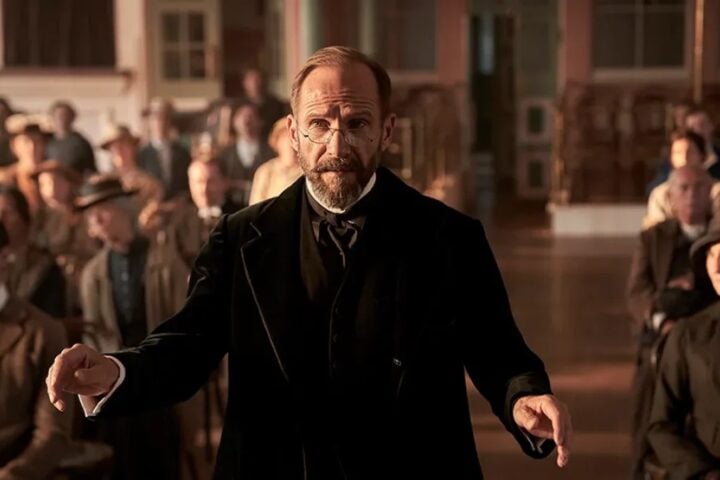
Davies bookends Benediction’s narrative with two distant events: a 1914 performance of Igor Stravinsky’s scandalizing ballet The Rite of Spring and the 1961 stage production of Leslie Bricusse and Anthony Newley’s popular musical Stop the World — I Want to Get Off. Both are attended by Sassoon, who’s played in youth by Jack Lowden and as an older man by Peter Capaldi, and the creative gulf separating these two works of art parallels the poet’s own evolution from a resolute man of his time to a bitter one outside it.
Society and its myriad cruelties help with that breakdown, of course. Early in the film, Sassoon is committed to an institution as punishment for a rabble-rousing letter he writes decrying the English war effort. (The official explanation for his hospitalization is “shell shock.”) It’s here that Davies vividly lays out what it means to live queer at this moment in time—via innuendo and evasion, even among friendlies like the benignly subversive doctor (Ben Daniels) who treats Sassoon and the talented poet, Wilfred Owen (Matthew Tennyson), who wins his heart.
Despite his lovelorn stirrings, Sassoon remains celibate with Owen. The only time men touch men in this section of the film is within the confines of performance, as when Owen and Sassoon waltz with each other while rehearsing for a talent show. Witnessing this display, a superior officer played by Julian Sands hisses with displeasure. In respectable society, how something looks is of paramount importance. How someone looks, by contrast, is the purview of the judgment-prone underground in which Sassoon eventually finds himself.
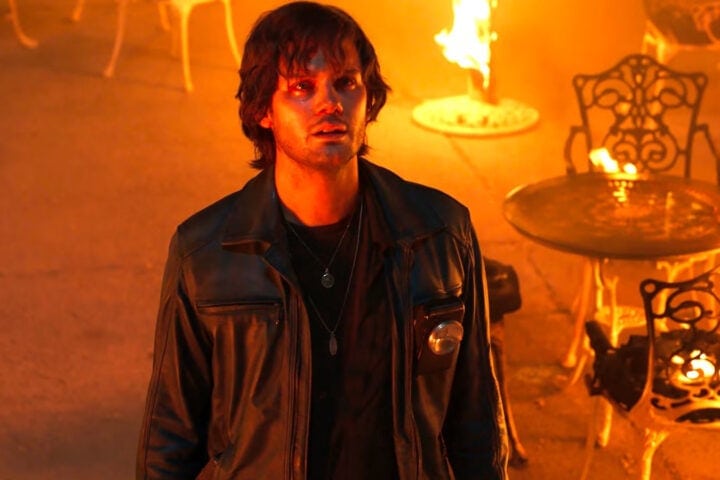
In a signature Davies touch, this middle portion of Sassoon’s life is inaugurated by a surrealist representation of the gunshot that took him entirely out of military service—a metaphorical shock to an until then restrained system. As Sassoon’s star rises, so do his prestigious confidantes and accompanying sexploits. His male lovers include Ivor Novello (Jeremy Irvine), the severely handsome Welsh actor who would star in Alfred Hitchcock’s The Lodger, and Stephen Tennant (Calam Lynch), a whirling dervish of a socialite. To a tee, these partners prove catty and cruel. One of them quips, when comparing Sassoon’s current poetry to his earlier efforts, that his work has moved from “the sublime to the meticulous.”

Prior Davies films like The House of Mirth and A Quiet Passion have dissected this kind of verbal mordancy, pinpointing it as an outgrowth of repression and oppression. And it’s particularly potent here since Benediction’s middle stretch is made up of almost nothing but repartee and putdowns. These young men mask their pain with badinage that’s humorous in small doses yet becomes dehumanizing as an all-hours way of life. The tragedy is that they don’t recognize the toll it’s taking. Two of the most powerful moments here involve the digital morphing of characters into their older selves, beauty collapsing alongside space and time.
Such evocative temporal transitions are a hallmark of Davies’s work, though Benediction’s high-def look takes getting used to. Cinematographer Nicola Daley often goes for a harsh flatness that initially seems at odds with what one expects in a Davies film. There’s purpose in this approach, though, as Sassoon and his gay coterie are mostly moving in shadows internally. The world outside is, by contrast, brightly, glaringly lit, its every feature apparent, whether beautiful or ugly, exalted or debased. There’s nowhere to hide. The only option is to deflect.
An existence like this breeds resentment, though Sassoon finds something temporarily peaceable in his eventual courting of and marriage to a woman, Hester Gatty, played at different ages by Kate Phillips and Gemma Jones. The couple have a son and settle into a kind of faux domestic bliss that at least provides the illusion of normalcy. But it’s still a fantasy, a delusion shattered as Benediction slowly winds its way to its profoundly upsetting endpoint.
In one memorable moment, Capaldi gives good rage as Sassoon rails against ’60s rock ‘n’ roll much as Davies himself did the Beatles in the prickly cine-memoir Of Time and the City. Mostly though, he seethes in silence, his wrinkled face and frenzied eyes a death-mask tribute to something lost. Since time is a fluid thing in Davies’s work, Sassoon’s deprivation is revealed through one final temporal collapse as his elder self dissolves into his younger one, and a poem that isn’t his own is read in voiceover. It’s at this juxtaposed point that Sassoon realizes who he truly is and, as his tears flow endlessly, that life has already passed him by.
Since 2001, we've brought you uncompromising, candid takes on the world of film, music, television, video games, theater, and more. Independently owned and operated publications like Slant have been hit hard in recent years, but we’re committed to keeping our content free and accessible—meaning no paywalls or fees.
If you like what we do, please consider subscribing to our Patreon or making a donation.