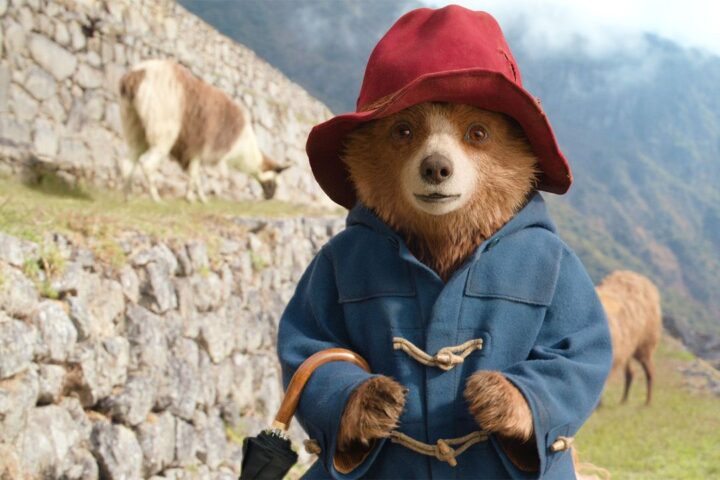
Ben Whishaw has stealthily become one of Britain’s most prominent actors, offering kind aphorisms as the voice of Paddington Bear and issuing intelligent retorts as the latest incarnation of Q in the James Bond series. But a deeper look at his filmography over more than two decades reveals a much more varied body of work. From the meek gentility of Women Talking to the brutal physicality of Surge, from playing with the iconography of Bob Dylan in Todd Haynes’s I’m Not There to committing to the absurdist antics of Yorgos Lanthimos’s The Lobster, Whishaw knows how to surprise in any register.
The actor gets one of his most compelling showcases to date in Ira Sachs’s Passages. As the graphic artist Martin, he’s one corner of an emerging love triangle between his husband, the film director Tomas (an electric Franz Rogowski), and the Parisian schoolteacher Agathe (a scintillating Adèle Exarchopoulos). More than any member of the trio, Whishaw best embodies the simmering, seductive, and ultimately sincere texture of Sachs’s film. He stews in the interiority of his character’s confusion and anguish without ever becoming a passive presence in Passages, a formidable feat given the volcanic ego of his mercurial screen partner.
In an interview conducted prior to the SAG-AFTRA strike, I spoke with Whishaw about the process and passion that went into the making of Passages. Our talk covered the challenges of not playing subtext, acting everyday emotions, and relaxing into the film’s sensual scenes.
When you were a guest on the What I Love podcast back in 2020, you discussed PJ Harvey’s “The Garden,” a tale of yearning and love and knowledge between two men, as a piece of culture you keep coming back to. Did you locate any of the same intrigue in Passages, which Ira Sachs has said became a priority during the pandemic because of that same spirit of tempting intimacy and desire?
I hadn’t made a connection with that particular song, really, although I just love that song so much. It’s so deeply a part of my life, it’s kind of in everything. I am interested in those things: desire, longing, sex, what people get up to at night. These are great things to make films about and really rich things to explore. I don’t find them trivial or small things. I find them profound. I think that they contain everything, actually. They tell us a lot about how the world is. Intimate things reveal a lot about the way the world is on a larger scale.
I saw you perform in the play Mojo on the same stage where you recorded that episode. Your character, Baby, has a volcanic temper that can flare up in an instant, whereas Martin in Passages simmers in his anger and resentment. Process can be mysterious and vague, but are you able to pull from the same toolkit to explore similar emotions in different registers?
My feeling is that the character tells you what it needs to be. Somehow, it always seems to be the case that you and the character have to be the same thing, when it comes down to it. You have to merge. I guess it’s coming from the same place. It’s coming from me and the writing, I think. Film is also a place where you don’t have to do so much to convey a huge amount of feeling, and I love the economy and intrigue of that. That was part of the way we explored this particular character, the intimacy of it. Also, Ira’s taste, he doesn’t want anything to be acted or demonstrated. He likes the everydayness of things, how people actually behave in everyday life.
Ira has described tailoring the roles in Passages to the actors for that very reason. Does that require you to abandon your technique altogether or just adapt it?
I would hope to work like this always, but you don’t want to be doing anything that draws attention to the fact that you’re acting. I know that’s such an obvious thing to say, but he particularly is hard on it. He really doesn’t want to see anything that you’ve prepared. He just wants you to be there with the other person, listening and just being present. I can’t talk about it in a way that doesn’t sound so cliché. I think it’s the way Ira makes you feel. He sees through bullshit. You have to just give him the truth, which you would always want to do, of course. But he’s got a laser-like focus, and he’s also very economical himself in the way he talks about the project and the character. There’s this cutting to the bone and getting to important things.
Does that affect the way that you try to get into the headspace of this character? As an actor, are you still figuring it out even if Ira doesn’t necessarily want to see it displayed on screen?
He just doesn’t talk about it because he doesn’t want it to be acted. He doesn’t want it to be demonstrated to the audience. But I think the films are full of subtext. It’s all about what’s not being said, or contradictory or conflicted feelings, or lying or manipulating or concealing. I think that’s all going on, but if you talked about it, you would start to act it and show it, perhaps.
Franz Rogowski noted that the film feels much shorter than what you shot because Ira pruned it down to the bare minimum needed for each scene. Even if this was all he needed to convey it for an audience, was it still valuable to perform it all?
Oh yeah. Of course, you don’t know in the moment that those scenes will not be in the film or that that moment won’t be important. And I don’t think Ira knows that in the moment. He’s gathering material. It’s like you’re creating real-life moments. He’s interested in the unexpected things that happen, and then he selects those things rather than the things that were planned. Something like that happen, and the process like that goes on.
Did it surprise you to see the moments that Ira found important?
I was surprised by how much he could do with so little. The dialogue is pretty sparse. Another kind of film I think would digress a bit more. It could be so much chattier and more expositional. There’s really none of that happening. I was amazed that he could pare it down and it would still hold. But it was so amazing and cool that he did that.
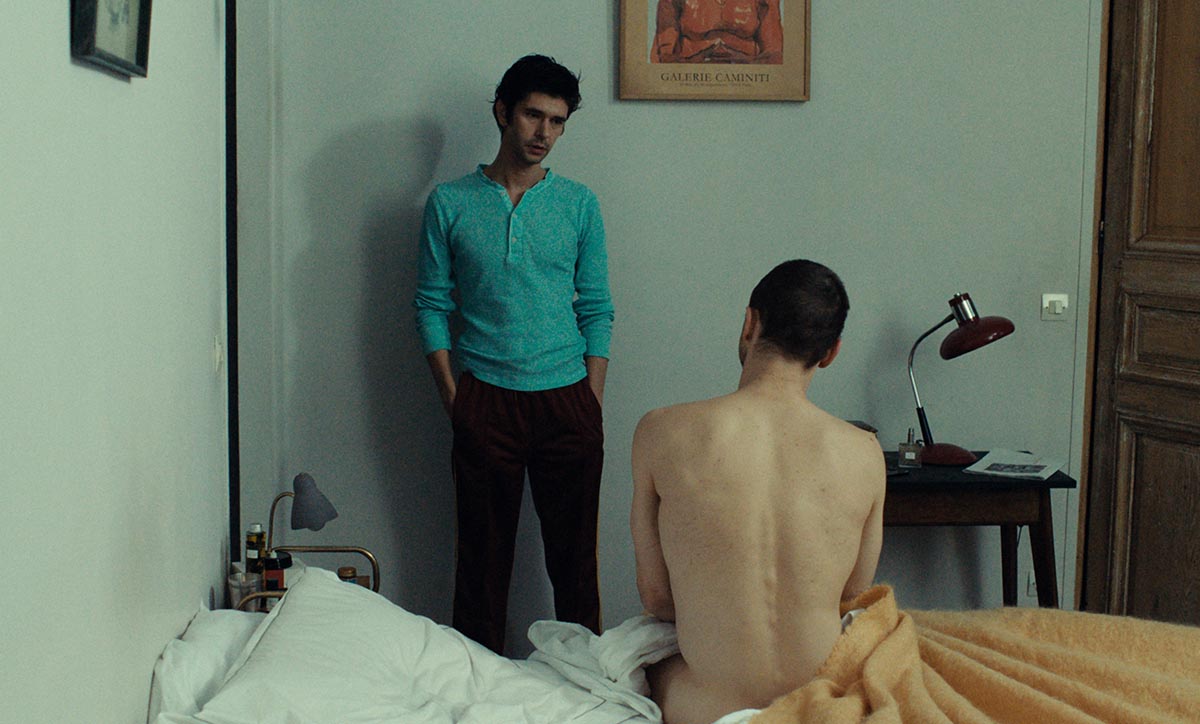
Did you come away with a different understanding of the film, especially Tomas, after seeing the moments that your character could only experience secondhand?
It’s weird, although the film isn’t exactly what it was in the script, it’s still somehow exactly the film that I imagined it would be. We all spent a lot of time with each other talking, hanging out, and just being together. I think there’s a process that happens when everyone’s unconsciously edging closer to the characters they’re playing and the dynamics of the characters’ relationship. It was very much in the air. Maybe it wasn’t so clear there was that much difference between Franz and his character—of course, there is. He’s not like that! But there’s a merging that definitely happened because of the way Ira set up the whole process.
Was there something different or unique about building a rapport with Franz given that his background is in dance and choreography? So many of his collaborators note that he’s in touch with his physicality in such a distinct way.
He had a real awareness of the frame that he was going to be in, his body within that frame, and the meaning of his body in that frame. When I asked him about the dance thing, he doesn’t make big claims for him for himself in that regard. But I do think it’s informed something about the way he thinks. In a way, it could sound like it’s an outside-in process, but it’s not quite that either. It’s not quite a technical thing of, “If I look here, or move my body this way, or do this with my face,” but there’s a bit of that. There’s an awareness that’s very hard to explain. I think there’s also a whole other layer of magic which is just indefinable.
Was his having that awareness helpful in terms of creating blocking for you all those characters that feels both very natural and composed?
I’m sure this is a bad thing on my part, but I very rarely think about that. I don’t even really want to know where the camera is. I just want to be in the scene. I feel that would make me self-conscious. But Ira didn’t require that you work in any particular way. He just wanted you to be the way you were and to be real and simple. His big thing was always, “You’re pre-empting what’s going to be said. You don’t know. Listen again.” I didn’t think too much about the composition. Although when I watched the film for the first time, I was really startled and in love with the beauty and the unusual nature of the compositions and how expressive they are.
Was Franz’s eye for composition helpful at all during the extended sex scene given that it was lightly scripted? You’ve both talked about it casually, but there are so many story beats within that scene just from body movement alone.
It just said: “Tomas comes into the bedroom, he undresses, they make love.” It was the shortest scene in the whole script. It’s not the only scene that’s like this, but it was like an improvisation in the sense that we didn’t know how it would go. It was discovered in the moment, and Ira let it just play out more or less in real time. I was like, “Wow, this is going on a long time!” But then I just sort of relaxed into it, and cool, we’re just like filming this like these two people are having sex. This is the length of the sex that they’re having. That was great. It felt completely essential to the story. Not gratuitous or exploitative or anything else like that. I always think that, of course, there should be a sex scene if you’re discussing intimacy between a long-term couple. It seems to me such an important part of life. I thought it was really important, and I think Franz felt the same. We were all adults who really liked—I think loved—and trusted each other.
It’s my understanding that you weren’t rehearsing any scenes with Ira. Did that give you something like a secret or an intimacy with Franz and Adèle that was helpful for creating an authentic relationship for Ira to capture with the camera?
Yes, I think that might be true. We didn’t rehearse, me and Franz. And we didn’t rehearse on the set with Ira. But I think as Ira’s said a lot, you often do a lot of takes. You’re finding it as you go, but his preference is to start shooting. And, actually, I love that. And I don’t know, what can you say? It’s one of those things, there was just a really beautiful dynamic between me and Franz. I can’t speak for him, but I just loved working with him. There was a love between us of some kind that was real. In a way, you’re right. It was a bit observational of just letting something happen.
Since 2001, we've brought you uncompromising, candid takes on the world of film, music, television, video games, theater, and more. Independently owned and operated publications like Slant have been hit hard in recent years, but we’re committed to keeping our content free and accessible—meaning no paywalls or fees.
If you like what we do, please consider subscribing to our Patreon or making a donation.