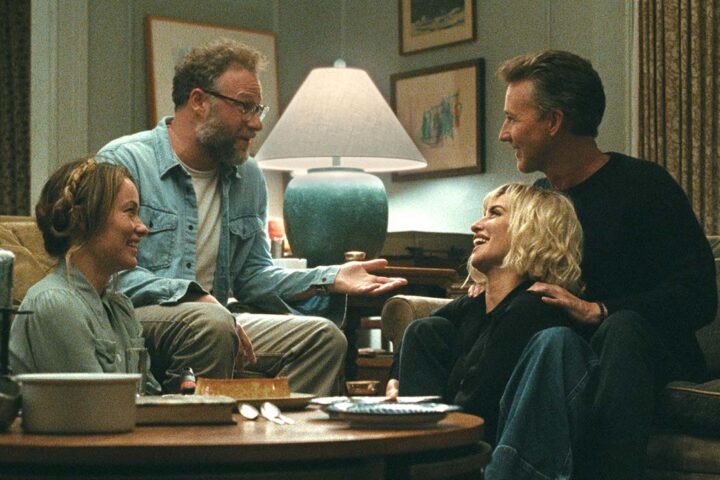
A dryly comedic bricolage of mid-century Americana and postwar anxieties with only the lightest dusting of plot, the 1950s-set Asteroid City finds Wes Anderson moving even closer to cultural curation and further from sustained storytelling. Still, the filmmaker’s gift for wringing laughs out of absurdity played straight is matched by few. That much is clear from the moment he drops an assortment of characters into the remote, alien-obsessed desert town of Asteroid City, whose attributes—from its proximity to an atomic testing facility to the stiff-necked soldiers milling about—provide numerous opportunities for funny weirdness.
The closest that Asteroid City has to a protagonist is Augie Steenbeck (Jason Schwartzman), a somnolent war photographer whose wife died three weeks earlier. The man was too depressed to tell his kids about the loss until weeks later when a car breakdown strands the family in the titular city, where twin romances break through the Steenbeck clan’s gloom.
Augie finds kinship in Midge (Scarlett Johansson), a Hollywood star whose icy hauteur keeps her from coming across as the Marilyn Monroe type that her bombshell styling suggests, while his anxiously nerdy son, Woodrow (Jake Ryan), crushes on Midge’s more confidently nerdy daughter, Dinah (Grace Edwards), who’S also set to receive an award at a science convention. Both pairings perform a stiff, nervous courtship primarily composed of each person slowly revealing their inner thoughts and fears to the other in a series of straight-faced declarations whose monotone delivery is played both humorously and with a hint of Jarmuschian bleakness.
Asteroid City’s characters, which also includes an Army general (Jeffrey Wright) whose speeches suggest quasi-beatnik performance art, a worrywart scientist (Tilda Swinton), and a motel manager (Steve Carell) who may be a real estate swindler, barely bat an eye at the absurdities that ripple through their world. The film’s finest running gag, a police car and motorcycle chasing a hot rod for seemingly days on end, suggests an unseen blip in their lives.
The film’s big event, though, does at least briefly focus some of their attention: Gathered at Asteroid City’s namesake attraction, a crater formed 5,000 years ago by a meteorite landing, they witness an alien drop down from a spaceship to retrieve the meteorite. It’s a wondrous sequence, from the ship’s nonthreatening beauty to the terrified-looking alien’s lithe, Henry Selick-esque gracefulness. The aftermath, though, is largely an excuse for a military-imposed quarantine that keeps everyone stuck in Asteroid City for the remainder of the film.
Like The French Dispatch, Asteroid City is frequently in danger of getting lost in its own manicured world and dense cultural riffing. And that’s by design: While the primary setting of the film lets Anderson play with mainstream 1950s signifiers—cowboy western iconography, starchily preppy clothing, boxy suburban landscaping, boozy and emotionally remote parents—he sticks all that inside a framework hailing from an alternate aspect of the same decade.
The framing device imagines everything happening in Asteroid City as a television play by a writer, Conrad Earp (Edward Norton), who has comedically grand rationale for the silliness of his work. The sections about the making of the play—presented in a square black-and-white TV ratio, narrated by a stupendously self-serious host (Bryan Cranston), and centered on a director, Schubert Green (Adrien Brody), possessed of a comedically virile intensity—serve as a mini-satire of the period’s Stella Adler-Playhouse 90 style of theater and internalized acting.
This isn’t the first, and definitely will not be the last, Anderson film to create a world that looks like an absolutely smashing place to hang out in but where few recognizably human characters reside. Though theoretically a desert town, Asteroid City is a place where nobody sweats, the neatly laid out tiny homes are designed just so, and the vending machines sell everything from parcels of real estate to martinis with fresh-cut lemon peels. But life in yet another Andersonian dream world also means people as muffled as the design and gags are impeccably sharp. In one of the title cards announcing the play’s acts, the on-screen stage directions read “to be played relentlessly, without a break.” Asteroid City should have followed that instruction.
Since 2001, we've brought you uncompromising, candid takes on the world of film, music, television, video games, theater, and more. Independently owned and operated publications like Slant have been hit hard in recent years, but we’re committed to keeping our content free and accessible—meaning no paywalls or fees.
If you like what we do, please consider subscribing to our Patreon or making a donation.