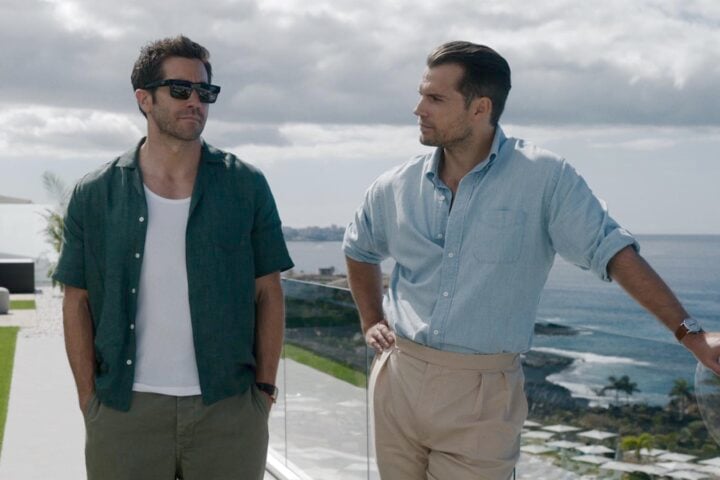
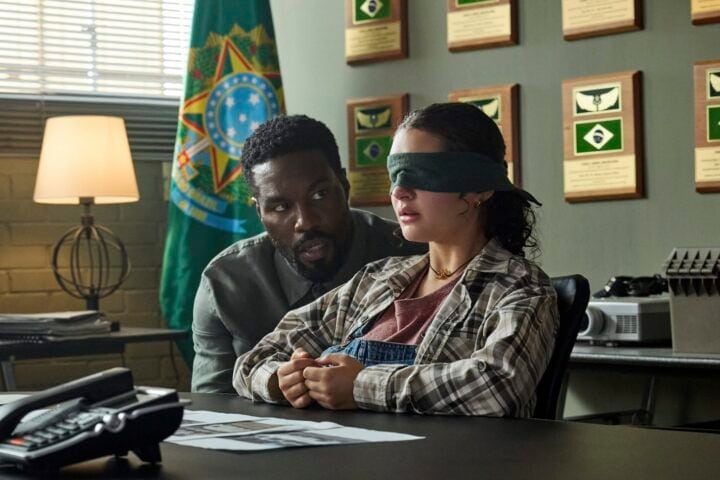
We don’t stop!” screams career criminal Danny Sharp (Jake Gyllenhaal) to the LAPD officer, Captain Monroe (Garret Dillahunt), who’s been pursuing him since a bank robbery went all sorts of wrong earlier that afternoon. While Danny is talking about the titular vehicle that he and his adopted brother, Will (Yahya Abdul-Mateen II), hijacked in order to use as a makeshift getaway, his declaration could just as easily double as Ambulance’s mission statement from director Michael Bay.
Bay’s filmmaking has always been defined by its stylistic excess, from rapid-fire editing to swish pans to highly saturated colors. Ambulance certainly offers more of the same in that department, as we get swirling drone shots that dive down the edge of skyscrapers for no other reason than it looks cool, and pointless money shots of American flags at magic hour.
But for all its frenetic and overindulgent flourishes, the film’s stripped-down narrative allows for an emotional intimacy and vulnerability between characters that Bay typically eschews, mocks, or merely aestheticizes. Indeed, Ambulance builds tension and pathos not only through its central, seemingly endless, car chase, but through the ever-shifting dynamic that develops between Danny, Will, and Cam (Eiza González), the paramedic who they’ve taken hostage. Within the ambulance’s tight quarters, Danny’s unusual blend of ruthlessness and empathy bounces off of Will’s unbending pragmatism and Cam’s steely resolve in the face of danger in surprising ways, especially as they figure out what to do with the second hostage, Officer Parker (Jackson White), who’s bleeding out in the back of the vehicle.
It’s probably giving Bay too much credit to suggest that he’s grappling with the fascist tendencies of his earlier work, especially since Ambulance’s gleeful flashes of self-awareness are mostly just ego-flattering references to his past work and acknowledgements of his need for speed. (“It’s a very expensive car chase right now,” says a police officer played by Olivia Stambouliah after several police cars have been smashed to bits.) But Will’s wrestling with the costs of his actions still feels like a step forward for the filmmaker, whose chase scenes in Bad Boys II show a casual indifference to human life that remains shocking to this day.
Taking its lead from literal “non-stop” action films like Speed and The Taking of Pelham One Two Three, Ambulance is ultimately too breakneck in its pacing to contemplate much at all. And while Bay’s work has rarely left much room for thought, that becomes something of a strength here, as the film’s jumpy, jagged editing and jolting camera moves perfectly encapsulate Danny, Will, and Monroe’s anxiety over being forced to constantly make split-second, life-or-death decisions as the ambulance speeds its way through Los Angeles.
As the film moves rhythmically between exterior and interior spaces, it allows for a compelling interplay between the big, chaotic action set pieces we’ve come to expect from Bay and the drama playing out inside the ambulance. For Will and Danny, keeping Parker alive means that they get to have a bargaining chip, which helps raise the stakes in a particularly gruesome scene where the underqualified Cam must slice open Parker’s stomach to remove a bullet. It’s one of the most gripping and nerve-wracking scenes of Bay’s career, especially because there’s a weight to the depiction of these lives on the brink of the void, and to Danny’s sense of self-preservation clashing with Will’s desire to minimize the carnage of their escapades.
Ambulance touches a number of themes, from the healthcare system and veteran care to fraternal loyalty and honor among thieves. But at its essence, it’s primarily about motion and inertia, both in the mostly unbroken movement of its characters through the city and in the manner in which Will’s initially minor step back into the world of crime, after decades away, becomes an irrevocable decision that sends him on a downward spiral.
The disorienting speed with which one bad decision can snowball out of control becomes the film’s ultimate raison d’etre. Answering Danny’s question about why he left home to join the Army, Will tells him, “It gave me purpose.” The same could be said of Bay and Chris Fedak’s screenplay for Ambulance, as the former’s frenzied stylistic tics have rarely been so well-suited and effectively intertwined with the substance of one of his films.
Since 2001, we've brought you uncompromising, candid takes on the world of film, music, television, video games, theater, and more. Independently owned and operated publications like Slant have been hit hard in recent years, but we’re committed to keeping our content free and accessible—meaning no paywalls or fees.
If you like what we do, please consider subscribing to our Patreon or making a donation.