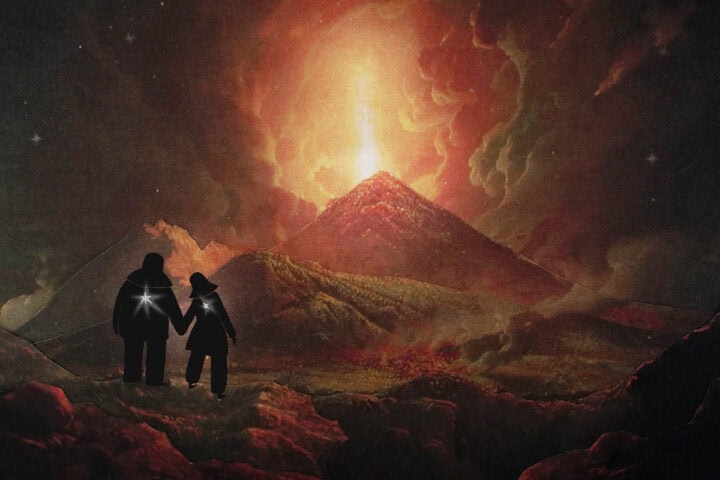
Natural phenomena are inexhaustible reservoirs of metaphors for human emotions because, say, tornadoes, earthquakes, and volcanic eruptions are part of our worldly experience. In Fire of Love, director Sara Dosa skillfully navigates between the treatment of nature as a romantic symbol of love and as a catalyst for contemplating our relationship to the earth, including our inevitable return to it as dust and ash.
Narrated by the soft, lightly cracking voice of Miranda July, Fire of Love consists almost entirely of archival footage shot by volcanologists Katia and Maurice Krafft throughout their careers. Spouses and lifelong collaborators, the Kraffts died together in 1991 while documenting the eruption of Mount Unzen in Japan. (Their story is of a Herzogian kind and, indeed, the Kraffts were briefly profiled in Herzog’s 2016 documentary Into the Inferno.) The documentary opens with some of their last footage and circles back to their final documented moments of life. There, we see at a distance the couple standing in front of Mount Unzen just before the blast with all the unfazed boldness of professionally reckless volcano scientists.
July’s narration then takes us back through the extensively documented lives of the Kraffts, who as a pair might be described as the Jacques Costeaus of vulcanology. Publishing books, doing media tours, and establishing their personas as a somewhat quirky husband-wife duo in an esoteric and inherently dangerous field of research, the Kraffts flirted with mainstream fame (at least in France) at the moment that the study of volcanoes took off.
Fire of Love presents their mutual attraction to volcanoes and each other as being formed not only by their shared memories of life in Strasbourg—atop a fault line whose shifting destroyed Basel, Switzerland, in 1356—but also by the crucible of the Second World War. Strasbourg lies in Alsace, coal-rich territory whose possession was long at the core of the Germany-French tension that exploded into violence over and over again in the 19th and 20th centuries.
Twice in Fire of Love, the unpredictable chaos of volcanic activity is compared to the destruction of war: First we’re shown glimpses of a city in ruins after WWII and, later, a smash cut brings us from the smoke rising from a rumbling volcano to a bomb being dropped over North Vietnam. One of the earliest images of the Kraffts together, it turns out, is from a front-page photo in a 1967 issue of L’Humanité taken during an anti-war protest in Paris. The intersection of and correspondence between geological and geopolitical history pops up again in Maurice’s assertion on French television, included later in the documentary, that he wants to live “a kamikaze existence in the volcanic beauty of things.”
And, indeed, the Kraffts often veer nail-bitingly close to danger in the old-school, platter-scratched footage that Dosa presents to us. To wit: At various points, Maurice goes paddle-boating on an acidic lake and professes his dream to go canoeing on a stream of lava. But the couple’s cool attitude toward danger doesn’t bespeak a general indifference toward death, because while in their early career they focus on the burning-hot but relatively mild “red” volcanoes, their work in the ’80s proved to be focused on studying “gray” ones—to try to prevent their much more devastating impact on human populations.
Just as the Kraffts pivot from a largely romantic view of volcanoes, so does Fire of Love slide from a coy exploration of volcanoes as metaphors for passion (fire) and both coupling and dividing (tectonic plates) to a less playful consideration of humans’ dichotomous relationship to nature. The world, as exemplified in lava as destroyer of life and creator of land, is both sustaining and endangering, sublimely beautiful and abjectly horrifying.
Such juxtapositions abound throughout Fire of Love, as in the ones between red and gray volcanoes, and those between Maurice the television personality and Katia the writer. The title image, taken from one of the Kraffts’ documentaries, shows a lava flow breaking apart, a jagged orange-colored rift cutting through the dark, partially hardened lava in the center of the pane. The image is at once lovely and ominous. That’s Dosa’s documentary in a nutshell, which oscillates between being playfully on the nose and existentially profound with the confidence of a volcano chaser surfing on a river of lava.
Since 2001, we've brought you uncompromising, candid takes on the world of film, music, television, video games, theater, and more. Independently owned and operated publications like Slant have been hit hard in recent years, but we’re committed to keeping our content free and accessible—meaning no paywalls or fees.
If you like what we do, please consider subscribing to our Patreon or making a donation.