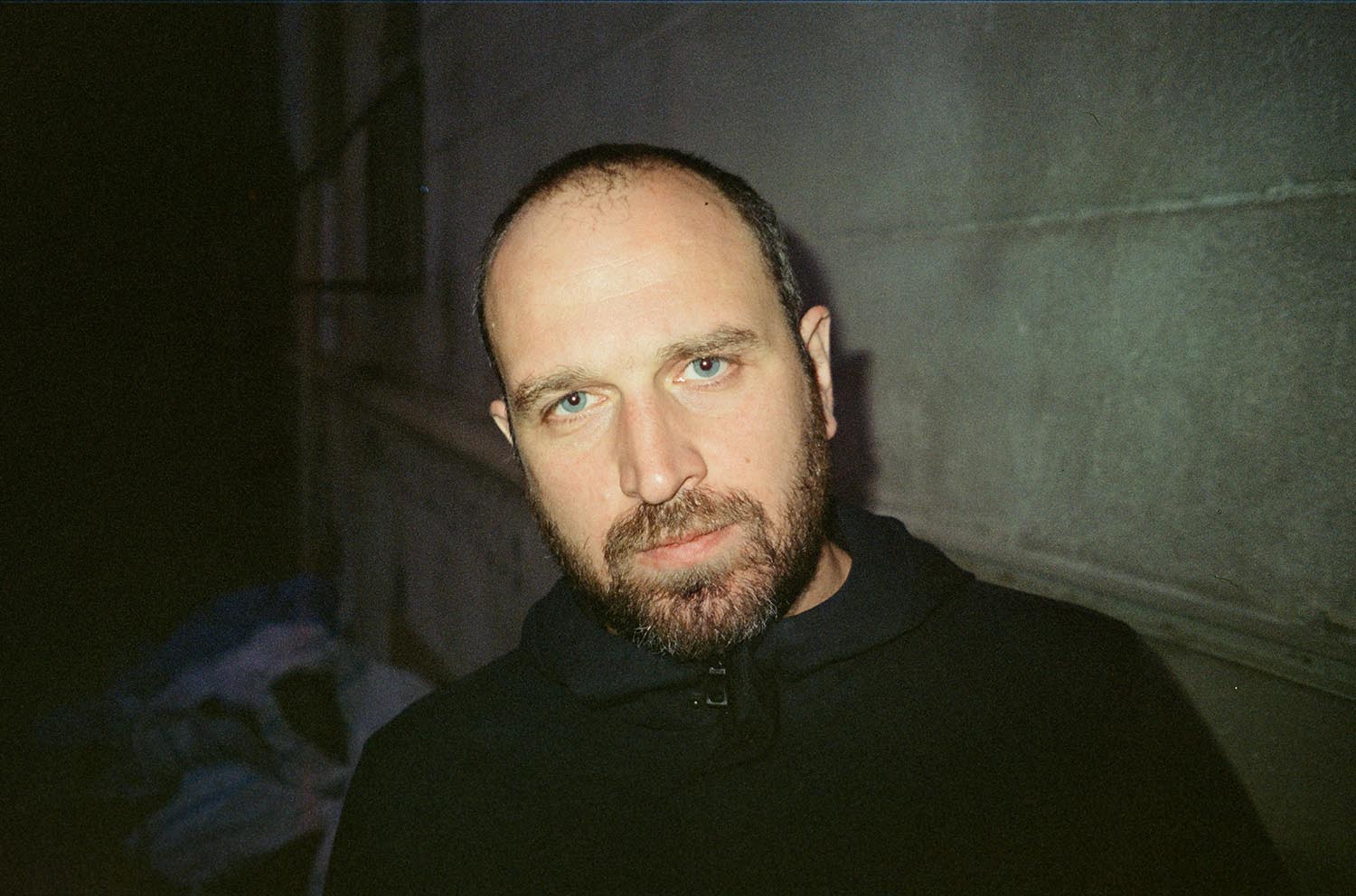
“I don’t know what the other guys are doing, but I’m preparing,” said Alexandre Koberidze about an unconventional but apt stop on the promo tour for Dry Leaf. In New York City, the Georgian director will face off against Christian Petzold in a football match—soccer, to us Americans—just blocks away from where their films will open at Film at Lincoln Center. “Tomorrow, I start to train seriously,” he added, declining to speculate on the outcome.
But on this day, we’re chatting over Zoom about his third feature and its many ties to football. Dry Leaf refers to a term from the sport in which a kick sends the ball skyward in such fashion that its landing becomes unpredictable. The title appropriately describes Koberidze’s existential road movie in which Irakli (played by David Koberidze, the director’s father) chases his missing daughter, Lisa, a sports photographer, by following the path of sites her lens has captured. The winding pursuit through the Georgian countryside frequently takes him to many a football field that has seen better days as a central locus of community recreation.
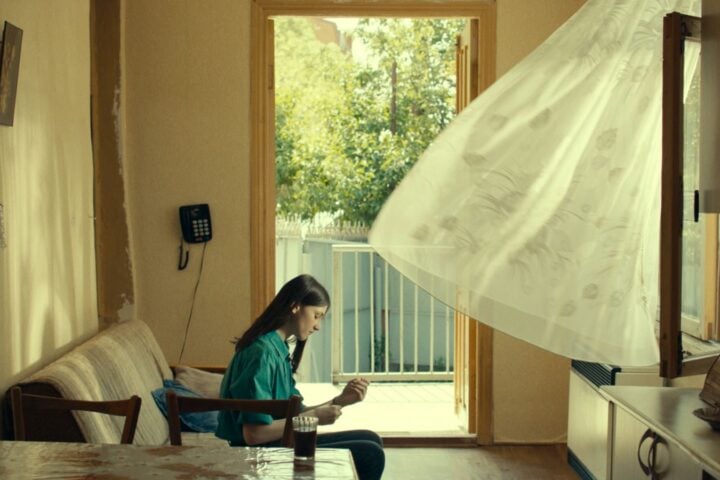
The 186-minute film exemplifies the well-known truism that the journey is more important than the destination. Koberidze shot Dry Leaf on an old Sony Ericsson phone, which renders the images with such a pixelated resolution that the film begins to resemble a digital pointillist painting in motion. The unique image-making style places viewers in a position akin to Irakli himself trying to make sense of an absent presence through a series of images left behind.
Much of my interview with Koberidze revolved around his camera of choice and how that guided the making of Dry Leaf, both practically and philosophically. But our conversation also covered why he’s fascinated by pixelated images and where he finds the rhythm of his work.
Do you feel there’s a connection between football and cinema?
I think there are many layers where these two things [are connected]. But I think everything is somehow connected. You can watch films, and you can watch football. The other thing is to make films and to play football. For me, all four of these sites are very interesting. I love all of them, but in these four, for me, playing football is the thing that pleases me the most. But I do it the least because my friends are lazy, and you need other people to play football.
But I think there are so many connections on the level of doing it. If you watch good players, like Messi, he sometimes makes things without knowing how they happened later. How he’s getting these limbo moments when he creates a miracle in front of the whole world is the most interesting thing for me to see. I think this is exactly the state of mind that any artist tries to tap into to create something, which is unpredictable and was not known before. There’s a similarity of getting into a rhythm and a state of mind where you unconsciously, in a glimpse of a second, create something which a short time before was not there.
The shoestring production of Dry Leaf was somewhat a response to working on a bigger scale in your last film, an environment in which you had to explain every change or decision. Is this, then, closer to a representation of your flow state?
In sports, you always have someone against you. These kinds of moments are often born in moments of tension. You can’t just take a ball, go outside, and make something incredible. You need someone. When you create something in art, this kind of tension mainly has to happen inside you. They’re more private things, but also, the things that happen outside help a lot. In both ways of making films, there are different kinds of tensions. Dry Leaf was different because, as you mentioned, there was no one to tell you not to do something. I could act really intuitively. But then, there’s this very strong inner tension because when you’re alone, different parts of yourself start to talk with each other. Making decisions gets harder. If there are other people, and you have to deal with them, this is another kind of tension, which is very interesting.
In between your second and third features, you made a short that’s exactly what its title says: “The More I Zoom in on the Image of These Dogs, The Clearer it Becomes That They Are Related to the Stars.” Was this exploration into finding beauty inside the lack of clarity of digital images a longstanding interest?
In that film—if you can call it a film—I zoomed a lot digitally. For some editing programs, you can zoom endlessly, but with the one I was working on, you can zoom a thousand times. So you zoom until the end, then you export, and you zoom a thousand times again and again. It becomes a microscope to go one pixel deep. I did this in my first feature also, where I tried to connect places without editing, and the same in Dry Leaf and a short called “Linger on Some Pale Blue Dot.” That’s four films where I tried it out. In the short you mentioned, there’s no cut or change between spaces. In Dry Leaf, I use this zooming in as a possibility to travel somehow in space and time. If you zoom really, really deep, at some point, you’re in a place where nothing is concrete, and nothing is sharp. It’s almost like a black hole, and then you can come out in a completely other place. You are here, then you zoom, and then the image is so blurry that actually it can be anything. Then you zoom out and come out in New York or something.
Watching the film and decoding the frames reminded me of how I have to work to bring a depiction of reality in an impressionist painting into my perception of the world. Is that processing at all something you have in mind?
I think there are different layers, because the camera itself already offers the frame of how the image looks, even though you can change the white balance and the quality. What this camera has, and one of the reasons why I work with it, is this limitation you mentioned. It gives you only part of the information. I don’t know exactly how much, but maybe it’s 1/4 of what it should be. Maybe even less! The rest becomes a part to create for the spectator. That’s the same thing with visual arts. With pointillist painting as an example, from the right distance, a painting can really look like a photorealistic picture. If you go nearer, it’s just a collection of dots. That’s the trick with our brain: it fills the gaps. Whether you want it or not, it’s working.
Some people say that they struggle in the first 15 to 20 minutes, but at some point, you completely forget that the image isn’t as you expected it. Many people said that after some point, they don’t remember that the image was different than a high-definition image because the brain started to make it like this. It’s the same now with A.I. and new TVs, which make an image really sharp. Actually, it’s making us lazier because our brains will do this work anyway.
When I think about digital images, especially the A.I. slop flooding social media, the general direction is toward higher resolution and greater photorealism. Is there some element of swimming upstream against the cultural currents with Dry Leaf, or does shooting with the Sony Ericsson just an individual fascination?
I think it’s a mix of different things, but, of course, I’m trying to understand which films need which kind of visual. There can’t be a standard to say “this is how films should look, and everything you make should look like this.” At the beginning of the 20th century, when people started to paint abstract paintings, and then to have the industry demand from them to paint only photorealistic images, it would have completely killed the art we have today. For me, this is the same path as cinema. I think cinema is just much younger than other art forms, so it needs some time to go through these changes and find more layers. For sure, there can be a movie for which it’s really important to have 16K visuals, but it has to be a decision. It’s the most artificial way for a film to look, so you have to really know why.

Other films shot on phones, like Sean Baker’s Tangerine, try to disguise the presence of the camera through Steadicam rigs and anamorphic lens adapters. Dry Leaf doesn’t. What are your considerations for making the shooting instrument present for the viewer?
With Dry Leaf, [the camera] is so obvious. The only thing that was important for me was the use of a tripod. It would be very different if I were to hold it in my hand. There’s also how the camera works with light. For me, this is also the main source of beauty from the Sony Ericsson camera. I try to catch and work with light in Dry Leaf. It tries to catch [the light] all the time, and it always fails somehow because it’s not strong enough. For three hours, you have a constant battle in front of your eyes, even though maybe the setting or the stories aren’t so dramatic. You have this constant fighting between shadow, darkness, and light, which is kind of a drama itself.
That description makes me think of the story itself and how Irakli is always trying to find Lisa and arriving at these places that she’s been and seen but not catching her. Was that echo intentional or just a nice coincidence?
I didn’t think about it that precisely, I have to say. For me, the big question about films is where the difference is between a film and a collection of images with sound. It’s a big question for everyone, and I don’t think that there can be a precise answer to it. Every filmmaker has to decide for themselves. For me, one of the elements is to have some kind of a simple [story]—but still a story—in film. It’s not. But we know it’s not necessary, because we have other examples of when filmmakers work without having a story. These are amazing films, but it’s a very private thing what decision we make. I thought I really needed some frame, and this looking for a daughter is part of this story, which is crucial for me to call this work a film.
There’s an old truism about film as a visual medium, but your work challenges this primacy of the image through devices like shooting on the Sony Ericsson, having invisible characters, or even asking the audiences to close their eyes in What Do We See When We Look at the Sky? is this part of a bigger project?
Again, it’s a mix of different things. On one hand, [it’s] what we said in the beginning with Messi and the state of mind where things are visiting you, not necessarily in a conscious way. I think it’s a very interesting question of where ideas come from and how to track them. Sometimes, it’s possible to know, “Okay, this came from there because it happened like this.”
On the other hand, when you start to work, you try to find some methods, which are more conscious ways of working. But still, in my experience, I understand what really happened when the thing is finished. When the film is done, I think that’s where maybe there’s some chance to for me to see, “Okay, that’s where it all went.” After I made my first short, I somehow understood that it’s impossible to decide what to do and then land exactly there. There are filmmakers and artists who can aim, and I have big respect for them. But for me, somehow, I felt very free to understand that I can start with this idea but end somewhere else, and it’s okay. It’s still my work. I also believe that for a filmmaker or artist, it’s impossible to understand what the thing has really become. I hear different reactions, and every reaction tells me something completely different about what I made. There’s no truth, I think.
You don’t tend to favor close-ups in your shot variation, which works in your favor on a film like Dry Leaf because the image resolution of the camera doesn’t give you much nuance in the facial expressions. Does that affect the actors at all, needing to use more body language to convey something?
Filmmaking is so visual, and the cameras often see a lot, especially the new cameras. For me, the films I like always give me something precise about the things and people I see in an image, and, on the other hand, make it global. Every human in an image is this human, but also represents something more general. Not this very guy with his things, which only he has, but somehow to represent more. If I make something and it only tells my story, it can’t be interesting if you can’t generalize it. This balance is crucial on every level in the story, but also in the visuals. To go on this very thin line, to have someone who has a personality but also represents something more general, it’s easier to work more with silhouettes than with facial expressions. It gives much more space for interpretation, but also, it helps to generalize the work.
Rhythm is something you talk about a lot as being central to your films. Is that something you can plan for at the writing stage or something you have to feel and discover in production or editing?
Already in the writing, things get clearer now, but it depends. With my previous film, What Do We See When We Look at the Sky?, the moment when the rhythm was coming to life was when we were doing the storyboard. That’s where you can decide what kind of images you make and at least the rhythm of the editing. Because if you shot a scene and do only one angle, and if you don’t make other pickups, it means you’ll stay there, and your rhythm will be this.
But with Dry Leaf, I wasn’t working with storyboards, and it was the first time that I worked like this. So it was, as most everything else in this film, happening in the moment of doing. [I was] sometimes deciding we’ll leave the scene with one shot or one angle, or we’ll divide it in many little shots. But it’s always a subject of discussion with actors, how fast they should move in the frame or how realistic it should be. It has to do a lot with the amount of work you’ve done.
I get a feeling the more films I make, the more I will feel how the rhythm translates as you see it in a moment of shooting to what you see then later on the screen. There’s a difference, which is still somehow uncatchable for me. But it’s very interesting, this pace of things happening when you are shooting and think, “Okay, this is perfect rhythm.” And then, you see it later, and it’s different. This is what you what you learn with experience: to know what the ratio is.
I haven’t seen you discuss the film’s ending: that Irakli doesn’t ultimately find Lisa. But as her narration reminds us, they saw the same things, and “isn’t that a kind of togetherness too?” To some extent, I also think that’s a description of cinema, but what does it mean to you?
I think that’s more or less why I wrote this sentence and also left it in her letter. I thought that’s what she wants to explain to him, that even though maybe they are not together all the time, they share something. Things can be shared like this. It’s also a tribute to cinema, that we can stay in touch if we watch the same things.
Since 2001, we've brought you uncompromising, candid takes on the world of film, music, television, video games, theater, and more. Independently owned and operated publications like Slant have been hit hard in recent years, but we’re committed to keeping our content free and accessible—meaning no paywalls or fees.
If you like what we do, please consider subscribing to our Patreon or making a donation.