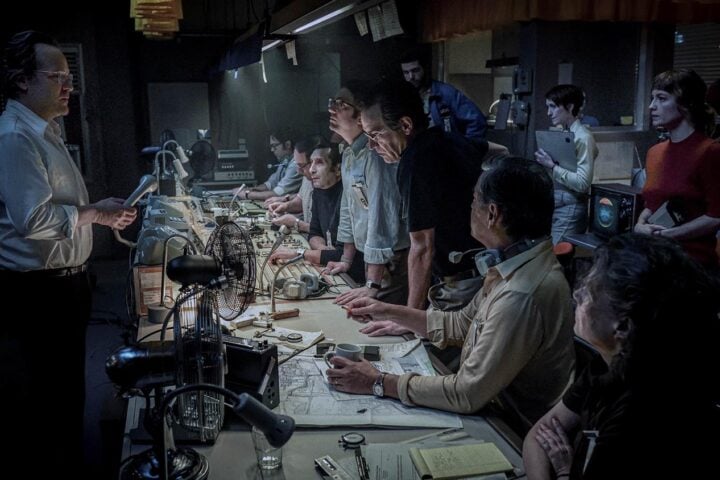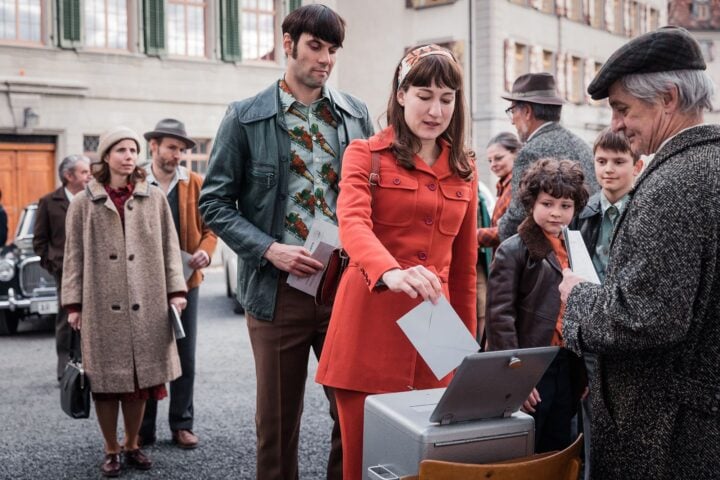
Petra Volpe’s Late Shift is the latest in a string of films that, taken together, announce the workplace thriller as a new subgenre. Often to captivating effect, these movies, like Eric Gavel’s Full Time, map the antic editing style of a Jason Bourne film onto the quotidian stresses of working-class jobs. The extent to which they furnish a real critique of working conditions (as opposed to capitalizing on them for cheap spectacle) varies. If Park Chan-wook’s No Other Choice and the Dardennes’ Two Days, One Night fall on the radical end of that spectrum by showing how employers pit non-union workers against each other, Late Shift takes a less politicized tack, depicting time and mortality, rather than class structures, as antagonists.
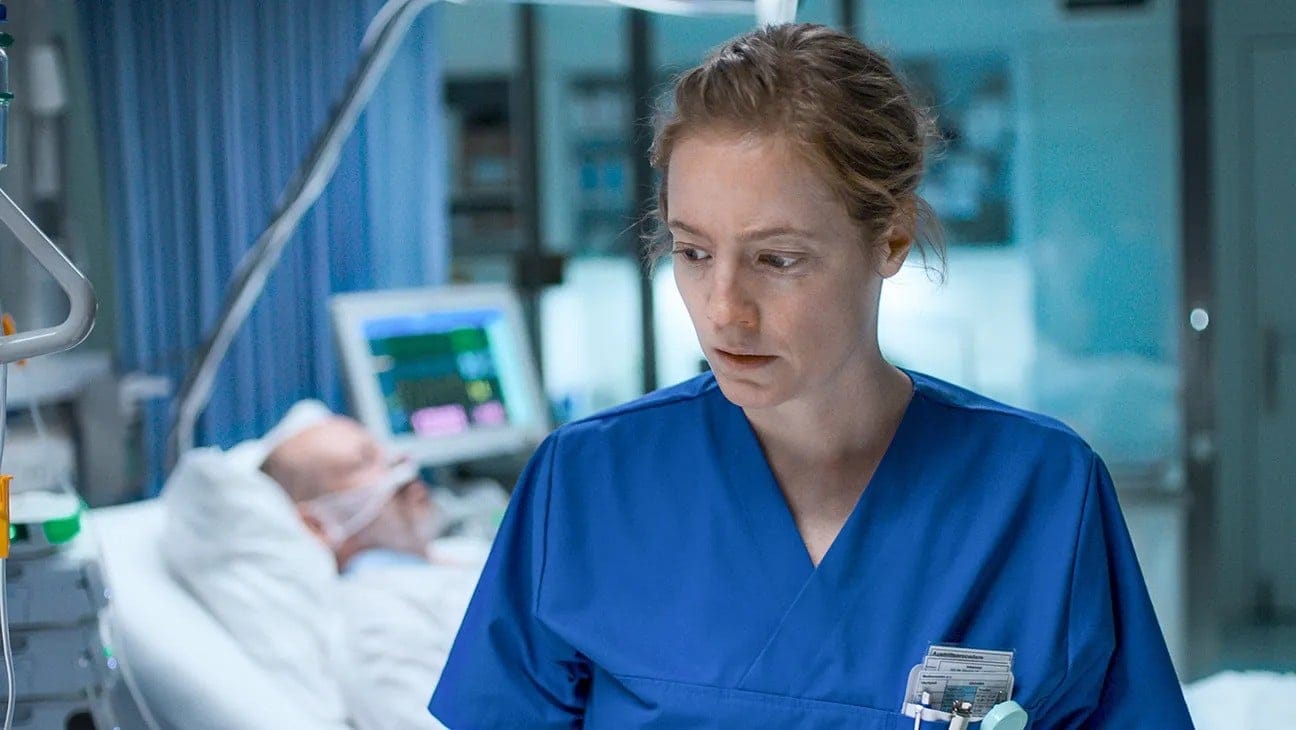
Volpe’s film follows a nurse, Floria (Leonie Benesch), over the course of a single shift in the cancer ward of an understaffed Swiss hospital. Making her rounds, she attends to the needs of various individuals, among them Mr. Severin (Jürg Plüss), an entitled entrepreneur, Mrs. Morina (Lale Yavas), a recalcitrant smoker, Mrs. Bilgin (Eva Fredholm), a dying mother to three adult sons, and Mr. Nana (Urbain Guiguemde), an immigrant from Burkina Faso.
Volpe’s empathetic script balances Floria’s perspective with those of her patients. Throughout, Floria slips in and out of multiple roles: servant, trainer to Amelie Afshar (Selma Jamal Aldin), friend, singer, confidant, athlete, priest, even philosopher, so that Benesch’s performance amounts to a commentary on labor as acting. The film’s gliding camerawork, interrupted at every turn by the editing, captures the tension of a competent person coming untethered under mounting strain. Though her personal life is barely alluded to, we learn that, on top of everything, Floria is divorced, and mother to a kid who doesn’t have much time for her.
The one strand that takes priority due to its placement at the climax is the conflict between Floria and the especially condescending Mr. Severin. After he times how long it takes for her to bring him a cup of peppermint tea with his €40,000 wristwatch, Floria, who’s had to deal with the death of Mrs. Bilgin, snaps and throws the watch out a window. Realizing that this could mean the loss of her job, she searches fruitlessly under the eye of Mrs. Morina who, angry with Floria for confiscating her cigarettes, offers no help. When she admits to Severin that she can’t find the watch and promises to pay him back (probably at the cost of lifelong debt), he unexpectedly tells her it doesn’t matter anyway, since he’s dying of pancreatic cancer.
At this point, Floria appears to have taught Mr. Severin a lesson about the nature of time, but this story of the wristwatch is also rich with thematic implications. Film and medicine both are industries in which time, like the watch, is astonishingly expensive. As a thriller, Late Shift wrings tension from the manipulation of time and the urgency of time limits. As a workplace drama, it necessarily involves the exchange of wages for hours of labor, even if the issue never comes up explicitly. Mr. Severin, in his high-status role as a businessman, is theoretically in control of time, accustomed not to waiting but being waited on. Floria’s lapse of professionalism reminds him that death comes to everyone regardless of wealth or status.
Some of these implications, though, are brushed aside when Mrs. Morina relents and gives the watch to Floria, who promptly returns it to its rightful owner. Despite Floria’s cathartic, rebellious moment, the status quo between nurse and patient, between worker and capitalist, is reestablished. This too-neat reconciliation identifies the film’s real antagonist as the time limit of death, rather than time as it is specifically structured under capitalism. Like the moral to a fairy tale, intertitles at the end warn of the looming global nurse shortage, but the film itself hasn’t gone far enough in diagnosing the root causes of the problem.
For all its empathy, Late Shift upholds the dubious virtue of self-sacrifice that underpins the Protestant work ethic. Instead of “let’s get organized,” the refrain is “we’ll manage somehow.” The film doesn’t ultimately upend the expectation that nurses be tireless “angels” (many characters refer to Floria as such), willing to sacrificing themselves no matter the cost, instead of ordinary flesh-and-blood people worthy of respect and decent working conditions.
Since 2001, we've brought you uncompromising, candid takes on the world of film, music, television, video games, theater, and more. Independently owned and operated publications like Slant have been hit hard in recent years, but we’re committed to keeping our content free and accessible—meaning no paywalls or fees.
If you like what we do, please consider subscribing to our Patreon or making a donation.