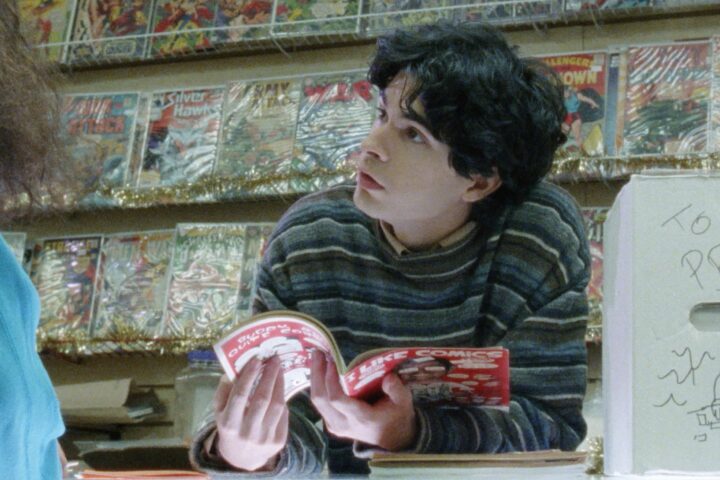
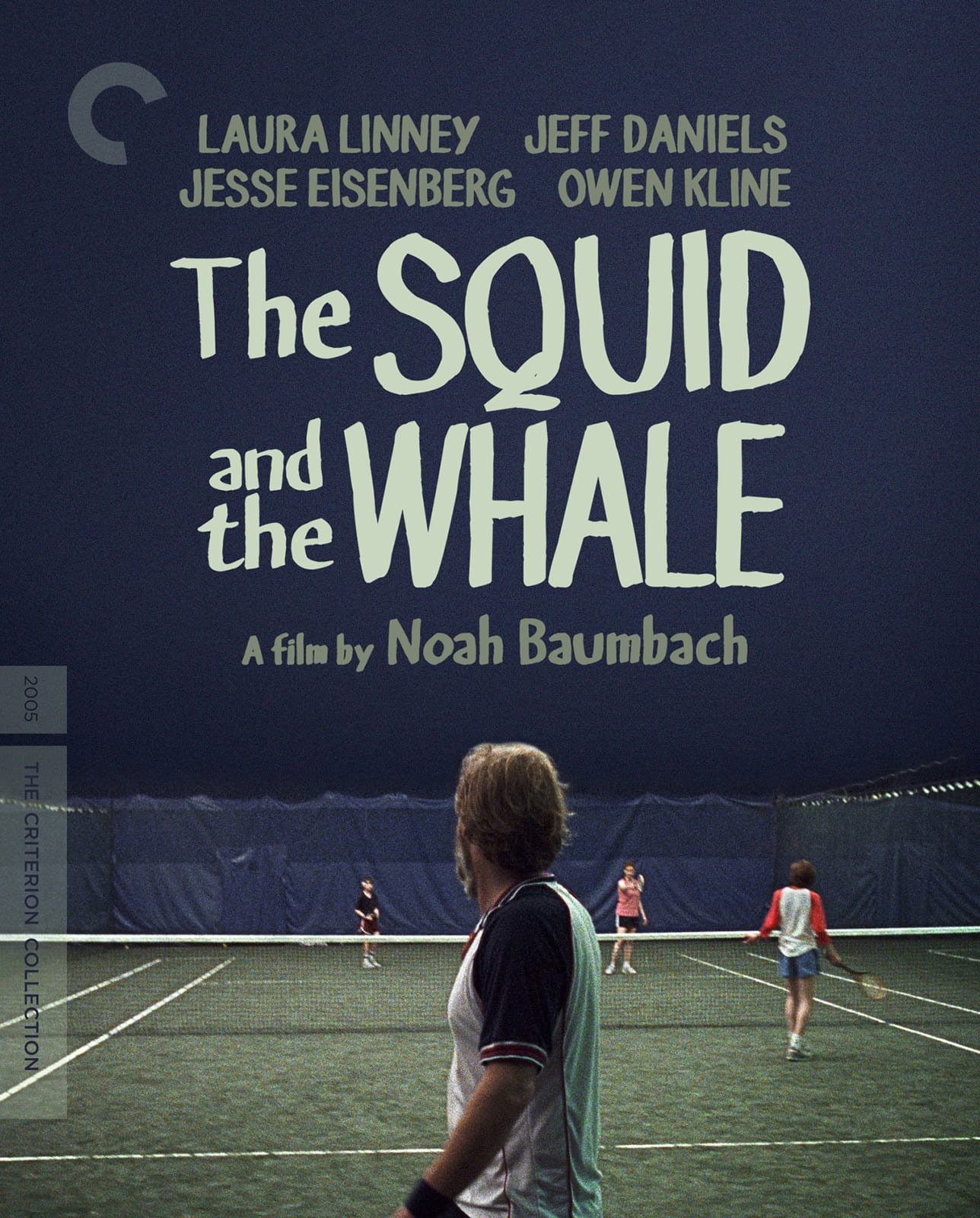
Though Owen Kline’s famous pedigree immediately presents itself in his surname, the more pertinent parentage to Funny Pages is that of New York City’s repertory cinema scene. Shortly after his performance in Noah Baumbach’s The Squid and the Whale drew considerable acclaim, Kline opted to pursue visual art rather than dive deeper into acting. Between curatorial work at Anthology Film Archives and his exploration of creating underground comic art, a unique sensibility emerged.
At the same time, Kline linked up with Ben and Josh Safdie—with whom he shared a formative high school teacher—as they began to cut their own unique path through the industry. Kline appeared in the Safdie brothers’ 2010 short film John’s Gone, and now the Safdies have returned the favor by executive-producing his feature-length directorial debut.
Funny Pages chronicles the misadventures of Robert (Daniel Zolghadri), a young aspiring comic artist looking to break free from his cloistered upbringing in Princeton, New Jersey, and have the sort of real experiences that he can then use in his drawings. This takes him to Trenton to apply his talents as a courtroom sketch artist, where he crosses paths with the wacky Wallace (Matthew Maher), a former employee of the comics industry. Kline’s film captures the scrappy, scuzzy, and ultimately sincere underbelly of the Tristate area, much like the Safdies do across their own work. But Funny Pages goes in its own uniquely, unexpected comedic direction with great inventiveness and introspection.
I spoke with Kline in the days prior to the theatrical release of Funny Pages. Our conversation covered his approach to curating two repertory programs in New York associated with the film, why he embraces archetypes in his approach to characterization, and how he crafted an uproarious comedy with no overt jokes.
I was just talking with a friend of mine who said she got you sorted out for access to the Sight & Sound greatest films of all time poll.
Oh yeah, that’s been a head-scratcher. I don’t even know number five. It’s a mess in my head.
So, Vertigo and Citizen Kane aren’t battling it out at the top of your ballot?
Well, I’m still trying to grasp the exercise. My favorite movies of all time I don’t necessarily think are the greatest of all time. They’re such a personal thing. I’m still figuring out what it exactly means to me, so I approached it in a pretty personal way. There’s plenty of movies that I think just deserve to be represented, and I think that’s ultimately what’s important about it.
How do you approach the nature of the canon? With the two repertory series that you’re programming in New York prior to Funny Pages, you’re expanding and exploding it with some of these unexpected pairings. How did you put it all together?
Growing up in New York, having the Film Forum calendar on my fridge for as long as I can remember, working at Anthology, trekking out to MoMA for some series…for my entire life, three o’clock rolled around, and I could get out of high school and go to see something. I just grew up with the rep movie scene and saved every single ticket stub I ever had. But the movies that I programmed for this, I tried to forget where I was programming: Lincoln Center. I thought about what I wanted to see on that screen. But I also thought about the movies that just naturally tattooed themselves on my brain in high school that formed me and my friends’ sensibilities and expanded our collective sense of humor. A lot of the movies that I was thinking about when making this, in terms of theme and tone, it felt natural to me to choose them. Even Warner Bros. cartoons. When was the last time they played at Lincoln Center? Maybe in the era of Cinema 16 and Amos Vogel, who the hell knows? But that was really fun.
I have a lot of friends who are animation historians or private film collectors and have mined comic books and a lot of different junk that I like. I sourced all these different prints from some interesting people I’ve known who collect. Assembling this mystery reel was particularly fun with Bob Furmanak, who was Jerry Lewis’s archivist in the ’80s. What’s really cool about Bob is that he has this Jerry Lewis cinema rebuilt in his basement. He met Jerry on the set of Smorgasbord, a.k.a. Cracking Up. He lives in New Jersey, but he trekked in with his brother and just stumbled on the set because there were a bunch of signs that said “this is an open set.” All of Jerry Lewis’s movies were open sets. He wanted the public to come and see how a movie is made and was generous at least in that regard. Not generous about everything…but for fans of his and people with muscular dystrophy, Jerry was very good to those people.
Bob has in his home theater all of these incredible posters from Jerry productions, hand painted with the Jerry Lewis logos, and it was with that same open-set generosity that he shares his collection with people. He has these screenings for his friends. He just restored Abbott and Costello’s Jack and the Beanstalk. But he has this astonishing collection of Jerry’s, and the Artists and Models print and Jerry Lewis cinema outtakes came from it. But assembling the mystery reel, we ran so much crazy stuff that he has. Advertisements, commercials, old cartoons, old Columbia short subjects of Joe Besser and Wally Vernon, all these different Three Stooges-adjacent, out-there slapstick, that’s what the mystery reel was. That was outrageous to put together and run it at Lincoln Center. That was a dream.
How did the mystery reel play?
It played really well. We spent a long time on it. After cutting Funny Pages and struggling with its structure and narratives, it was fun to curate a bunch of oddball clips, stick them together, and find some sort of corollaries between them in the splices. It was fun to do that [alongside] creative archivists with good senses of humor.
With the increasing access to cinema through digitization, how do you stay connected the underground renegades who did or are still doing things really under the radar?
I know so many people living in New York who have their canon of unrecognized geniuses that they’re committed to the research and restoration of. They’ve devoted their lives to other artists, neglected artwork, or just artwork that deserves to be seen in new contexts. I’ve been very fortunate to work on a lot of these kinds of projects since I was 14. When they hired me at Anthology, they had me archiving and cataloging what was left at the Harry Smith collection.
Harry Smith was this great experimental filmmaker, and they had all of his work there in the archive and filmmakers’ co-op. He had a 78 [rpm record] collection of primitive folk and hillbilly music that was put out by the Smithsonian. This anthology of American folk music was this landmark thing, but there was still stuff in this guy’s collection like Ukrainian Easter eggs. I was cataloging his paper airplane collection and any piece of paper that came through this guy’s apartment: a Chinese food menu, an Anthology newsletter, a piece of stationery he was folding up and turning it into paper airplane. I was unfolding them, figuring out all that stuff was and photographing it multiple ways. I was just breaking apart someone’s collection last week, a mix of ’70s Xeroxed fanzines, Flamin’ Groovies monthlies…all of this Small Press stuff from the ’70s is completely forgotten but was lingering around the New York punk scene in ‘77, ‘78, and ‘79. Because of the work that I do, that stuff is just really relentless for me.
Your film was originally titled Two Against Nature. How did you settle on Funny Pages?
Yeah, it was more of a two-hander. That was always a working title. The movie never had a title, in a way. There were a lot of funny pages in the movie; we shot so many inserts. I guess it slyly orients the movie as a comedy, which allows it maybe to be more. Hopefully, there’s a Trojan horse for someone, and it’s more than just a comedy. It just felt sort of droll in a funny way too. The kid wants to draw funny pages. I just felt [the title] almost was a no-brainer, and I liked how it didn’t feel overly lyrical. It allowed the movie to do its thing, breathe, and not suffocate it with any kind of over-orientation. Titles are so funny. I kind of hate titling.
Tough to sell Untitled Owen Kline Film, I guess.
Well, that’s how we’re trying to sell the next one! [laughs]
You’ve said that there are no jokes in the film. How do you manage to elicit such laughter without jokes? My screening room was just erupting.
It’s more about the connections between the characters. The missed or lost connections that the audience might pick up on that [the characters] don’t. Generally, it’s hard if you write a joke joke in a script, there’s something inherently false about trying to “get” the laugh. When you see that on a page, it’s awkward. When you don’t laugh at something and it’s clearly intended to be funny, I find that to be awkward. Sitting with a script for so long, those moments you just end up pushing them. You have to really press yourself. Would the character actually say this? What is the funniest thing that could come from this character’s perspective about the scenario? That’s what I was focusing on: behavior and situation.
A lot of humor just comes from [dis]comfort or anxiety. There’s a lot of nervous laughter in this movie because you don’t really know what’s going to happen next. And certainly, sometimes that just happens by accident. Sometimes that doesn’t happen by design. Maybe there’s also some desire to sort of be like, “Well, if it doesn’t get a laugh, it gets a gasp.” At least someone will have to react to something. There’s a moment we’re Barry reaches up and is handing Miles a glass of wine, and it either gets a gasp or people laugh. I think when it gets a gasp, it’s because people don’t know where the scene is going at that moment. The kid’s already sitting in his bed, and then he hands him a glass of wine. I never thought that anyone would think that, but now what I’m seeing it, I realize that that’s where people think it’s going.
You capture such an eccentric group of people in the film, but they’re not caricatures. Is finding that balance informed by your experience in cartoon drawing where you’re boiling somebody down to an essence but still retaining their connection to humanity?
Yeah, I think essence is the key. If you can capture somebody’s essence, it doesn’t matter if you’re caricaturing it or using it in a really subtle way. It’s not simplifying someone, which is stereotyping. It’s distilling it, which is archetype, not stereotype. With this movie, I was just trying to think about strong people and strong characters. I was writing for strong voices and trying to write to everybody’s strengths, whether they were a performer or a first-timer.
You’ve expressed some affection for Mike Leigh. Were able to incorporate any elements of his famous collaborative method in terms of making the film?
Certainly with MIles [Emanuel] and with some of the actors because there was a lot of downtime before production as well as in between principal [photography] and reshoot. There was a lot of time to think about these characters and their inner worlds, and I did it alongside the actors, which is a Mike Leigh method. But he starts with the actors. I think people think that that the Mike Leigh process is more mystifying and hush-hush than it is. With his film productions, he spends six months with a bunch of different actors he knows he wants to include. He might have some themes in his head of what he wants those to be, and he may or might not share those. But ultimately, he has them write out a list of people that compel them, and then slowly they’re figuring out why they connect to this or that quality.
It’s about bringing stuff out from them within those things. They’re building costumes. They’re coming up with backstory. They’re figuring out a character’s irritations, pet peeves, flaws, issues, rationalizations. And he’s doing that with different people, separately, for months. Then he networks them, puts them into real-life scenarios, and starts taking notes. It sounds almost pretentious, but he’s building one up to be this way who has a pasta phobia and the other one is Italian. When he cross-pollinates, he’s already created a rife scenario by design, and then that’s going to be the raw material for his screenplays. He transcribes all this material with these actors. There’s a lot of aspects of that method that were employed in this.
Miles, we met when he was 13. And we finished building the character by the time he was 22 because we kept growing it. He was someone that wrote a lot of his dialogue with me. We sat together, read scenes that I did, and then improvised off them. We talked about how it connected to him and rolled on that on video, tape recorders, zoom recorders, and so many different things over the years. A lot of the details of the Miles character he brought, we were magnifying elements of the real Miles. And with the other characters, Matt Maher and I talked a lot about Wallace and his life and what it was. We came up with a pretty full trajectory.
That guy, pretty much his whole path is just alluded to, so we really wanted to know how this guy ended up where he is and why he is the way he is with this kid. Thinking about those things improved the script and the contemporary stuff of what’s happening in the story. One feeds the other, and that work can happen with actors. I think that you have to customize everything for every performer. There are very particular directors who think that nothing they do is wrong, the way that they have it in their head is right, and they’re bringing someone in to execute a thing that they have perfected, which is nonsense.
The line that unlocked the movie for me is whenever Robert’s dad says, “This is brat shit.” Do you think you’d have had the perspective to have had that line when you started writing it 10 years ago…
[interjecting] No!
Do you think the long journey from the inception of the idea to what we see now is reflective of the growth and maturity of the last decade of living and working?
Give me another six years for that one! There’s that classic Godard quote about all movies being documentaries, and that’s definitely how I look at this movie. It’s funny because people have a relationship with the movie, and different things stand out to them. I’m still piecing the lot of these things together myself, taking it apart. A lot of elements were unconscious, inherently. Because once you’re sculpting with fabric, you’re in vulnerable terrain.
I think it’s a question better left for the movie to answer, but after making Funny Pages, did your perspective around Miles’s question “isn’t imagination more important than craft?” evolve at all?
I think those things go hand in hand. Craft is something that you can personalize. It’s more complicated than the “Coke or Pepsi?” that Miles is putting out there.
I like what you’ve said in the press notes about how that simple dichotomy is the foolish breakdown that only like a very young person could make.
Well, he’s rationalizing his own amateur quality, but he’s also 17. It’s amazing to be able to see your own fingerprints on something, even if you’re not quite there yet, and that’s a really frustrating predicament. That doesn’t just exist when you’re 16; it exists with everything you do. You’re constantly trying to bring out something within the thing that you’re doing in order to complete it, and nothing ever feels complete. That’s the nature of all projects, of all interviews, of everything. Trying to unlock the thing. You hope that whatever virtuous thing within that, whether it’s imagination or some point you’re trying to get across, is going to be enough. But you’re also trying to give someone a full meal.
I used to argue a lot about construction with my friend in high school. We were obsessed with this book about Preston Blair, which [gets up to pull a book off a stack] I have right here. We can never get past arguing about the first page [opens book to show page of technical instructions around drawing a head]. You have to learn construction. You have to be able to draw these heads. You have to start with this circle. I used to draw not this way, where you block it out first and create the perspective so that you know where the eyes have to be on that line so that it has a perspective because it’s pointed this or that way.
I had a friend who was a rough penciler in that way, and he was hard on me because I would actually just go straight to ink. But I was a really good inker. Crumb would do this, a lot of artists in their sketchbooks just go straight to ink because they’re nuts or have some kind of brash confidence. He was like, “No, you have to start with pencil, you have to do it!” Part of it, he was right. But part of it was insecurity, that I could do this thing that was more inherently artistic. My argument was, “Well, isn’t imagination more important than craft?” I wanted to be an underground cartoonist, so there’s a sort of flippant regard for the idea of craft as some sort of Judas to the Jesus of the human spirit. But those things aren’t diametrically opposed.
Since 2001, we've brought you uncompromising, candid takes on the world of film, music, television, video games, theater, and more. Independently owned and operated publications like Slant have been hit hard in recent years, but we’re committed to keeping our content free and accessible—meaning no paywalls or fees.
If you like what we do, please consider subscribing to our Patreon or making a donation.