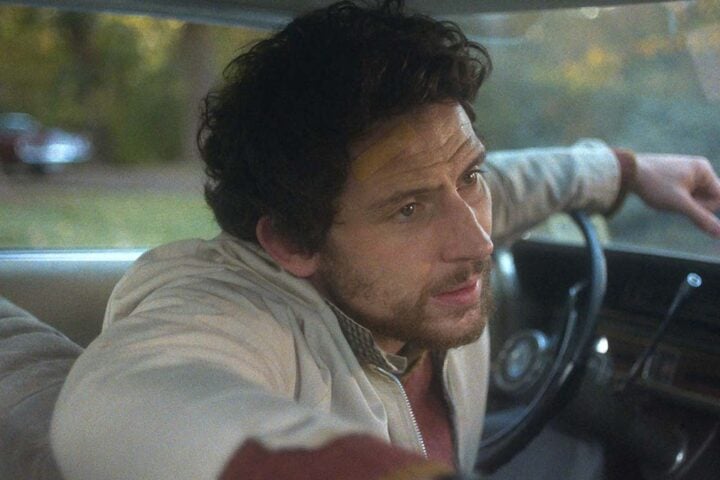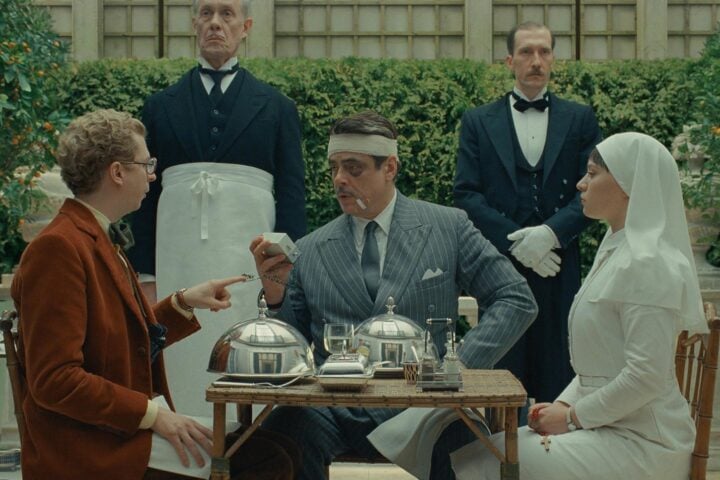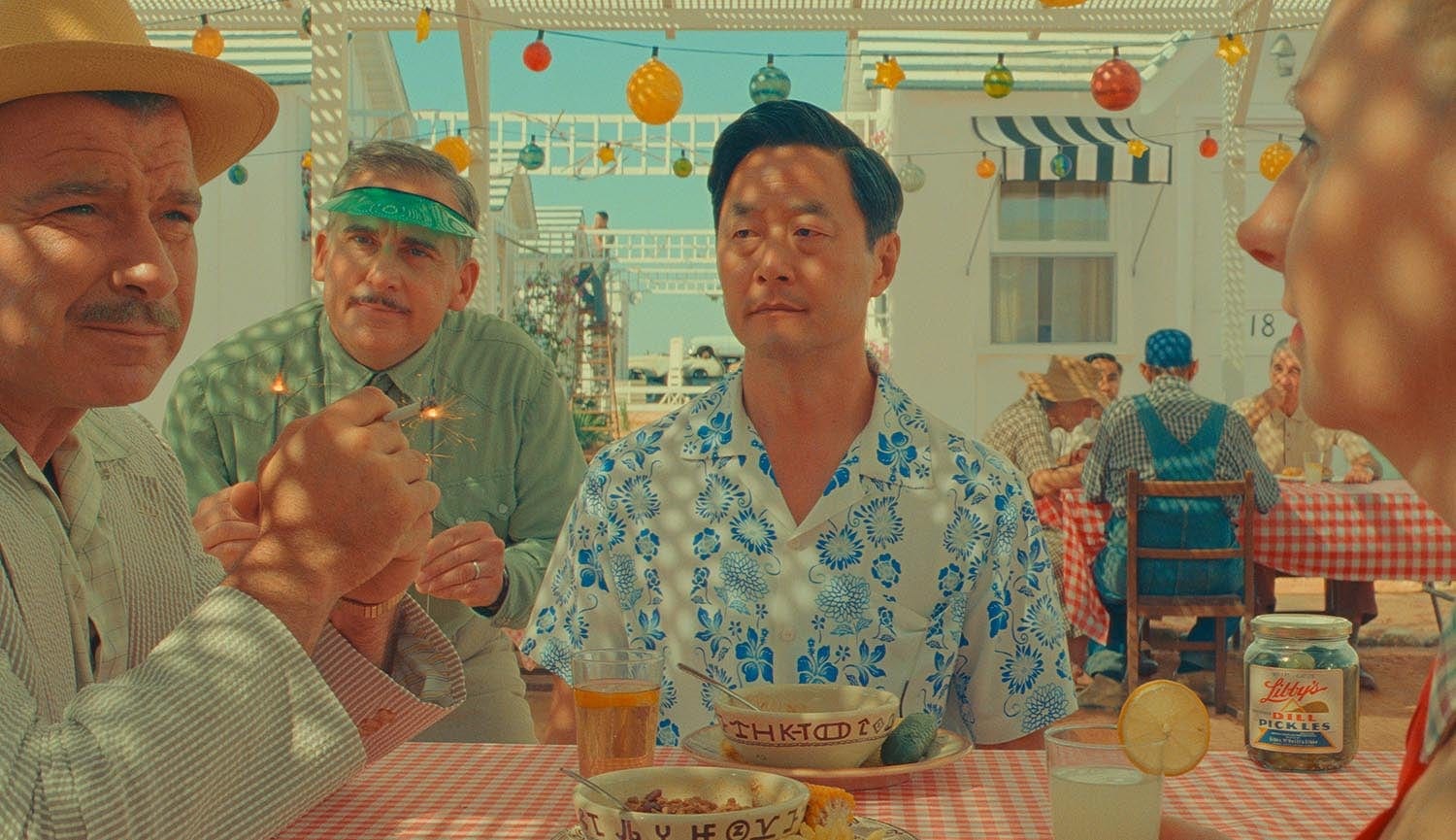
The internet of 2023 has transformed Wes Anderson from director to design aesthetic through countless generative AI videos and an enduring TikTok trend mimicking his distinct visual style. To watch Anderson’s actual output in Asteroid City is to realize that boiling him down into snackable social media content cannot fully capture his magic. From the whimsical wonder and meticulous mise-en-scène, there’s no replacement for the real thing.
Asteroid City depicts a theater company staging a teleplay at a 1955 Junior Stargazer convention in the titular desert town. For Anderson, the premise is a springboard for crafting frames within frames, which he then proceeds to summarily collapse. The film upholds and undermines his signature all at once. Yet all these crisp compositions also need a committed cast of actors placed within them, delivering his droll dialogue with amusing affect. Most members of Anderson’s assembled troupe are playing actors who are also playing their characters, adding another layer of complication to a film that belies its seemingly straightforward construction.
At the film’s press junket, I spoke to cast members Hope Davis and Stephen Park. The two play Sandy Borden and Roger Cho, respectively, both single parents of children convening for the Junior Stargazer convention. Our conversation covered the distinctiveness of Anderson’s aesthetic, how functioning as a troupe off-set translates into on-screen dynamics, and what role they play as a through line in the artist’s career-long exploration of parent-child relationships.
Both of you all are no strangers to directors with very exacting visuals, be it the Coens, Charlie Kaufman, or Spike Lee. What makes Wes Anderson distinct?
Hope Davis: The world he creates is unique. I don’t have social media, but I guess the look of an Anderson film is all over, his incredible color palette and his visual style. We, of course, inhabit that when we’re on set. But there’s also the whole world that Wes creates of a bunch of actors coming and living together at a hotel, eating together, spending the day together. You form a little acting troupe. And that’s pretty unique, I’ve never experienced though.
Stephen Park: He has the movie already plotted out in an animatic that he’s done all the voices for, so you know every frame of it before we even step on the set. So that’s really unusual.
Did becoming somewhat of a troupe all staying together transfer over into your playing a group of actors?
HD: Yes, I think it does, especially with so many movie stars in the cast. To get to know one another at dinner, and then show up on set the next morning is much more fun than just sitting alone in your trailer and then coming out.
SP: Yeah, it makes all the difference because we’re constantly together, eating together. Like she said, we’re not in trailers, we’re not separated. We’re all together.
HD: You get comfortable, get ready to play!
SP: Very much so.
Did you all learn something about your own craft, given that the film is a meta exploration of actors playing actors?
HD: Well, it was a reminder in this very disconnected age that we’re living in of how joyful it is to hang around with a group of people and actually talk to them and sit with them. I always love stepping onto a set before plastics, when life was just simpler, in a way. It was a reminder of how nice it is to actually have a face-to-face conversation.
SP: The camaraderie of just being together, eating together, living together makes all the difference.
HD: It’s inspiring.
How does this compare to other period work you’ve done? It’s set in the ’50s, but it’s Wes Anderson’s refraction of the period rather than a faithful representation.
HD: It’s more beautiful. The color palette, you feel like you’re in a painting. It’s so extraordinarily beautiful. You just want to stay in the world.
SP: And the hairstyles. I remember Wes had my hair cut a few times because it wasn’t quite ’50s enough. [He was] constantly looking at the hair and making sure it was just right. And, also, that Hawaiian shirt that I’m wearing, I think Milena Canonero, the wardrobe designer spent hours looking at that shirt. Everything is so precise.
When I think of Anderson’s filmography, I think of his unconventional parents, and now you all are stepping into that legacy in Asteroid City. Did you feel there was something unique about his point of view on what it means to be a parent?
HD: Well, my character that I play, she seems pretty disconnected from her kid. She’s tagging along with her kid to see if any excitement is gonna come her way. They’re all single parents in this film. Not too many happy families right there.
SP: I think he has a thing for kids and for intelligence. They were all very smart kids. I think that’s a through line with him. Everybody is really smart and clever and unusual.
Since 2001, we've brought you uncompromising, candid takes on the world of film, music, television, video games, theater, and more. Independently owned and operated publications like Slant have been hit hard in recent years, but we’re committed to keeping our content free and accessible—meaning no paywalls or fees.
If you like what we do, please consider subscribing to our Patreon or making a donation.