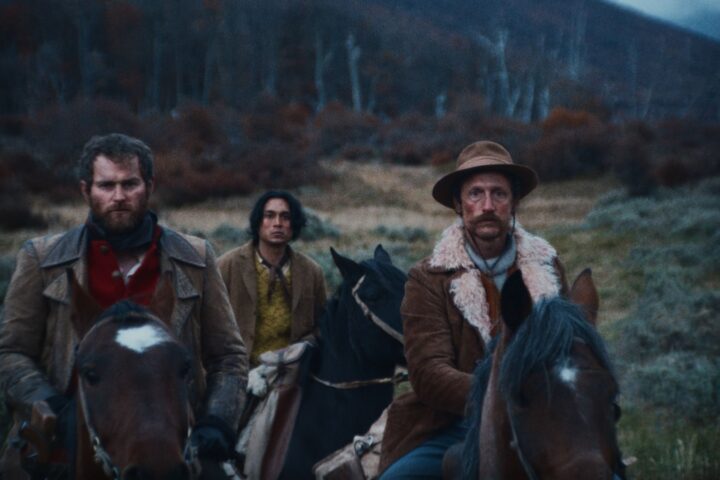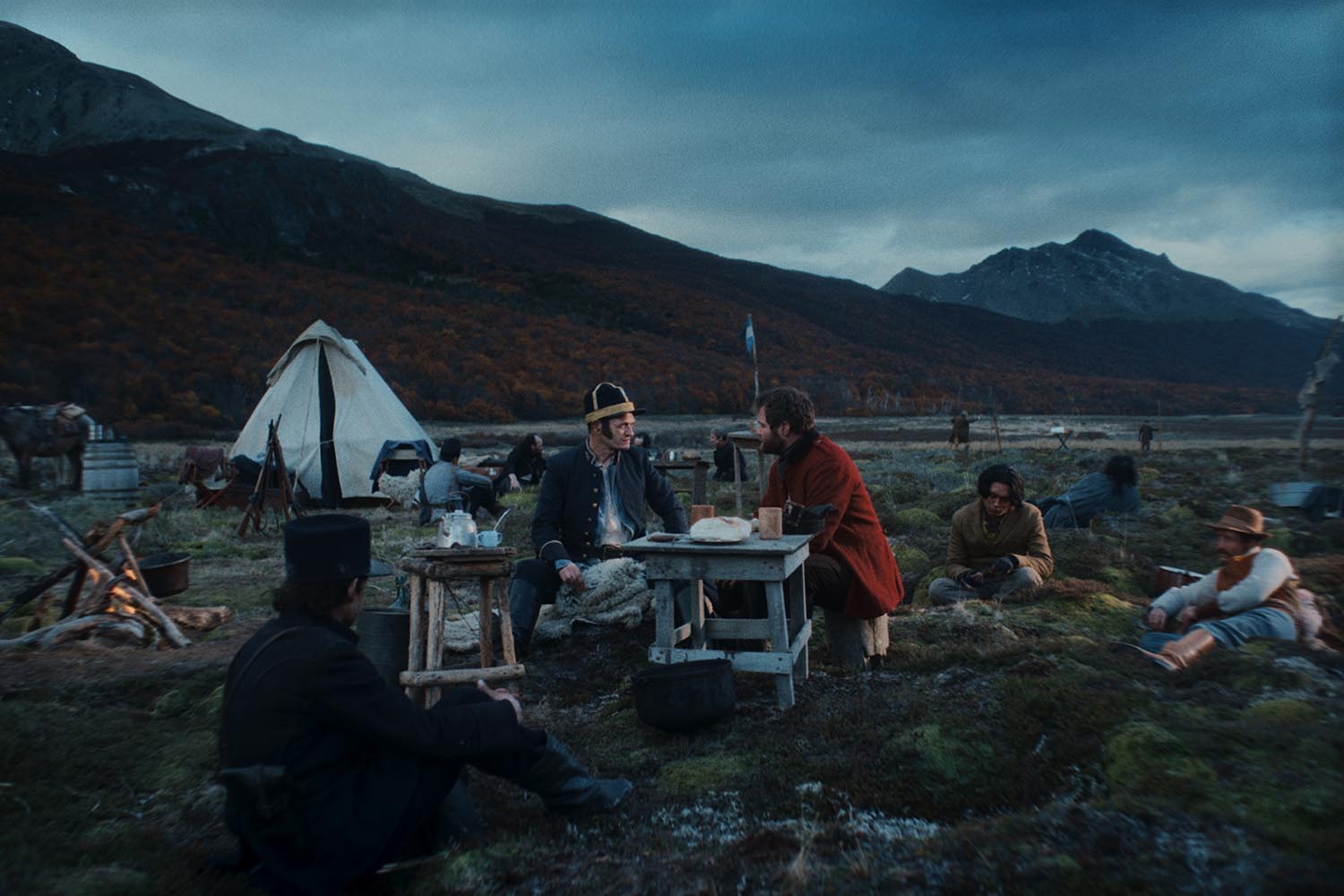
Chile’s Oscar submission committee made quite the statement in choosing Felipe Gálvez’s The Settlers to represent the country in the Best International Feature race. That’s not just because this directorial debut beat out the latest films by filmmakers who had been previously tapped for the honor, including Pablo Larraín and Maite Alberdi. It’s also that Gálvez asks such tough questions about the South American nation’s history that look even further beyond the long shadow cast by the autocratic regime of Augusto Pinochet.
The Settlers confronts the myths of Chile’s very founding to highlight the original sins that still stain the national fabric. Gálvez’s film follows an unlikely trio consisting of a Scottish soldier (Mark Stanley’s Alexander MacLennan), an American mercenary (Benjamin Westfall’s Bill), and a mixed-race Chilean mestizo (Camilo Arancibia’s Segundo). Their journey starts with a simple command from the oligarchical José Menendez (Alfredo Castro) looking to consolidate his control over the country’s emerging commerce: clean this land.
Gálvez, who co-wrote the film with Antonia Girardi, uses the framework of a classical western to blow it up from within. Throughout the various episodes on their journey, a common theme of colonial control and dominion emerges—over nature, land, and ultimately other humans. Gálvez’s visceral approach highlights how many of the founding myths of the nation are written in blood. Strikingly, even those that are not still involve violent acts of omission.
I spoke with Gálvez after he presented The Settlers at last year’s New York Film Festival. Our conversation covered how his background in editing, why animals feature so prominently in the film, and why The Settlers always had to exist within the western genre.
Going way back in the development process, what did the screenwriting lab with Critics Week at Cannes help you unlock about the film?
I learned a lot about the script. The Chilean fund was really difficult to get. I got a little bit worried that the project was getting old. I didn’t want it to get stagnant, so I made sure that it always stayed young. I wanted it to be relevant even in the present times.
What does your background as an editor add to the process of conceiving a film from the beginning, rather than just shaping it at the end?
The entire film was there in the script. I think I only erased maybe one scene. As an editor, I wanted to be risky. We made it in such a way that if we erased some of the scenes, it really wouldn’t have worked. As an editor, I’m used to erasing a lot, maybe 20%, 30%, 40% of what’s filmed, so that work was pre-done in the script. We really put our entire budget in front of that camera. A lot of the time, most of the problem-solving happens in editing, but most of our problem-solving [here] happened in the script. It was really just about following the script and setting it up there. That [editing] process was pretty quick. In terms of shooting, I actually tried to do two shots per scene. If it wasn’t working, I would just move on to a different scene. I think what really helped is that I really learned from the mistakes of others.
Did that experience as an editor help you know whenever there were moments that didn’t need a lot of dialogue or explanation? There are so many scenes in the film that trust the audience to fill in the blanks where you leave ellipses.
In terms of the killing, for example, that entire sequence was going to be focused on the aftermath of the killing. When we were filming that massacre, I realized the potency of those images and decided to work more on the part before the killings. It ended up being one day of shooting. I’m also quite dyslexic; I really think in images. There’s a scene with a lot of smoke, and that ended up being very fragmented. It took a lot of small shots. They were decisions that happened in the moment, and that flipped and got switched around there.
With connectors when we were going from one part to another, those came to be as we were shooting. For example, there’s a scene with all those birds. That came to me as we were traveling back to the hotel. As we were around the island, I noticed that there were all of these birds. We took a lot of the footage over a space that was filled with garbage where all the birds were coming together. In the script, I would mark that I needed a transition. But the transitions themselves, those solutions, came about as we continued filming.
How were you incorporating the animals into the film? Especially in the second act, it feels like the horses are talking to each other when they’re neighing.
Horses are important in westerns. At some point, I was scared that the audience would lose empathy with our characters as the journey moved forward. Our characters do some really terrible things, and we begin to create some distance with the audience. We are very close to Segundo, but after he kills that woman, that relationship gets a little bit complicated. The horses are also observers, mimicking the same role that the audience has. I always say the horses are also settlers. They’re not part of the continent. At the very beginning, I start the film with a guanaco that leaves. That’s a native animal from the area, and then you have the horses which aren’t native to the area. There’s also that conflict that is being portrayed there.
What about the sheep? It’s hard to see a big group in a movie and not think about Luis Buñuel’s The Exterminating Angel.
[in English] Many movies with sheep!
With colonization, there’s also so much destruction, and I thought it was necessary to have that point of view. Like in Andrea Arnold’s film [Cow] where she’s being with the cow, I thought it would also be good to be with the sheep. The sheep also are a way for us to understand the space. Part of the conflict is also because the sheep need more space, so there’s that.
Was the film always going to be a western?
Yeah. The western is also a propaganda genre. It was created by the film industry to justify these killings. It was also a way to show Europe that we were getting civilized. The character of Vicuña, in a way, is also that filmmaker documenting this and questioning these images. I wanted to criticize it from within. We have Bill, who’s a caricature and very much a stereotype. It was a conscious decision. I wanted him to remind us of this cowboy, the essence of the western.
What were the considerations behind making a western without a clear hero?
I wanted to create multiple heroes. At the beginning, we’re thinking MacLennan’s the hero. Then we think Segundo is the hero because he’s going to kill Bill. Maybe it’s the Argentinians or Moreno. Then there’s Colonel Martin. Or, at the end, maybe it’s going to be Vicuña. I was interested in building these ideas of heroes and destroying them. He kills Bill, so we think that he’s the hero, but then you see that Martin rapes McClellan. We see that when you have this dynamic of all of these men that are trying to outdo each other to see who’s the hero. The idea is having each of their definitions of the hero kill the other. And we end with Rosa’s image, which is resilient. She’s the only one who’s able to say no and manifest that she’s not alright.
The making of a moving image and the making of a nation converge powerfully in the last scene. Do you see the birth of cinema and the birth of Chile as intertwined?
Cinema is a great tool for new and emerging nations. When you see documentaries from the 1900s, you don’t see any Indigenous peoples. It’s on purpose that Vicuña attempts to document Segundo and Rosa, but those images aren’t in his final film footage. Photography as well was also an incredible tool to show development. We tend to think that these tools are there to represent reality, but what they actually do is transform and distort. In the 20th century, most of the role that it took was distorting that reality.
I have to ask about the humor in the film because it does feel unexpected. Do you see it as a force working in tandem with the violence to heighten the stakes?
I always say irony is a part of my personality. But I think it also comes from love for the audience. I don’t want to keep them at a distance. I always say, “Bien viaje,” or have a good journey. I think bringing in humor is understanding that, at times, the film can get quite heavy, and it’s interesting not to keep it too solemn. It’s important to be critical and ironic. You talk about violence, but I think, “Well, what’s violence?” Many times, a lot of those jokes can be even more violent than the actual physical violence that we see on screen.
Translation by Cordelia Montes
Since 2001, we've brought you uncompromising, candid takes on the world of film, music, television, video games, theater, and more. Independently owned and operated publications like Slant have been hit hard in recent years, but we’re committed to keeping our content free and accessible—meaning no paywalls or fees.
If you like what we do, please consider subscribing to our Patreon or making a donation.