Felipe Gálvez’s feature-length debut, The Settlers, takes place in an independent Chile at the end of the 19th century that’s still defined by its period of colonization. Figures of power and influence are all either of European extraction or simply Europeans who’ve sailed over to stake claims to land in a rapidly modernizing country. One such businessman, the real-life Spanish oligarch José Menéndez (Alfredo Castro), hires a small band of surveyors to properly map the outlines of territory that he’s recently acquired in the Tierra del Fuego region. That his tract of land extends into Argentina is the first of many indications that capitalism, with its ignorance of national borders, will simply continue colonialism’s tradition of land theft.
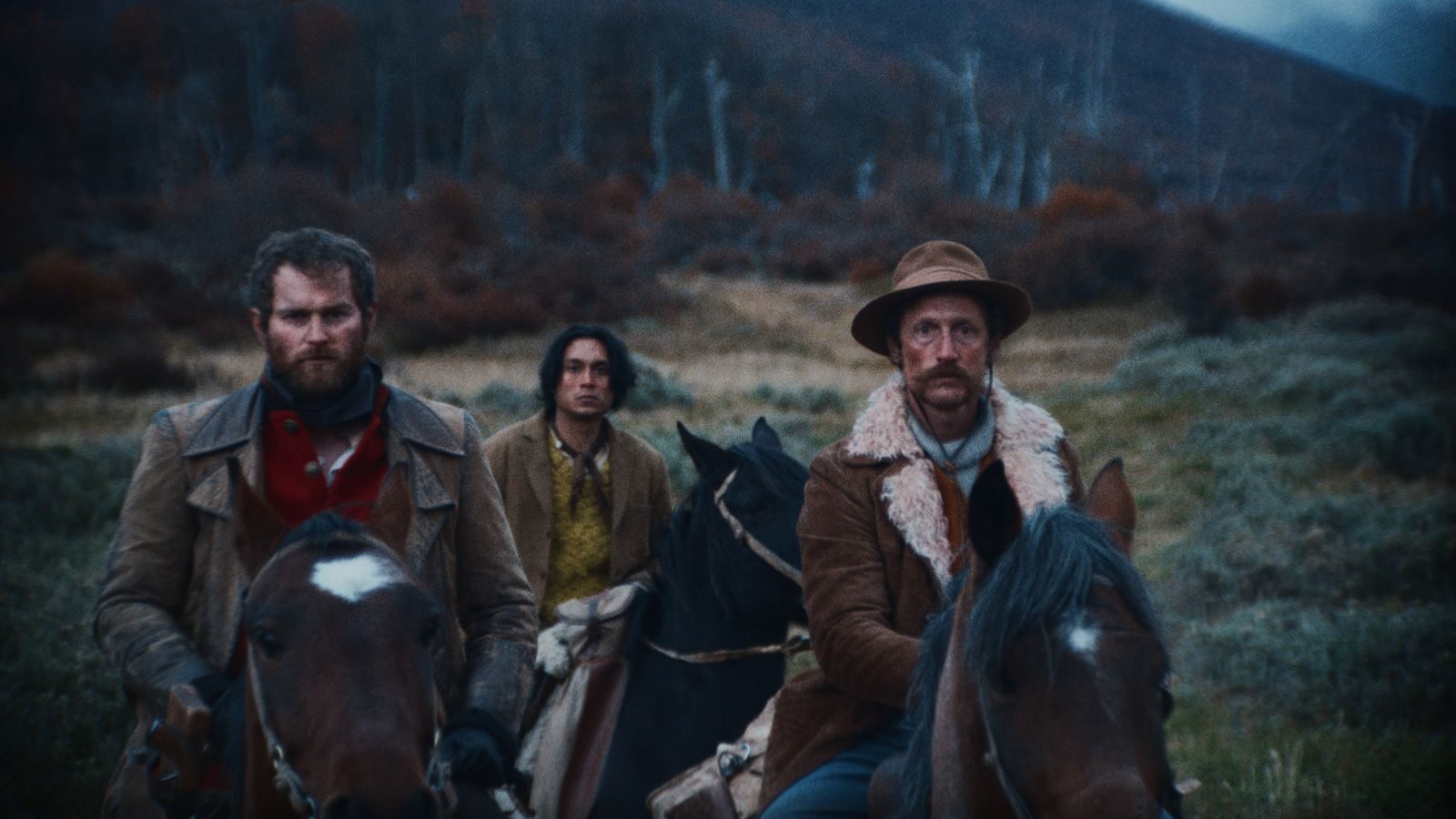
Leading the oligarch’s hired hands is Alexander MacLennan (Mark Stanley), a Scottish ex-soldier who treats a simple surveying mission as something akin to a military engagement. In tow are an American, Bill (Benjamin Westfall), and a taciturn, mixed-race Chilean mestizo, Segundo (Camilo Arancibia), who looks at every moment like he went along with this assignment solely to avoid the possibility of being on the receiving end of its violence.
And sure enough, MacLennan barely sets out with his men before getting into scrapes, first in the form of macho competitions with other whites they encounter across the frontier and, later, in more horrific displays of aggression against the indigenous Selk’nam people of the Patagonian region. MacLennan claims to have been an officer in the army, and Stanley plays the man with an imperious sense of authority that backs up that claim. He directs Bill and especially a withdrawn Segundo to join in his acts of depravity, speaking to them not as colleagues hired by the same boss, but subordinates under threat of court-martial for disobedience.
The group’s ghastly actions stand in contrast to the gorgeous mountain ranges and rolling plains glimpsed throughout The Settlers. By the same token, the filmmakers charge their panoramas with a paranoid feeling through such simple methods as using slow zooms in and out to create a disorienting effect, or by framing the characters in such extreme long shot that the emptiness around them is the dominant element of the frame. This, in turn, makes it all the more disorienting and vaguely surreal when they somehow stumble across other people out of nowhere. There’s a purgatorial aspect to the party’s roaming that provides a constant reminder of the absurdity of shedding so much blood to control patches of dirt.

Any story that directly confronts the wanton brutality of colonization and manifest destiny in the Americas perhaps inevitably draws comparisons to Cormac McCarthy’s Blood Meridian, a Grand Guignol of frontier extremity. MacLennan’s callously detached carnage against indigenous South Americans blatantly recalls some of the more wanton violence of that book, but Gálvez takes an inventively circumspect approach to depicting that slaughter.
When MacLennan leads his group in a massacre of a tribe, the scene unfurls amid a heavy, haunting fog sporadically lit up into a yellow haze by muzzle flashes. The whole time, the camera remains fixed on the men shooting rifles at men, women, and children—their off-screen shrieks of terror communicating everything necessary about the horror being inflicted upon them. And just when the film threatens to sink into pure derangement, it skips forward several years, leaving the full extent of the survey party’s exploits to be recounted rather than shown.
The Settlers also recalls McCarthy’s sense of pitch-black humor, which is so intense that it threatens to absorb all light. Gálvez’s satire lacerates the contradictions and hypocrisies of European racism and how its convolutions would pit even fellow whites against one another. At one point, MacLennan stumbles across a British colonel, Martin (Sam Spruell), who’s also taken up mercenary work and speaks in the prim manner of a highborn, high-ranked officer. Yet the man’s stiff-upper-lip calm barely masks a psychotic rage that induces him to murder someone for equating a “lowly” Scot like MacLennan to a proper Englishman like himself, and his disgust toward racial mixing enforces bigoted and repressed rules of Victorian sexual politics that, in the end, he only selectively follows, given his penchant for sodomy.
This blistering film’s most pointed observation comes at the end after the aforementioned leap forward in time, whereupon the story relocates from the sparse wilderness to the lavishly appointed interiors of the manors built upon it. Filming brightly colored rooms at sharp angles to further emphasize the clash with the natural environment, Gálvez makes the act of Europeans taming foreign land look as fantastical and unnatural as sci-fi terraforming. Blood soaks the ground on which such homes are built, and even an attempt by a government official (Marcelo Alonso) to catalog the atrocities committed by the economic masters of a new Chile come across as halfhearted efforts, a mild pang of conscience that will no doubt end up buried in an archive with no repercussions meted out to those who conquered an already conquered nation.
Since 2001, we've brought you uncompromising, candid takes on the world of film, music, television, video games, theater, and more. Independently owned and operated publications like Slant have been hit hard in recent years, but we’re committed to keeping our content free and accessible—meaning no paywalls or fees.
If you like what we do, please consider subscribing to our Patreon or making a donation.