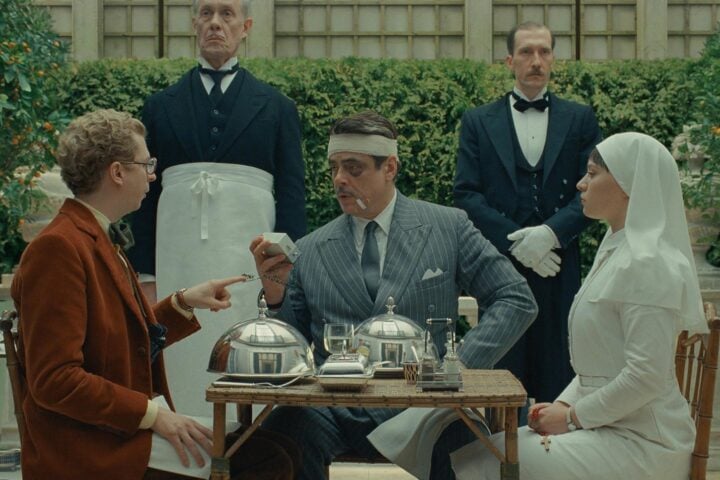
The internet of 2023 has transformed Wes Anderson from director to design aesthetic through countless generative AI videos and an enduring TikTok trend mimicking his distinct visual style. To watch Anderson’s actual output in Asteroid City is to realize that boiling him down into snackable social media content cannot fully capture his magic. From the whimsical wonder and meticulous mise-en-scène, there’s no replacement for the real thing.
Asteroid City depicts a theater company staging a teleplay at a 1955 Junior Stargazer convention in the titular desert town. For Anderson, the premise is a springboard for crafting frames within frames, which he then proceeds to summarily collapse. The film upholds and undermines his signature all at once. Yet all these crisp compositions also need a committed cast of actors placed within them, delivering his droll dialogue with amusing affect. Most members of Anderson’s assembled troupe are playing actors who are also playing their characters, adding another layer of complication to a film that belies its seemingly straightforward construction.
At the film’s press junket, I spoke to cast members Adrien Brody (who plays Schubert Greene, the production’s director) and Jeffrey Wright (who plays a military general hosting the Junior Stargazer awards). Our conversation covered the joys of repeat collaborations with Anderson, the meta nature of the plot, and the film’s perspective on American culture.
You’re both experienced veterans working with Wes Anderson now. Do you gain additional fluency the more you collaborate with him?
Adrien Brody: I always say there’s a shorthand now, because it’s very clear. Obviously, Wes has a real love for specificity in the work and [has an] exacting nature. You know what’s required of you going in, so you both go for the target right away. I think it yields a better result.
Does Asteroid City feel like a look behind the curtain given the way that a Wes Anderson ensemble is somewhat of a repertory company, and you all are putting on a show inside the film?
Jeffrey Wright: I think it’s a look behind the curtain, but I think it’s a celebration of the process. Maybe, as well, it’s a celebration of a different time in American theater and filmmaking. In some ways, maybe it’s Wes paying homage to some of those influences that worked on him and that he admires. I think that holds true, maybe not only for the filmmaking process, but also for these parts of America that he may have a yearning for. We shot this outside of a small town called Chinchón, which is about 45 minutes east of Madrid. Wes chose that place to recreate this desert town of the American ’50s. It’s an interesting thing to recreate that there, to bring the beauty of that place in that time there. Not all of it, but just those elements that I think he feels are worth recreating. A simpler time, a more analog time, in some ways.
What’s it like stepping into Wes’s recreations of the past, especially when you’re channeling real-life individuals, like James Baldwin in The French Dispatch and Tennessee Williams and Elia Kazan here in Asteroid City? Does that scramble the way that you would normally do research or prep given that these figures are filtered through his sensibility?
AB: I think there’s a lot on the page. It’s definitely quite distinct and clear. It’s fun, in this case, to reference the time in history when there was such a shift in filmmaking and acting, to honor those people and play with personality types. We’ve all been to drama schools, and so to reference ideas and theories and qualities of a man of that era was really fun.
JW: They’re really artistic or cultural heroes for all of us. Literary heroes, in the case of Baldwin. That character wasn’t entirely Baldwin, but certainly referenced him. I think one of the things that Wes is trying to say is remember these people. Know these people. Celebrate these people because they are the best of us. They’re not perfect, but they certainly represent the best of us.
AB: Immortalizing them, in some way.
JW: There’s that aspiration toward, whether or not you understand the play, keep moving. Keep telling the story. Part of the story is these figures who were heroic in their artistry.
Since 2001, we've brought you uncompromising, candid takes on the world of film, music, television, video games, theater, and more. Independently owned and operated publications like Slant have been hit hard in recent years, but we’re committed to keeping our content free and accessible—meaning no paywalls or fees.
If you like what we do, please consider subscribing to our Patreon or making a donation.