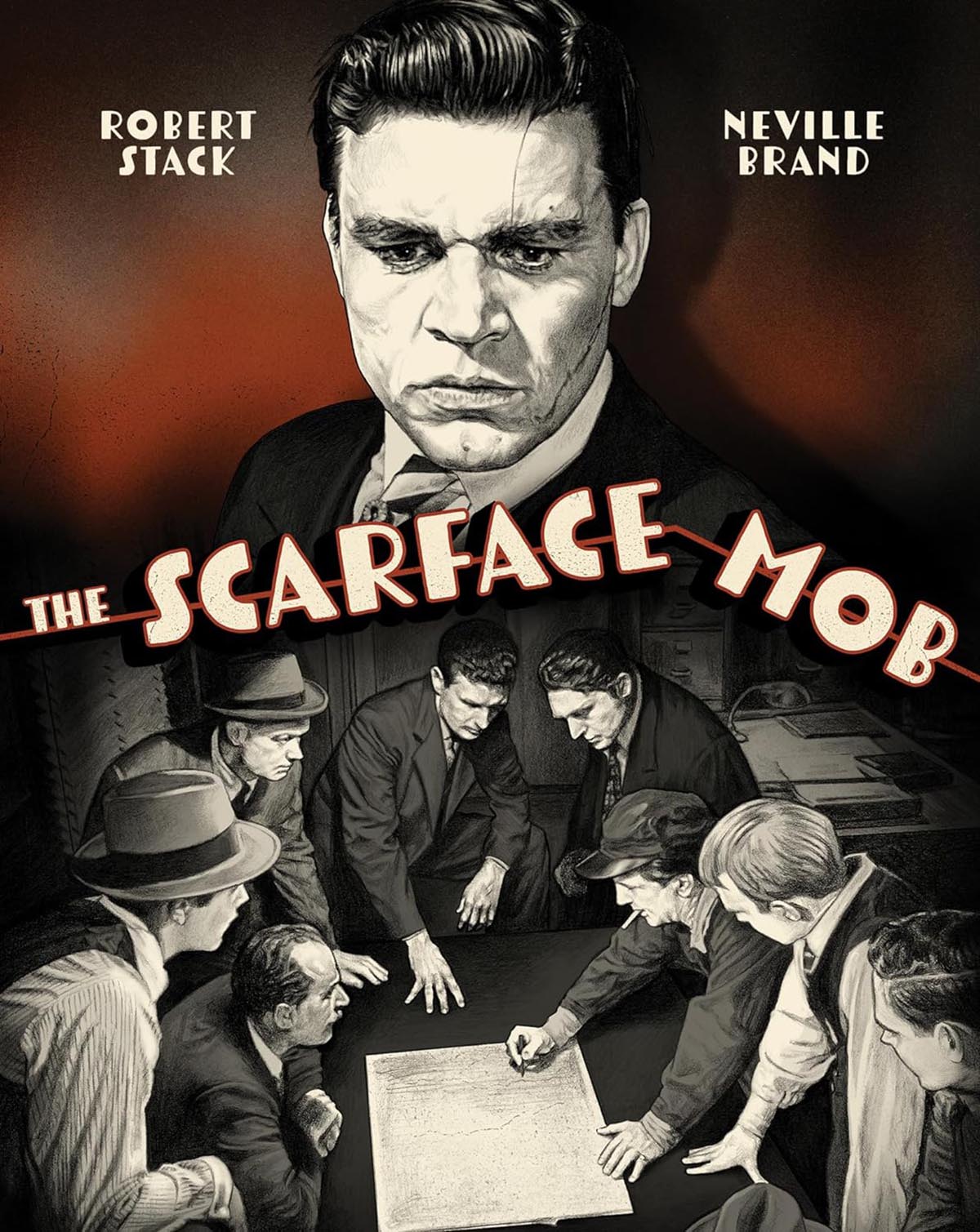
 Phil Karlson’s The Scarface Mob was originally made as a two-part pilot for the Westinghouse Desilu Playhouse anthology series before the 80-minute episodes were re-cut for theatrical release. Given the sterility of so much dramatic television in the 1950s, it’s hard to imagine Karlson—best known for hard-hitting noirs like Kansas City Confidential and The Phenix City Story—seeing the format as suitable for his style. But Desi Arnaz, a huge admirer of the latter film, promised Karlson no studio interference. And while The Scarface Mob’s story presents a clear battle between good and evil in the form of Eliot Ness (Robert Stack) and Al Capone’s (Neville Brand) Chicago bootlegging empire, Karlson’s gritty brutality finds its way on-screen as the film conflates the maniacal ruthlessness of both men’s actions.
Stack’s performance went a long way in cementing Ness’s legacy in the public imagination. Yet for all Ness’s protestations of incorruptibility and inability to be “swerved from our duty,” his stoic demeanor barely masks his seething contempt for illegal activities, even those that involve breaking laws that he himself disagrees with and, at times, conveniently ignores.
While at a nightclub with his wife, Betty (Pat Crowley), Ness agrees with her that a glass of champagne would be nice before swiftly declaring that it’s his job to make sure they can’t have one. This lack of self-awareness soon slips into outright hypocrisy when he overlooks the rum and brandy being poured on the cherries jubilee being prepared at their table. Moments like this slyly undercut The Scarface Mob’s frequent valorizing of Neff for his unwavering pursuit of law and order by revealing his resoluteness as an excessive stubbornness that, given the unpopularity of 18th Amendment even in its time, borders on the absurd.
Karlson also never shies away from depicting the lives lost on both sides of the law. Given the corruption in law enforcement that Ness is also fighting against with his team of special agents, known as the Untouchables, it’s no surprise that even he questions whether or not it’s all worth it. Of course, The Scarface Mob inevitably seems to land squarely on the affirmative to that question once Capone is put behind bars. But seeing Ness lean down to identify the corpse of an informer (Joe Mantell) he brought on or comfort his wife—her shirt tattered and ripped open—after a trio of thugs break in and rough her up as a warning, it’s clear that Karlson is planting seeds of doubt in his audience along the way.
Indeed, The Scarface Mob is almost explicitly about the myriad costs of bringing Capone to his knees, whether in terms of manpower, risk (an elegantly thrilling phone-tapping sequence highlights Karlson’s skill at ratcheting up tension), or patience and perseverance. In one of the film’s most spectacular moments, a high-angle shot gazes thoughtfully down at a slew of dead bodies scattered about a brewery as the foam of the spilled beer envelops them. It’s all in the name of justice, but the prevailing thought we’re left with is, ultimately, what a waste.
Image/Sound
Arrow Video’s high-def presentation looks fantastic, boasting a strong contrast ratio, tight and even grain distribution, and strong detail throughout. Even the nighttime exterior shots of the nerve-wracking phone-tapping sequence are vivid and clear, showing the care that director Phil Karlson and DP Charles Straumer put into their low-key lighting. The uncompressed dual mono audio is, for the most part, crisp and clean, but there are a half-dozen or so lines, mostly in night club sequences, where the dialogue suddenly becomes muddy and echoey.
Extras
This Blu-ray includes a pair of new video essays. The first, by critic David Cairns, provides a comprehensive overview of the first two decades of Karlson’s career. Cairns touches on the director’s hits, but the most fascinating stretches are when he’s discussing Karlson’s early years writing gags for Abbott and Costello and how Desi Arnaz convinced him to direct the first two-part pilot of The Untouchables. The second video essay, by critic Philip Kemp, focuses on the various on-screen depictions of Elliot Ness, and makes the argument that Robert Stack’s performance in The Scarface Mob and The Untouchables TV show helped to set the standard of how Ness was portrayed from then on. The disc is rounded out with a theatrical trailer, while the handsome packaging includes a reversible sleeve, several lobby cards, a two-sided poster, and beautifully illustrated booklet with an essay by author Barry Forshaw and extremely detailed liner notes by Untouchables experts Dan and Kelly Lynch.
Overall
Arrow’s Blu-ray of The Scarface Mob offers new audiences the chance to see the genesis of The Untouchables, which pushed the boundaries of violence on television like no show before it.
Since 2001, we've brought you uncompromising, candid takes on the world of film, music, television, video games, theater, and more. Independently owned and operated publications like Slant have been hit hard in recent years, but we’re committed to keeping our content free and accessible—meaning no paywalls or fees.
If you like what we do, please consider subscribing to our Patreon or making a donation.