
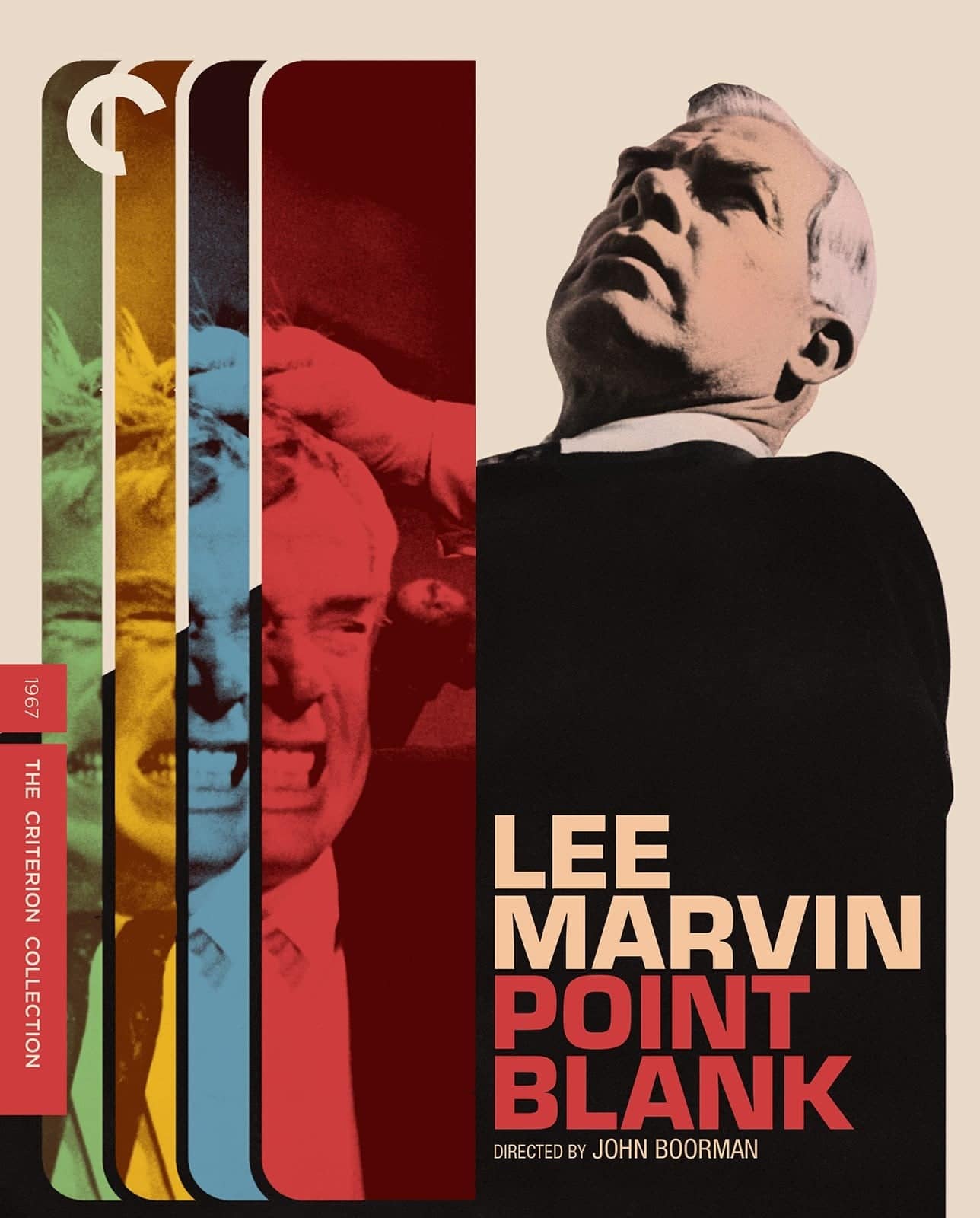
 Lee Marvin’s initial claim to fame was disfiguring Gloria Grahame’s face with a pot of scalding coffee in Fritz Lang’s The Big Heat, but even for cinema’s quintessential thug, there was something more terrifyingly callous about his performance in John Boorman’s seminal 1967 neo-noir Point Blank.
With daunting broad shoulders, hard, searing eyes, and a face that looked like it had been carved out of iron, Marvin was an imposing goliath, and as he rises from the dead during the title credits of Boorman’s tour de force, one becomes immediately aware of the actor’s enormous physicality. As he stomps stoically and silently amid Los Angeles’s glistening high-rises with an enormous .38 pistol at the ready, Marvin’s character seems almost inhuman; his one word moniker, Walker, and lack of dialogue for the film’s first 20 minutes merely confirms the impression that he’s less a man than an unbridled, indestructible elemental force.
Long before Mel Gibson turned the character into an endearing, wise-cracking antihero in the pathetic remake Payback, Marvin’s Walker was the cinema’s ultimate unsentimental badass—chillingly determined, unfettered by pesky human emotions like love, sympathy, or remorse, and unwilling to halt the bloodshed until he had fulfilled his quest.
That quest, as Boorman spells out during Point Blank’s masterful first few moments, involves reclaiming $93,000 that was stolen from him during a heist. Through a number of lightning-quick, elliptically assembled shots, Walker, his pal Mal Reese (a sniveling and exemplary John Vernon, in his first screen role), and wife Lynne (Sharon Acker) successfully intercept a clandestine money drop-off taking place on Alcatraz; when Reese finds that his share of the spoils isn’t satisfactory, he and Lynne plug Walker full of holes in a dank, shadowy prison cell. Left for dead, Walker somehow manages to survive the ambush and, with a stomach full of lead, returns to San Francisco by floating along the treacherous Alcatraz currents on his back. A year later, a mysterious informer tells him how to find his wife and Reese, but as Walker makes clear, his motivations aren’t revenge. He simply wants what’s rightfully his: the $93,000.
If Walker isn’t interested in the retribution most men would crave after such a betrayal, Boorman is similarly uninterested in merely replicating the style and tone of prototypical film noir. (After the 1965 British comedy Catch Us If You Can, Point Blank was the director’s American film debut.) Influenced by the French New Wave’s radical formal innovations, the European ennui of Michelangelo Antonioni’s films, and the genre revisionism of Sergio Leone’s spaghetti westerns, Boorman set out to make a thriller that looked and felt like nothing else before it, using widescreen Panavision cinematography, explosive colors, and a multi-layered soundtrack to re-envision the noir picture as highbrow Euro-art film.
Whereas noirs generally boast a shadowy, expressionistic interplay between light and dark, Boorman casts most of his film in brilliant daylight and summery colors. Where noir creates a visual and thematic atmosphere of constriction and imprisonment, Boorman shoots everything in expansive widescreen that posits characters in oppressively open spaces and, when more than one person is on screen, at opposite ends of the frame. And instead of noir’s typically convoluted narratives involving plenty of unnecessary exposition, Boorman’s film is a model of silent visual storytelling that broke new ground in non-linear cinematic narrative construction.
What makes Point Blank so extraordinary, however, isn’t its departures from genre conventions, but Boorman and cinematographer Philip H. Lathrop’s virtuoso use of such unconventional avant-garde stylistics to saturate the proceedings with a classical noir mood of existential torpor and romanticized fatalism. The action is set against (and within) a sunny corporate L.A. landscape characterized by its sterile, overwhelming enormity; situated in the corners of Boorman’s off-kilter compositions, a colossal architectural or natural edifice weighing down upon his back, if not literally crowding him off the screen, Walker is denied sanctuary.
Through odd camera angles and stylized compositions that position our hero as powerless and adrift amid this malevolent, foreign metropolis, Boorman creates a tone of uneasy dislocation. Los Angeles seems more menacingly inhospitable in sunshine than at night, and this irony plays into the film’s dichotomy between the old and new world. Just as classic noir’s sinister darkness is replaced in Point Blank by creepy brightness, so has Walker’s old-school criminal been replaced by the corporate villains who work their nefarious schemes on behalf of faceless financial entities (Reese has stolen Walker’s money as a means of buying his way back into the ominous “The Organization”). For these conglomerates, “Profit is the only principle,” and unlike yesteryear’s two-bit crook (of which Walker is one), they do business in checks, not cash.
The film’s pervading sense of disorientation is heightened by the flashback structure of the screenplay (adapted from Donald E. Westlake’s novel by Alexander Jacobs, David Newhouse and Rafe Newhouse). Like Don Siegel’s 1962 remake of The Killers (which also starred Marvin), Point Blank effortlessly jumps back and forth in time, but Boorman’s oblique narrative, as opposed to Siegel’s more conventional thriller, works on a somewhat subliminal level. The film feels refracted through its protagonist’s mind, with chronological logic blurred by a narrative free association that finds particular sounds, colors and images subconsciously intertwined—a technique Steven Soderbergh would ape in 1999’s The Limey.
Reese, begging for his life, tells Walker to trust him, and the appeal conjures up the memory of the last time his former friend made such a plea. Walker sees a broken bottle of perfume in a sink, and the image of swirling red liquid makes him recall being shot on Alcatraz (or is he foreseeing a brawl that’s yet to occur?). Since the story is fluid and replete with detours and digressions, any easy interpretation is challenged by the script’s tantalizing ambiguity.
Despite the film’s reluctance to provide definitive answers on the subject, one can safely assume that Walker is fatally wounded during the film’s opening scene, and that his recovery and search for the $93,000 is merely a deathbed fever dream. Boorman repeatedly hints at such a reading, from Walker’s first meeting with his enigmatic benefactor on a boat circling the Rock (the tour guide’s speech about the near impossibility of escaping the island fortress is intercut with the implausible sight of Walker floating his way back to civilization) to numerous scenes in which he’s either framed by bar-like shadows (recalling the Alcatraz cell he was shot in) or told by someone that he should just “lie down and die.” Marvin’s understated performance only reinforces this interpretation—with his expressionless countenance and deathly silence, Walker resembles a walking corpse, charging toward his singular goal like a specter that must fulfill one last unfinished earthly task before gaining entry into the afterworld.

Noir protagonists are, in part, defined by their spiritual, emotional, or psychological alienation, and thus Marvin’s impassivity—reflected in every one of his fractured conversations—pinpoints him as a man cut off from, and alone in, the world. When Walker finds his wife, he bursts into her house and, after tossing her aside, instinctively fires his mammoth revolver into her empty bed. It’s a symbolic act of sexual violence aimed at purging himself of his love for Lynne, but the gesture is an empty reflex rather than the by-product of pent-up feelings—as his muteness during their subsequent conversation conveys, he’s incapable of forming even the most basic human connections, much less experiencing passion, kindness, or misery.
And when Walker is repeatedly slapped by Lynne’s sister, Chris (Angie Dickinson), he stands there and takes it; when she’s done, he methodically straightens his suit, walks over to the couch, and turns on the TV to listen to an actor talk about “neurotic inertia.” Later, when he abandons Chris to finish his mission, she asks him, “Hey, what’s my last name?” His response (“What’s my first name?”) heartbreakingly sums up the irremediable isolation that both Walker and those around him are doomed to endure.
Though Point Blank is rife with existential malaise, it’s also one of the most ferociously sexy crime movies ever made. Boorman shoots violence with more than a hint of sexualized wickedness, and many of Walker’s most brutal moments (bursting through Lynne’s door and grabbing her around the mouth as he spins in a circle with his gun cocked and loaded; forcefully reaching between the legs of an Organization secretary in order to disconnect the office’s alarm) have more than a hint of wanton salaciousness. Anything that doesn’t feel impersonal in Boorman’s world seems tainted by cheap luridness (such as the blood-red jazz club that Walker can’t begin to comprehend), and it’s to the film’s credit that the director doesn’t shy away from providing the tawdry kicks that have always enlivened even the best noirs.
After dispatching everyone who gets in his way, Walker kidnaps an Organization bigwig named Brewster (Carroll O’Connor) and finally sets about getting his money. But because he’s already deceased and, therefore, the money really doesn’t mean anything, it’s unsurprising to find that, when the job is done and the loot is there for the taking, Walker—staring emptily at his prize while semi-cloaked in darkness—does nothing. For a film about a dead man engaged in a self-originating, self-perpetuating, and wholly meaningless pursuit of a relatively meager bounty, the final image of Walker receding into the enveloping darkness is a fittingly despondent conclusion to one of noir’s most bleak, vicious and inventive masterpieces. Walker ultimately winds up just where he began, but after Boorman’s Point Blank, noir would never be quite the same again.
Image/Sound
The Criterion Collection’s 2160p UHD transfer of Point Blank looks pretty amazing overall, with a major uptick in fine details and black levels from prior releases. The major issue here, as with a number of other Criterion restorations, is the shift into cyan with the color timing and grading, which for some folks is a make-or-break proposition. Sometimes the shift is more subtle, like a bathrobe changing from orange to red, and sometimes it tinges an entire scene, as in the famous shots of Walker stomping down a particolored hallway at LAX. The audio, meanwhile, comes in an LPCM mono mix that’s crisp and clean, really putting across sound effects like gunfire or Walker’s aforementioned heavy tread, and nicely supporting the atonal score from Johnny Mandel and diegetic music from the Stud Gardner Trio in a memorable nightclub scene.
Extras
Criterion compiles a healthy selection of bonus materials. The very listenable 2005 commentary track with director John Boorman and filmmaker Steven Soderbergh covers every aspect of the film’s production history, leaning into specific discussions about Boorman’s directorial choices and approach to the material. A recent interview with Boorman by author Geoff Dyer repeats and expands on some of the stories included in the commentary.
In a new interview, critic Mark Harris discusses the noir genre, Point Blank’s source material, and the changing state of the film industry in 1967, particularly when it comes to representations of sex and violence. Also included here are new reflections on Point Blank by filmmaker Jim Jarmusch; a then-and-now look at the midcentury L.A. architecture featured in the film, with historian Alison Martino; a 1967 archival piece about Alcatraz and the film’s location shooting; and Lee Marvin’s funny and at times very uncomfortable appearance on a 1970 episode of The Dick Cavett Show. Lastly, the release’s accompanying booklet contains an essay from Geoff Dyer about the film’s innovative structure and relation to the noir genre.
Overall
John Boorman’s Point Blank is a haunting rumination on social alienation, betrayal, and the need for revenge, and it gets a generously supplemented release courtesy of Criterion.
Since 2001, we've brought you uncompromising, candid takes on the world of film, music, television, video games, theater, and more. Independently owned and operated publications like Slant have been hit hard in recent years, but we’re committed to keeping our content free and accessible—meaning no paywalls or fees.
If you like what we do, please consider subscribing to our Patreon or making a donation.


I’ve always loved Point Blank, but have always had a big problem with the ending of the film. SPOILER ALERT: Keenan Wynn plays a mob-tied character who helps Walker in trying to get back his money. In one of the scenes with Carroll O’Conner, a phone call is placed to the top financial guy in the organization who refuses to give Walker his money. At the end of the movie, it is revealed that the guy on the phone in that scene is supposed to the same character played by Kennan Wynn. However, that defies reality because the guy on the phone sounds NOTHING like Keenan Wynn, so the whole revelation is VERY hard to believe if not impossible. For me, it really ruins the ending, if not the film.