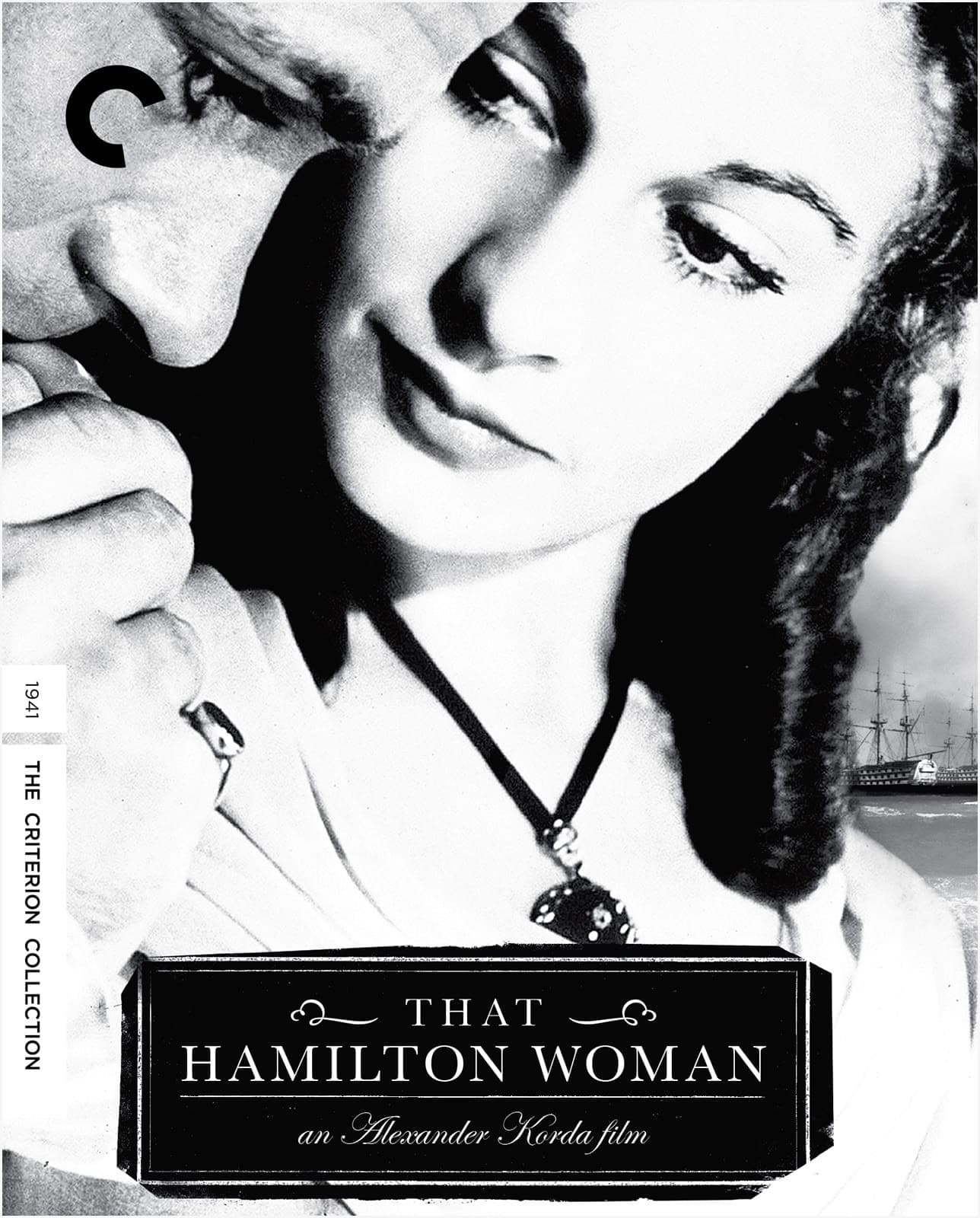
 A relic of WWII homefront propaganda where the call to arms ultimately overwhelms its star-driven romance, That Hamilton Woman showcases the then-reigning first couple of Anglo-American cinema—Vivien Leigh and Laurence Olivier, newlyweds fresh from international triumphs in Gone with the Wind and Rebecca—to good effect until England and duty come between their historical characters. Leigh’s Emma is introduced as a baggy-eyed indigent who recounts (from a Calais jail cell) a feature-length flashback of her scandalous legend. Leigh plays her as a somewhat dialed-down Scarlett O’Hara of humbler birth and comparable ambition, whose hand is bartered away by a paramour to retire debts, landing the girl and her dotty mother (Sara Allgood) in the Neapolitan palace of art-collecting ambassador Sir William Hamilton (Alan Mowbray). Making up seating plans for dinners with the local aristocrats, young Lady Hamilton proclaims herself superficially happy, just as Olivier’s jut-jawed Captain Nelson, the naval commander fated to be her immortal love and savior of the empire, rows ashore seeking reinforcements for his campaign against Napoleon. “War? That’s torn it,” Leigh pouts without adding a fiddle-dee-dee, but she’s soon skirting court protocol to procure him a few thousand sailors, then becoming the most notorious woman in Europe by seducing and standing by the married and progressively war-mutilated Nelson.
Directed by the reigning monarch of the British film industry, the Hungarian-born Alexander Korda, That Hamilton Woman gains much from Leigh’s playfulness and placid beauty; Rudolph Maté’s often glowing cinematography matches the sparkle of Lady Emma’s diamonds with that of her falling teardrops. But while Olivier looks great in a silvery wig and eyepatch, or with his chest bared for his lengthy great-man’s death tableau at the climactic battle of Trafalgar, he was still an unfinished film actor; his most mechanical moments of declamatory speechifying are thinly disguised anti-Hitler cheerleading, and likely the key to the film’s legacy as Churchill’s favorite: “Look out, Bonaparte! By God, we shall lick you now!” Along with Miklós Rózsa’s interpolation of nationalistic hymns into his button-pushing score, the film’s second half is saddled with the lugubrious clucking of the humiliated Lady Nelson (Gladys Cooper) and the “we must/mustn’t” dilemma which leads to the adulterous pair’s sacrifice of their love on the altar of Britannia’s endurance. (Their affair seems irrevocably doomed when Emma, tending their love child out of the spotlight in increasingly humble quarters, begins calling Lord Nelson “Horatio” as his shrewish wife does.) The shine of the A-list production, with its cavernous-looking interior sets, period costuming, and state-of-the-art sea battle finale, still diverts, but the mid-film image of Leigh in an ecstatic clinch with Olivier while a windblown luminescent cape dances above her head is what lingers, rather than the defeated, solitary woman whose loss yields a curtain line that serves as a bleak counterpoint to the actress’s “Tomorrow is another day” capper in Gone with the Wind.
Image/Sound
There’s a noticeable amount of vestigial scratches and mild flickering on the image for a Criterion release, but the black-and-white tones generally emerge as vivid, and Alexander Korda and Rudolph Maté make creative use of soft focus in close-ups and the many interior scenes of confrontation and romance. The Oscar-winning mono sound rings with cannon fire and orchestral patriotism.
Extras
An interview with retired book editor Michael Korda, son of production designer Vincent and nephew of director-producer Alexander, yields family lore on how the tempestuous relationship of the recently married Oliviers fed their performances in the film, and what the genesis of the “hastily improvised” project (shot in six weeks, shortly after the filmmaking brothers were uprooted by the war to Hollywood) owed to Alex’s friend Winston Churchill, who thought its propagandistic effect on the movie-mad American public, a majority of whom supported U.S. neutrality in the European war as of 1940, could be immense. Ian Christie’s scholarly feature-length commentary is a bit dry when cataloguing the differences between the characters’ historical and screen incarnations (Horatio was vain and slightly built, Emma zaftig, and Lady Nelson no harpy) but details Alex Korda’s obligatory dance with the censors on getting the required amount of tut-tutting toward a heroic pair of glamorous adulterers into the film, which commenced production with a far-from-complete script. Critic Molly Haskell’s booklet essay focuses on the “self-reflexive charm” of Leigh and Olivier’s on-screen sizzle, with asides on the director’s use of gliding pans across the lushly-dressed sets and the “pure Anglocentrism” of a scene in which Lord Hamilton employs a globe to show Emma how humble and wee poor, persecuted England is. Rounding out the supplements: a radio promo featuring accounts of the shooting, soundtrack clips, and a British trailer using the U.K. title Lady Hamilton.
Overall
The wartime flag-waving beloved by Churchill seizes That Hamilton Woman from the rightful ownership of Vivien Leigh.
Since 2001, we've brought you uncompromising, candid takes on the world of film, music, television, video games, theater, and more. Independently owned and operated publications like Slant have been hit hard in recent years, but we’re committed to keeping our content free and accessible—meaning no paywalls or fees.
If you like what we do, please consider subscribing to our Patreon or making a donation.