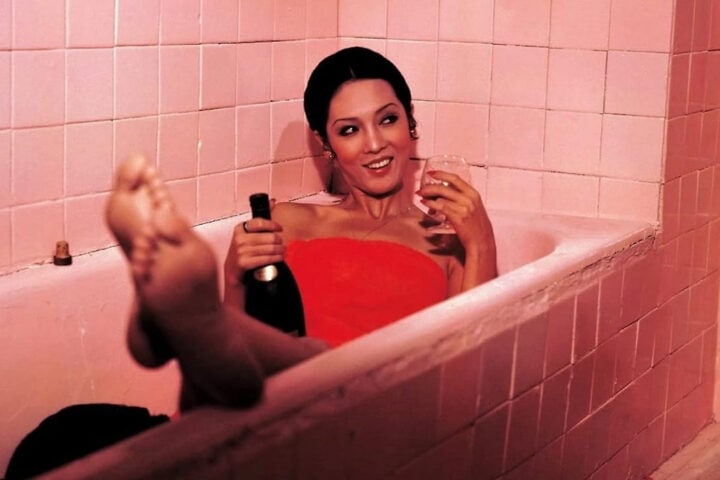
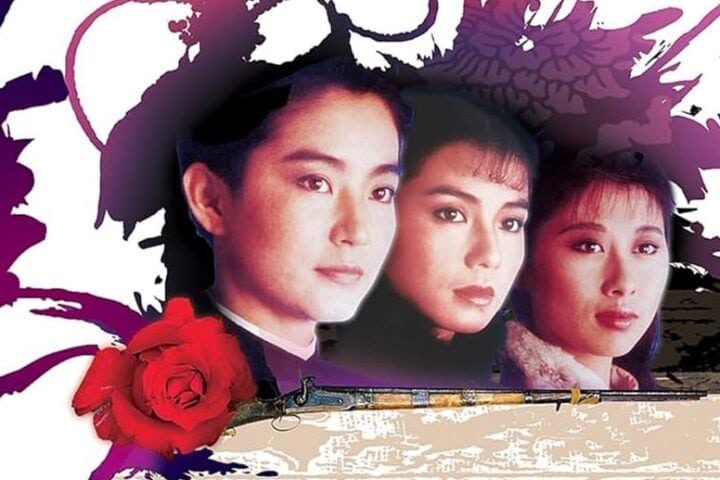
Arrow’s recent box sets Shawscope Volume One and Volume Two highlighted the golden age of Hong Kong’s Shaw Brothers studio, spanning roughly from the mid-1970s to their pivot toward TV in 1986. Now, Shout! Factory’s Shaw Brothers Classics: Volume 1 focuses on the studio’s rapid commercial ascendency at the end of the ’60s with their then-new, harder-edged take on martial arts cinema.
The earliest film in the set is, fittingly, Chang Cheh’s The Assassin, from 1967. Made hot on the heels of Chang’s (and the studio’s) breakout feature The One-Armed Swordsman from the same year, The Assassin furthers the filmmaker’s interest in moving the martial arts film away from its erstwhile emphasis on female heroes who are prone to musical outbursts and flowery romances as they are violence and toward the sort of male-centric revenge narratives that dominate the titles collected here.
One-Armed Swordsman star Jimmy Wang Yu amps up his on-screen ferocity as an ice-cold killer, Fang Kang, who emanates such rage that a mood of horror hangs over The Assassin, and only a lugubriousness middle section holds the film back from besting the director and star’s prior collaboration. And yet, if Chang almost single-handedly ushered in the era of the at once principled and savage male warrior in Hong Kong cinema, even at this early stage in his illustrious career he casts a jaundiced eye on the moral worth of this violent sacrifice.
Chang pushes the gore to some daring lengths for the time period, with the copious bloodletting deliberately eschewing vicarious thrills for a more unsettling queasiness that leaves one questioning the worth of Yu’s hero facing death for no other reason than personal honor. And that revisionist sense of ultraviolence forms one of the two gravitational centers around which the other films in this set orbit, the other being King Hu’s more spiritually inclined Come Drink with Me, whose star, Cheng Pei-pei, appears in many of this set’s films.
In Hsu Teng-hung’s The Thundering Sword, Cheng plays a wrathful killer, Su Chiao-chiao, who becomes remorseful when she inadvertently poisons an innocent man and falls for a combat-trained but philosophically pacifist monk, Yu Chien-wen (Chang Yi, in a rare heroic performance that he pulls off with serene aplomb). The 1967 film is as indebted to contemporary Shaw efforts as it is to the spirit of the studio’s past, with Cheng regularly breaking out into song amid the bloodletting before the story ultimately becomes a star-crossed lovers tale, and the unwieldiness of these conflicting tones speaks to how quickly the studio was seeking to change the formula of its films in order to better capitalize on its recent successes.
Cheng is also the star of two Chang films in this set, 1968’s Come Drink with Me sequel Golden Swallow and 1969’s The Flying Dagger and in both you can see her natural star power conflicting with the director’s efforts to focus on the roiling philosophical wrestling matches in which the male characters are caught. The stern-faced male heroes of these films operate according to duty and a strict, if often contradictory, moral code, but it’s the open romantic longing of Cheng’s otherwise murderous figures that are most captivating.
Still, the batting average of these movies remains high. Some of the films, like Yueh Fang’s nihilistic The Bells of Death from 1968, demonstrate a clear cross-pollination between Shaw’s brand of wuxia and the starkly beautiful, wantonly violent spaghetti westerns coming out of Italy around this time. Yueh films the brutality of a gang of rapacious marauders against frequently breathtaking vistas of forested hills as Morricone-esque music blares over the soundtrack. But just as arresting are the small moments of poetic horror, like a henchman’s blood dripping slowly into a cup of tea, or a sword fight in a temple that is filmed largely via close-ups on the candles that both warriors balance on their blades while they duel.
Actor Lo Wei’s directorial efforts Dragon Swamp and The Golden Sword, both from 1969, demonstrate a solid grasp of fight choreography and camera movement and a willingness to embrace the more absurd sides of the fantasy elements still pervasive in wuxia films. Dragon Swamp in particular is loaded with delightfully goofy touches, from rear-projected monsters that feel ripped out of a ’50s B movie, to the abundance to split screens, to the double dose of Cheng Pei-pei, who plays two characters in conflict with one another.
Few would argue, though, that the highlights here are the three films directed by Chang. The Assassin finds him experimenting freely with camera styles, with the wide-angle camera adopting a first-person approach as it pans in stately fashion through battle scenes before darting forward or whirling in a semicircle with each stab or swing of a sword.
These methods are developed further in Golden Swallow as Chang pushes the envelope of his intricate fight choreography by incorporating more byzantine set design into his action sequences. Particularly notable is a garish bandit dungeon filled with torture devices and several tiers of flooring to permit several planes of action in the same frames.
And The Invincible Fist, from 1969, pushes its set design into almost surrealistic terrain as bamboo forests become expressionistic thickets of intersecting stalks that are ripped apart just as much as the human bodies navigating the area. Chang would only grow as a filmmaker over the next decade, but as evidenced by his films collected here, he was already firmly established as the Shaw Brothers studio’s flagship director as it entered its golden age.
Image/Sound
Each of the film’s transfers looks terrific, with consistent color balancing, black levels, and textures. Fine details like the glint of light off of prop swords are clearly visible, and there are expressive contrasts between earth-toned soundstage exteriors and the florid costumes and bright gushes of blood. Meanwhile, the audio tracks are clear and free of any of the tinny, degraded hiss that used to be an expected feature of countless inferior imports of kung-fu and wuxia films. Dialogue is always front and center in the mixes, while the exaggerated clang of metal weapons and the boisterous action scores fill out the remainder of the audio space.
Extras
Shout’s box set comes positively bursting at the seams with extras. A host of Hong Kong film experts ranging from New York Asian Film Festival programmer Frank Djent to blogger Brian Bankston contribute commentary tracks for nearly every film in the collection, and Shout includes interviews with Cheng Pei-pei and critic Kim Newman. There are also a handful of documentaries unpacking the impact of Shaw Brothers on the Hong Kong industry and world cinema at large. These are bountiful, informative extras that argue for these movies as more than merely rousing entertainment, treating them as serious touchstones of global film history.
Overall
Shout! Factory adds to the ongoing glut of archival Hong Kong cinema releases with an outstanding collection of Shaw Brothers martial arts classics.
Since 2001, we've brought you uncompromising, candid takes on the world of film, music, television, video games, theater, and more. Independently owned and operated publications like Slant have been hit hard in recent years, but we’re committed to keeping our content free and accessible—meaning no paywalls or fees.
If you like what we do, please consider subscribing to our Patreon or making a donation.