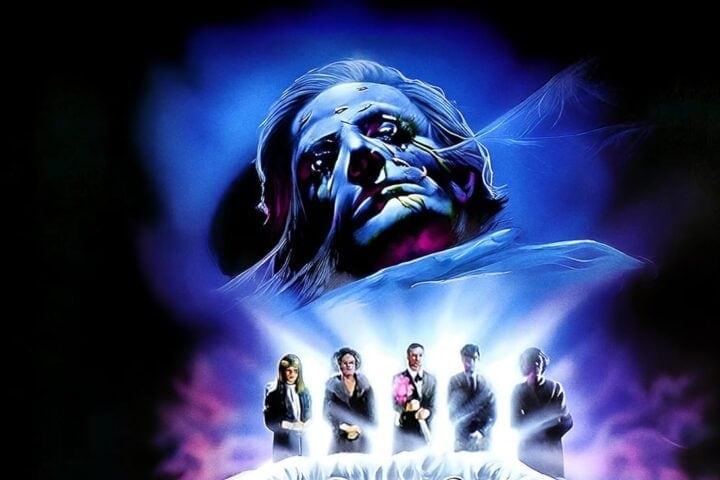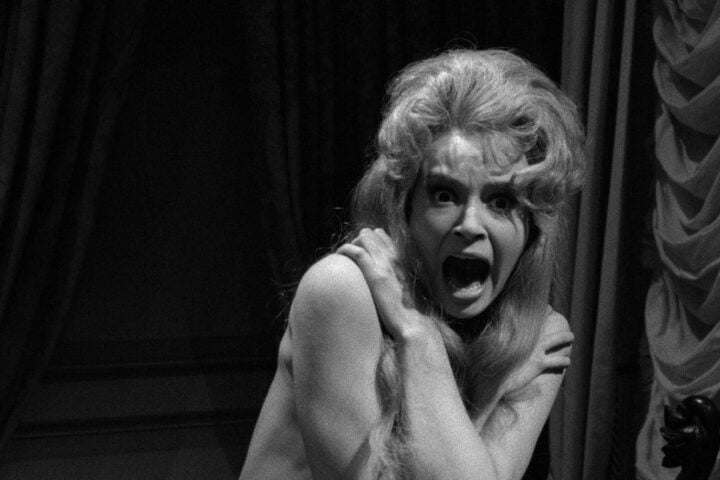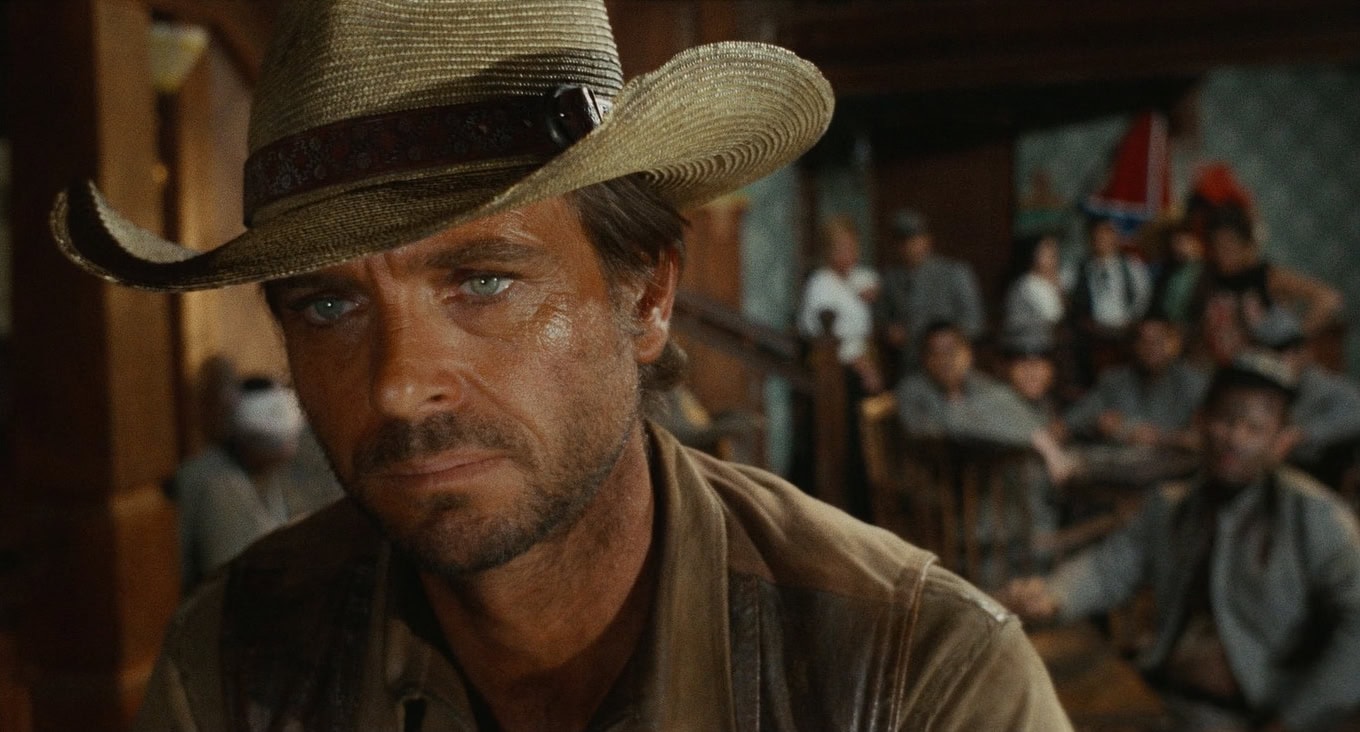
Following up on their excellent Blood Money box set from last year, the folks at Arrow Video now offer the four-film collection Savage Guns, another deep dive into the vaults of the Italian western. With each of these releases, Arrow gives viewers the opportunity to form a richer and broader notion of the genre, to examine the way these films work the warp and weft of similarity and difference, providing audiences with expected payoffs of sex and violence while also playing variations (subtle or otherwise) on familiar generic themes.
Featuring sparkling new restorations based on original film elements, Savage Guns comes in another lavishly appointed package from Arrow Video, complete with hours of bonus materials, like cast and crew interviews, commentary tracks, introductions to each of the films by critic Fabio Melelli, and appreciations of two of the film scores by audiophile Lovely Jon. Also included in the slipcase are a two-sided foldout poster with striking art from Gilles Vranckx, and a lavishly illustrated book with essays on the films by critic Howard Hughes.
What unites the films is their preoccupation with matters of revenge. Payback is, of course, the engine for many westerns, Italian or otherwise. But most of the films in this set take pains to illustrate the terrible cost of vengeance, not only for the innocents who often serve as collateral damage on the bloody road to retribution, but for their monomaniacally minded central characters, most of whom you couldn’t exactly call heroes in any conventional sense of the word.
The one real exception is Paolo Bianchini’s I Want Him Dead, from 1968, which—despite an early act of sexual violence against the protagonist’s sister that sets the story in motion—concludes on a surprising note of domestic bliss for disillusioned Confederate soldier Clayton (Craig Hill). All he wants is to set up a homestead far from the field of battle, but instead gets drawn into the insidious plot of arms dealer Mallek (Andrea Bosic) to prolong the Civil War until he can unload all the weapons and munitions in his stockpile.
Bianchini’s film is a sturdy actioner that intriguingly dovetails the personal and the political, albeit not in any truly radical manner. It also doesn’t do much to establish any sense of historical accuracy. While the film is supposed to be set somewhere in the American South, it was filmed against the arid desert backdrop of Almeria, Spain. What we’re left with are a series of admittedly well-staged set piece showdowns, including a rousing climax in which the five members of the gang Clayton’s been pursuing turn on each other like rabid dogs.
Edoardo Muraglia’s El Puro, released in 1969, is a darker, weirder prospect. Languidly paced almost to the point of enervation, the story circles around the titular gunslinger (Robert Woods), whose drunken dissipation is fueled by an existential terror of death. El Puro’s one hope of cleaning up his act is the love of a good woman, in this case saloon dancer Rosie (Rosalba Neri). But their happiness is doomed: El Puro has a bounty on his head, and a ragtag bunch of desperadoes led by Gipsy (Marc Fiorini) are intent on tracking him down.
In the film’s most disturbing sequence, Gipsy has his righthand man, Cassidy (Aldo Berti), beat Rosie to death when she refuses to divulge El Puro’s whereabouts. The scene is protracted and quite literally pulls no punches. But what pushes it beyond the pale is the fact that both men seem to take perverse sadistic pleasure in the murder, culminating quite unexpectedly in them sharing a deep, passionate kiss. Whatever the sexual politics at work here, whether it’s yet another example of “killer queer syndrome,” it’s a virtually unprecedented moment in an Italian western. And it definitely contributes to the film’s overall unique vibe. (The ending is also resolutely downbeat, anticipating the equally bleak finale of Mike Hodges’s Get Carter in the manner in which it caps what seems like sanguine success with bloody failure.)

Mario Camus’s Wrath of the Wind, from 1970, explores issues of political engagement and fealty to one’s family. The film centers on Marcos (Terence Hill), a mercenary who, along with his adopted brother, Jacobo (Mario Pardo), has been paid by land baron Don Antonio (Fernando Rey) to quell a peasant uprising in late 19th-century Andalusia. Despite what its title might imply, Wrath of the Wind is a slow burn in its early going, especially as Marcos haunts the edges of events in the village where blacksmith José (Ángel Lombarte) has invited an itinerant agitator (Berto Cortina) to work the campesinos into a righteous froth.
Eventually, Marcos gets to work. The town’s subversive elements are quickly and ruthlessly eliminated. Unlike Sergio Corbucci’s Zapata western from the same year, Compañeros, where Franco Nero’s gun-for-hire has an 11th-hour political awakening and joins the fray, Marcos simply doesn’t care a fig for the workers or their plight. When Jacobo is betrayed and gunned down by Don Antonio’s men, Marcos goes in for some Old Testament-style retribution, indiscriminately taking out the don’s sons: sadistic Ramón (Máximo Valverde) and the more level-headed Carlos (Andrés Resino). But there’s a price to be paid for Marcos’s political apathy. Like El Puro, Camus’s film concludes on an extremely pessimistic note for its protagonist.
The strongest and strangest film in the set, Lucio Fulci’s Four of the Apocalypse, from 1975, is a prime example of the western as road movie, following the plight of four outcasts—cardsharp Stubby (Fabio Testi), pregnant sex worker Bunny (Lynne Frederick), dipsomaniacal Clem (Michael J. Pollard), and Bud (Harry Baird), who claims to converse with the dead—as they cross an unforgiving landscape in search of a place to call their own. We first meet them when Stubby is clapped into jail as soon as he arrives in Salt Flats, which turns out to be a good thing, since later that night vigilantes proceed to blow away every other undesirable type in town.
This extrajudicial purge establishes upfront the comparatively extreme level of violence in the film, with massive blood squibs exploding left and right. By the time Fulci is done with them, viewers will have been treated to visions of slow torture by flaying, a bloody massacre of pioneer “bible folk,” a pretty graphic depiction of a C-section, and even desperate acts of cannibalism. Four of the Apocalypse threatens on several occasions to tip over into the kind of outright horror film that would cement Fulci’s reputation as a godfather of gore in the 1980s.
Freed the next morning by Salt Flats’s corrupt sheriff (Donald O’Brien), albeit stripped of all their worldly possessions, the central foursome are promptly sent on their way. Their subsequent sojourn is as much metaphorical as it is literal. For a while, we settle in and learn a thing or two about these people as they grow into a sort of alternative family. We’re firmly on their side, rooting for them to reach their destination of Sun City.
But this is decidedly the western as tragedy of an almost Shakespearean variety. A savage law of attrition soon settles in, partly in the person of Chaco (Tomas Milian), a wanderer with a pouch full of peyote buttons, not to mention a penchant for rape, torture, and all-around slaughter. His brutal actions set up the arc of retribution that carries through the film’s episodic second half.
One of Four of the Apocalypse’s most striking sequences is set in a rain-battered ghost town where Bud goes off his rocker, trying to commune with a cemetery full of dead folk before he, too, seems to vanish. When Stubby and Bunny, who’s on the verge of delivering, arrive in the snowbound mining town of Altaville (shades of Robert Altman’s McCabe & Mrs. Miller), they’re met by a convivial bunch of miners who form their own sort of alternative family. They’re a veritable flock of fathers for the newborn that they promptly name Lucky.
Except, by this point in the story, Stubby has lost too much to feel he has a place in this masculine society, so he lights out for the territories. Interestingly, Four of the Apocalypse almost tosses off its climactic act of revenge as an afterthought. It isn’t exactly unsatisfying to see Chaco get his, but it does serve as a rather dour coda to an already gloomy film. At least, in the end, Stubby finds a canine companion for his future exploits.
Savage Guns: Four Classic Westerns is now available from Arrow Video.
Since 2001, we've brought you uncompromising, candid takes on the world of film, music, television, video games, theater, and more. Independently owned and operated publications like Slant have been hit hard in recent years, but we’re committed to keeping our content free and accessible—meaning no paywalls or fees.
If you like what we do, please consider subscribing to our Patreon or making a donation.