
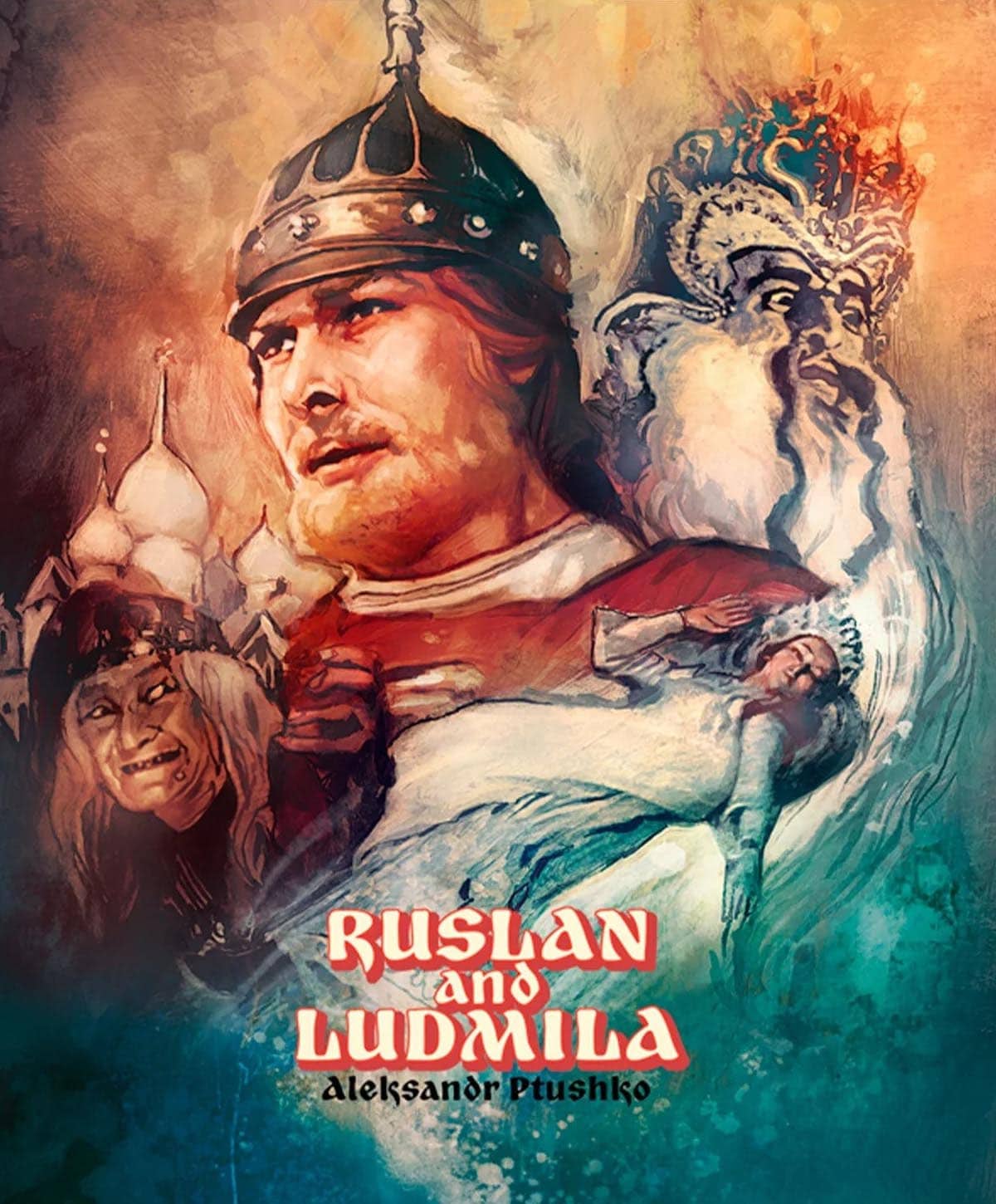
 Aleksandr Ptushko’s Ruslan and Ludmila is a technical triumph, boasting an eye-popping array of costume and set designs, some impressive special effects work to rival the low-budget wizardry of Mario Bava, and color cinematography of considerable sumptuousness that was the combined effort of two DPs. That’s not to say that Ptushko’s final film only catches the eye. The fantastical story, based on an epic narrative poem by Alexander Pushkin from 1820 that was in turn inspired by old Russian folktales, is replete with earthy humor, dramatic incident, and even its fair share of charming musical numbers.
The narrative opens in 10th-century Kiev with the nuptials of the heroic knight Ruslan (Valeri Kozinets) and the beautiful Ludmila (Natalya Petrova). The consummation of their marriage is rudely interrupted, though, when Ludmila is abruptly spirited away by the magical forces of evil wizard Chernomor (Vladimir Fyodorov). Angry at Ruslan’s inability to protect his daughter, Prince Vladimir (Andrei Abrikosov) summarily annuls the ceremony, offering Ludmila’s hand to whichever suitor returns her safely, whether that’s Ruslan or one of his rivals: bellicose Rogdai (Oleg Mokshantsev), untested Ratmir (Ruslan Akhmetov), or gluttonous Farlaf (Vyacheslav Nevinny).
The story thus concerns a crisis of masculinity. Ruslan’s metaphorical impotence in the bedchamber sets him off on a quest to prove his mettle. Over the course of Ruslan and Ludmila, Ruslan’s rivals provide him with three very different models for how to be a man in the world. Rogdai represents unchecked and unthinking aggression. At one point, Ratmir abandons his quest in order to settle down with a young maiden, Rybirka (Eve Kivi), so he comes to stand for embracing domesticity at the price of larger social obligations. Farlaf appears to win the day, and quite literally over Ruslan’s dead body, through treachery and malfeasance, a different way of rejecting one’s responsibilities to family and country.
For her part, Ludmila isn’t exactly the damsel in distress. She actively spurns Chernomor’s rather feeble advances, seizes the opportunity to steal his helmet of invisibility, seeks every means of escape, and shows admirable compassion for the shackled titans she discovers in a cavern beneath Chernomor’s castle. She only falls under his spell once again due to her all-consuming love for Ruslan, whose guise Chernomor assumes. Despite all this, Ludmila is ultimately relegated to playing the Sleeping Beauty analogue whom Ruslan must awaken.
Politically, Ruslan and Ludmila is unabashedly patriotic, using the defeat of the invading Pechenegs as a substitute for contemporary affairs. Pushkin’s original poem was conceived in the warm afterglow of Russia’s defeat of Napoleon’s Grande Armée in 1812, and the film, written by Ptushko and Samuil Bolotin, can be seen as celebrating the Soviet Union’s valor in the face of the ongoing cold war against the forces of international capitalism. Ptushko doubles down on the invasion motif, bookending the film with Ruslan’s battles with the Pechenegs.
In its final battle sequences, Ruslan and Ludmila radically shifts tone from the childlike whimsy of magic and derring-do to a more mature stoicism when it comes to depicting violence that’s surprisingly graphic for the genre: We’re shown a slew of bloodless decapitations, multiple impalements on spears, and even one of the enemy split down the middle with a sword, though the latter admittedly is played for some sort of splatstick laughs. In failing health at the time, Ptushko apparently knew this would be his final film, so perhaps we can see this increase in brutality as some kind of reflection on the state of world cinema.
At the end of the film, you’re left not with the bitter taste of violence, but rather a sense of wonder at the magical sights and sounds that have unfolded before you. Ptushko is above all a cinematic wizard, conjuring up a plethora of delightfully surreal images, perhaps none more so than Ruslan’s encounter with a giant head in the middle of the moonlit steppes. It’s eerie, slightly disturbing, and gorgeously rendered, all at the same time. In a sense, the character of the Finn (Igor Yasulovich) serves as a fitting stand-in for Ptushko. They’re both conjurers who have spent their lives perfecting their art, and now bring it to bear for the betterment of humanity. This is the legacy of Ruslan and Ludmila, Ptushko’s magnum opus.
Image/Sound
Deaf Crocodile presents Ruslan and Ludmila in a stunning new 4K restoration that was prepared by Mosfilm from the original camera negative and sound elements. The 1.37:1 full frame image looks incredible, with radiant colors that practically pop off the screen, boasting some impressive clarity of fine details when it comes to the elaborate costumes and jaw-dropping set designs. Audio comes in a Russian LPCM two-channel mono mix that’s full and rich, admirably conveying Tikhon Krennikov’s resoundingly melodious score.
Extras
The commentary from artist, film historian, and author Stephen R. Bissette is an engrossing listen, packed with information about the life and career of Aleksandr Ptushko and key cast and crew members. Bissette also draws connections between Ruslan and Ludmila and earlier Ptushko films, as well as provides a long and fascinating sidebar on the history of the fantastic in Russian cinema. Also included is a video essay by film critic Walter Chaw that examines the ways in which Ptushko’s films opposed the dominant trend of socialist realism in Soviet cinema. Finally, the illustrated booklet contains an essay by film professor Peter Rollberg that delves into the history and reception of the Pushkin source material, the political subtext of both poetic and film versions, and the film’s place within Ptushko’s body of work.
Overall
Aleksandr Ptushko’s final film, Ruslan and Ludmila, is a gorgeously rendered fable about the salvific power of love, fidelity, and patriotism.
Since 2001, we've brought you uncompromising, candid takes on the world of film, music, television, video games, theater, and more. Independently owned and operated publications like Slant have been hit hard in recent years, but we’re committed to keeping our content free and accessible—meaning no paywalls or fees.
If you like what we do, please consider subscribing to our Patreon or making a donation.


What ? russian defeat against Napoleon ??? You need a lesson in history. NAPOLEON lost against Russia.