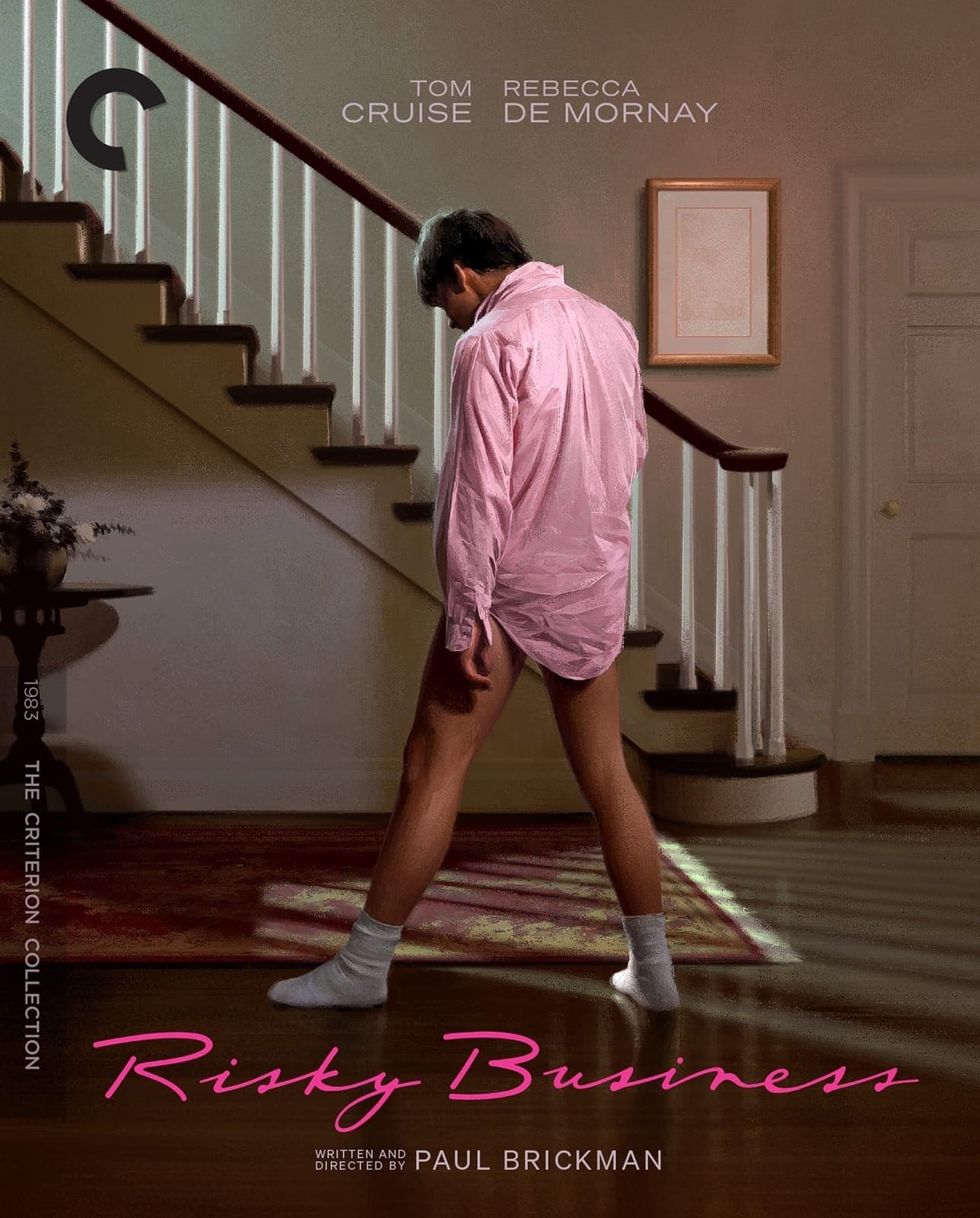
 In Paul Brickman’s Risky Business, Tom Cruise and his character, ambitious teenage virgin Joel Goodson, appear to be going on the same journey toward the status of killer shark—the good-looking guy with the money and confidence and limitless future. When Cruise flashes that iconic smile in those sunglasses near the end of the film, while Joel is at the height of his freeing, enterprising euphoria, the journey is complete. In 1983, you wouldn’t have been wrong if you thought a legend was being minted on celluloid.
Risky Business created “Tom Cruise” and the subgenre that drove his career for the following 15 years: the capitalist redemption fable. Cruise’s Reagan-era films—particularly Top Gun, Cocktail, and the accurately titled The Color of Money—are most obviously intoxicated with the theme that a neurosis must be transcended so that ideals of money and respect can be attained, while his 1990s-era films and beyond would begin to complicate the formula. The irony of Risky Business is that it’s critical of the formula that it initiated. Is the film a satire of consumerism or an example of it? It’s both and the better for it.
Modern satires have a tendency to sell what they’re ostensibly attacking, especially when the target is sex or money. Martin Scorsese’s The Wolf of Wall Street is among the most blistering parodies of American excess, in part because it admits that excess is intoxicating. Ideals about business regulation and equal dispersing of resources have a way of taking the side exit when one is faced with wealth and its attendant toys and freedoms head-on.
Risky Business operates with a similar honesty. Joel wants to go to Princeton because his posh mother and father (Nicholas Pryor and Janet Carroll) tell him he wants to, but he’s more interested, desperately interested, in playing with his father’s Porsche and getting laid.
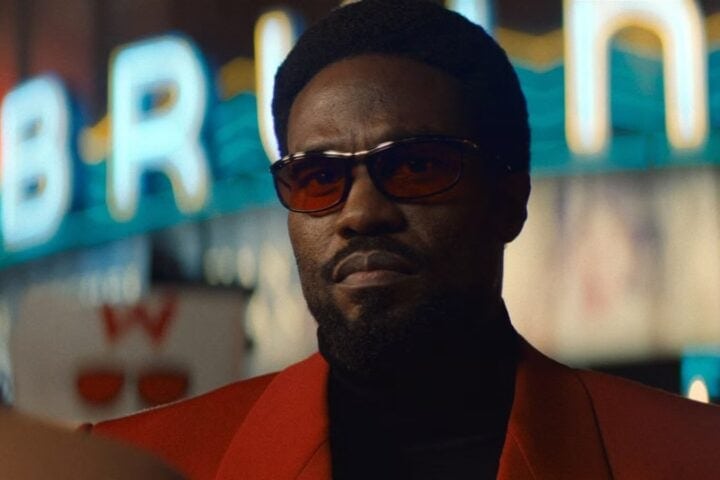
Brickman acknowledges the pleasures of Porsches and cigars and ball-busting with buddies, as well as the pull of dream-like sex with a call girl as beautiful as Lana (Rebecca De Mornay). The writer-director is also, unlike John Hughes in his teenage coming-of-age stories, aware of the world that exists at the periphery of the protagonist’s blinkered vision. With Lana comes risky business, and the broadening of Joel’s worldview is first signaled by his encounter with an older Black trans escort, Jackie (Bruce A. Young), who arrives at his doorstop after a crank call by one of Joel’s buddies, Miles (Curtis Armstrong), and surmises that she’s not what Joel wants.
The very funny exchange that ensues between Joel and Jackie is remarkably empathetic for an ’80s-era sex comedy about a guy looking to lose it. Jackie, a good capitalist, recognizes that Joel shouldn’t be spending his money on a situation that he doesn’t want. If she can understand that, then Joel can understand that she needs to be paid for her time and patience.
Brickman resists stereotypes and soap-boxing, and his suggestion of how capitalism both divides and unites two people as different as Joel and Jackie are is unusually nuanced. Jackie tells him that Lana is what he wants, that she’s what “every white boy on the lake wants.” The scene is a marvel of navigating minefields centered around race, sex, and class, and with a mind toward human behavior and common sense rather than platitudes.
Lana is written with a similar directness. Obviously, Brickman is exploiting the horny-boy fantasy of the call girl who actually likes her john. But Brickman resists, to an extent, “hooker with a heart of gold” clichés. Joel and Lana are from two different worlds. She’s working class and experienced, in and out of the bedroom, and he was born comfortable and coddled and is virtually preordained to remain so. When Joel, thinking he’s being thoughtful, tries to get Lana to conform to his condescending idea of her struggles in life, she cuts him off.
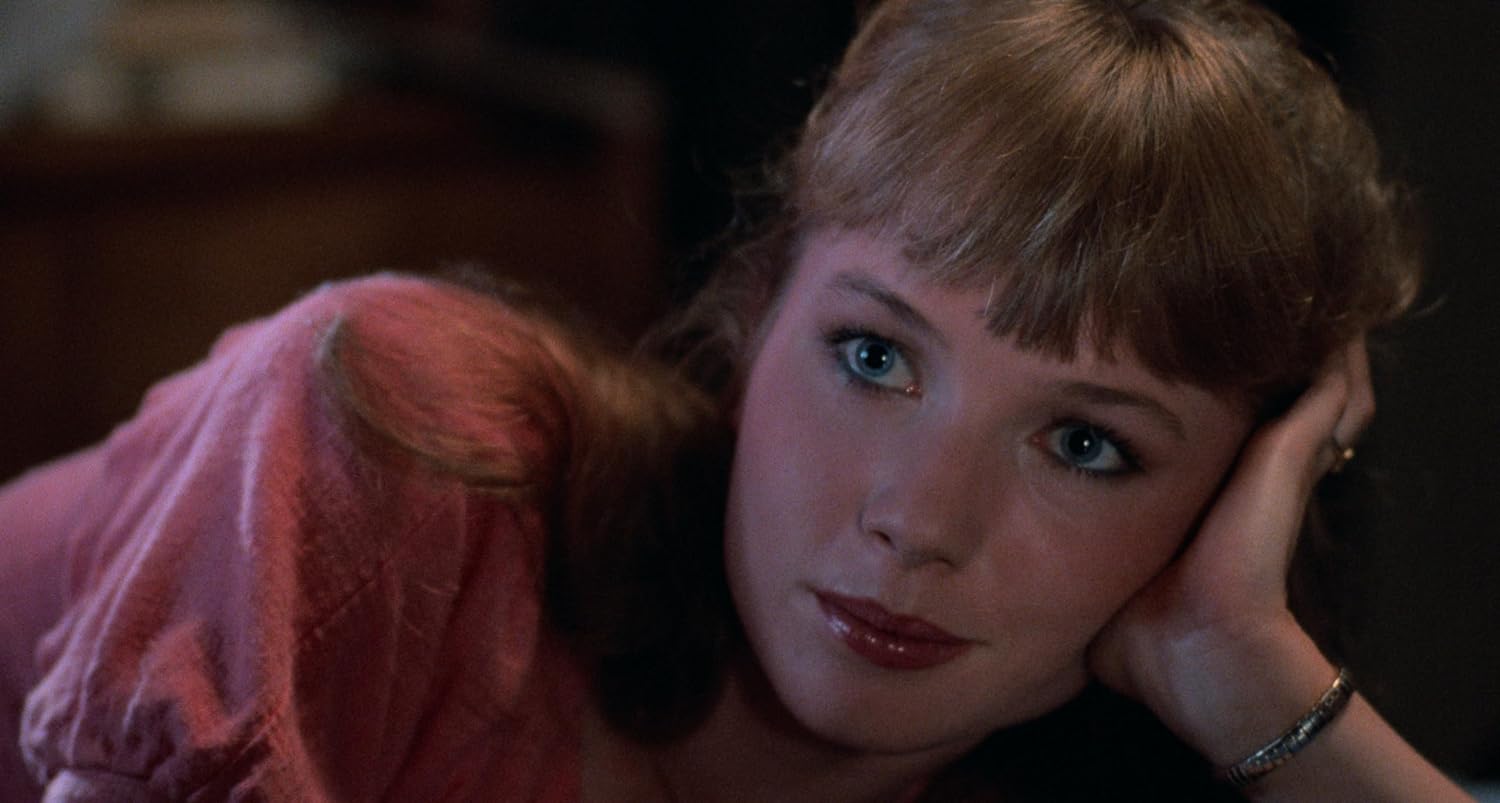
Lana, who deals with the worst of the American male’s instincts, is informed by De Mornay with a subtle sense of exhaustion. That state of being scans as worldly to horny boys, but to people who might be thinking with something besides their carnal instincts, it’s poignant. The ending of the director’s cut of Risky Business brings Joel and Lana’s class differences into particularly stark relief. A close-up of Lana’s crystal blue eyes is especially haunting, ringing with uncertainty. Lana has been written and acted with teeth, with an aura of the unknowable, as a harbinger of all that Joel’s privilege keeps him from understanding. And what Joel was missing in his cocoon is at once deeply dangerous and deeply pleasurable.
The satirical core of Risky Business pertains to Lana, who hustles to earn a living, teaching Joel that those with the money make the rules. Lana’s world is full of street-level capitalists, micro-versions of the robber barons that Joel is taught to worship in a sanitized fashion. Joel is all bound up in anxiety, torn between the desire to achieve and get laid, when one is rooted in the other. Lana turns Joel’s house into a bordello and suddenly wheels of all sorts can be greased, including the wheels to Princeton. If men want to be powerful for access to sex, then an un-powerful man who already has access to sex is already powerful. As Lana lays all this out for Joel, Brickman’s lucid and defiantly unsentimental dialogue could cut glass.
As Lana herself says at one point, this is how Joel can become the free enterpriser that he’s trying to learn how to be. In the wild, attempts at regulation are fairy tales, something that Miles, who famously advises Joel to say “what the fuck” and make his move, seems to already understand. (Miles, an unforgettable second banana, has the decency to admit to his own class-centered power.) Regulation in Risky Business comes from Lana’s pimp, Guido (Joe Pantoliano), who takes from Joel what he wants because he can. And yet Brickman is so casually empathetic that you even understand where Guido is coming from.
Joel’s feelings of being stranded between the innocence of boyhood and dog-eat-dog adulthood are taken seriously by Brickman. The film’s atmosphere, unusually forlorn and erotic and beautiful and filmic for a teen comedy—less John Hughes than Michael Mann—is rooted in Joel’s confusion, from the haunting Tangerine Dream score to the lonely noir nightscapes that appear to be informed by paintings like Edward Hopper’s Nighthawks.
At times, you may even wonder if you’ve stepped into something akin to David Lynch’s Blue Velvet, which was still three years away. The two films are startlingly similar thematically, and they stand as two of the most iconoclastic of American films about teenage boys’ consciousness, especially as boys discover that there’s more to life than minding the fairy tales proffered by Mom, Dad, the school system, and the American government.
Image/Sound
Supervised and approved by writer-director Paul Brickman and producer Jon Avnet, this new 4K restoration of Risky Business is revelatory, bringing to light the full scope of the film’s formal ambition. Quite a bit of the film is set at night, and there are all sorts of new hues apparent in these images. Neon colors are more saturated, and the grain of the image is more attractive than it was in the prior Blu-ray release by Warner Bros. Home Entertainment.
In general, the visual temperature of the film runs cooler and darker in this 4K transfer than it has in prior home video presentations. For a comparison, check out the Blu-ray that’s included with this set. It’s a strong illustration of what Risky Business usually looks like, with fine detail as well as a brighter sheen that’s tough to return to after encountering the sleek nighttime sensuality of the 4K. Meanwhile, the English DTS-HD Master Audio 5.1 track is rich and healthy, especially when that Tangerine Dream score soars.
Extras
The best news here is that the theatrical and director’s cuts of Risky Business have both been restored in 4K and included with this set. The two cuts are identical save for the final scene, which is vastly more evocative in Brickman’s version. Meanwhile, the best of the new supplements is a 30-minute conversation between Risky Business editor Richard Chew and film historian Bobbie O’Steen, which offers an unusually detailed glimpse at how editors work with directors to shape raw footage into fully formed sequences.
A new conversation with producer Jon Avnet engagingly outlines how he embraced Brickman’s sensibility and sought to get Risky Business funding via David Geffin’s company, while a conversation with casting director Nancy Klopper details the many, many up-and-comers she met in her search for the actors to play Joel and Lana. Screen tests, an archive audio commentary with Brickman, Avnet, and Tom Cruise, a leaflet with an essay by critic David Keh, and an archive documentary round out a very solid mixture of old and new supplements.
Overall
Criterion’s outstanding new restoration of Paul Brickman’s Risky Business suggests that the film is a noir in a superb teen comedy’s clothing.
Since 2001, we've brought you uncompromising, candid takes on the world of film, music, television, video games, theater, and more. Independently owned and operated publications like Slant have been hit hard in recent years, but we’re committed to keeping our content free and accessible—meaning no paywalls or fees.
If you like what we do, please consider subscribing to our Patreon or making a donation.