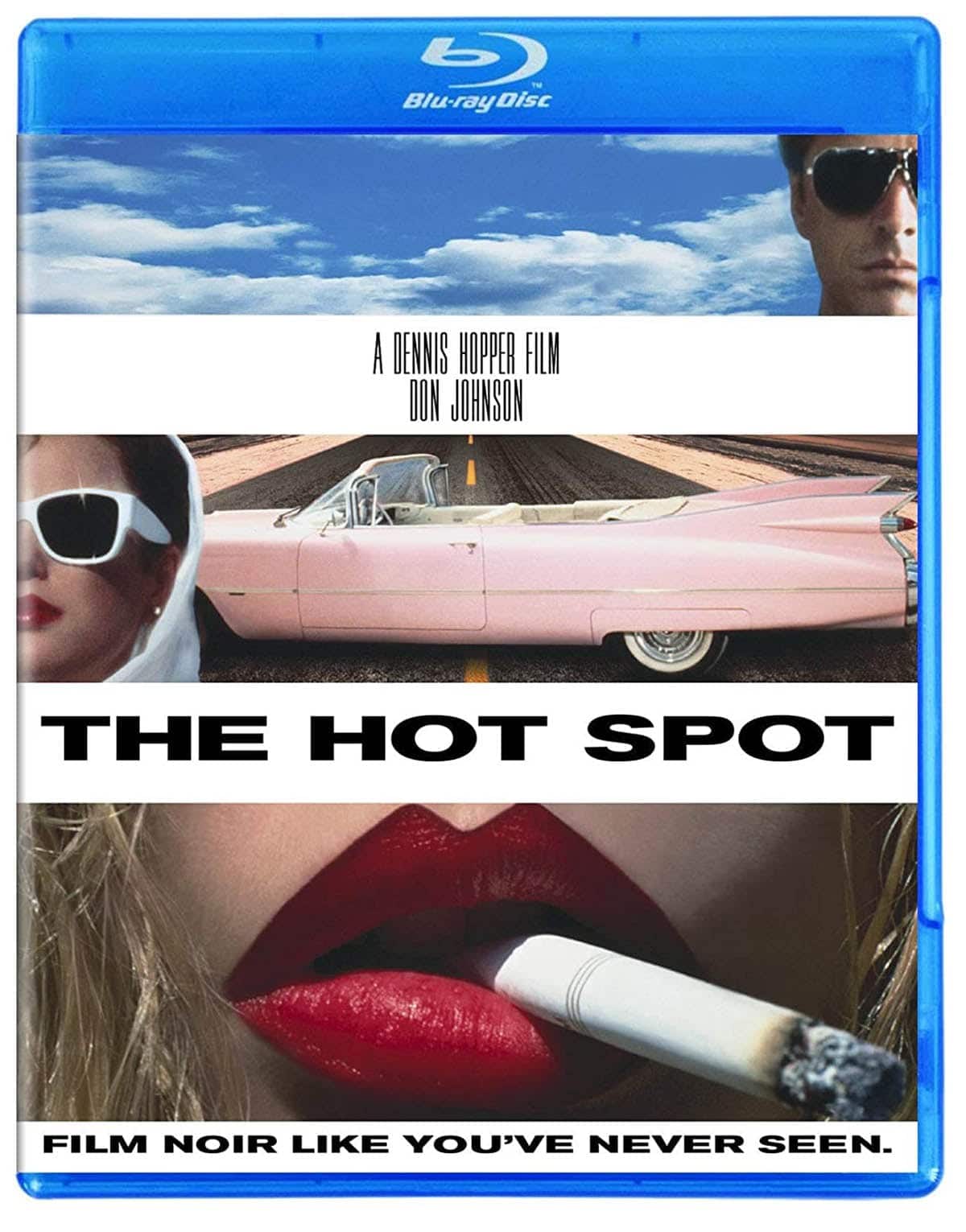
 Dennis Hopper’s The Hot Spot abounds in turbo-charged innuendo that’s particular to the golden-age American noir, in which sex and violence appeared mostly to be either on the verge of happening or transpiring behind closed doors. Hopper understands that it’s this aura of tension—of acts often thought of but rarely seen or talked about plainly—that imbues the vintage noir with its erotic power, and he mounts a daydream that fuses the mores of the ’50s with the greater liberties permitted by American culture in the ’90s. The result is something like the best of both worlds, as Hopper doesn’t go overboard on modern-era explicitness, adding just enough spice to intensify fantasies without doing the audience’s work for it. Hopper is rather, well, courtly.
That courtliness may come as a shock to audiences who think of Hopper as a countercultural madman, with a reputation for violent behavior exacerbated by a prodigious consumption of drugs and booze. Released in 1990, The Hot Spot was a few years into his “play nice” period, in which he had come back after career exile and a bout with mental illness as a ferocious character actor and even as the director of the respected 1988 crime film Colors. And familiarity with Hopper’s personal story may influence how one reads The Hot Spot, as it feels like a film that’s been made with a sense of relief. It’s nowhere near as conflicted or extraordinary as Hopper’s Easy Rider and The Last Movie, and that seems to by intent. The Hot Spot is a celebration of the pleasures of conventional craftsmanship by a man who professionally came of age in the waning years of Hollywood’s golden era.
The film opens on a series of hallucinatory desert tableaux—rich in fevered orange hues—that would be at home in either Easy Rider and The Last Movie, before settling into a form that’s as traditional as kabuki. Harry Maddox (Don Johnson) is in the middle of nowhere before landing in a small Texas town. Hopper offers no exposition concerning what Harry has been up to before the plot kicks in—information that Charles Williams’s 1952 source novel, Hell Hath No Fury, included. This decision feels more than incidental or merely a matter of cutting to the chase, as it de-sentimentalizes Harry while acknowledging that we know the noir ropes. Harry isn’t in dire straits or nursing a broken heart. He’s the archetypal drifter who drifts with not much in the way of conviction in anything. Johnson doesn’t shirk away from the character’s superficiality or callousness, and as overheated as The Hot Spot is, the film doesn’t pivot on the protagonist’s escalating lust or desperation, which distinguishes it from many noirs. Harry is understood to be trapped from the beginning, locked into the role of charismatic cipher.
Harry may think he’s fallen for Gloria (Jennifer Connelly), a beautiful, much-younger woman who serves as the virtuous brunette yin to the debauched and mercenary blond yang of Dolly (Virginia Madsen), but Hopper understands him to be going through the motions. The film’s governing joke—a good one—is that events that would send normal men into spasms of anxiety, lust, or gratitude roll off Harry’s back. Cinematographer Ueli Steiger fashions images of explosive intensity—rich in hot pinks, strategic flashes of flesh, and the roiling heat and humidity of the town itself—which have at their center a man who seems to have done all this before. Yet there’s nothing macho in this portrait of indifference, as Harry is a cool cucumber that we don’t especially envy. A straight man who can take Virginia Madsen at her most deliriously sexy for granted is a man who’s lost something vital about his senses.
Johnson is the center around which the other characters orbit. Given the film’s lurid, heightened, not-quite-parodic atmosphere, Connelly gives a startlingly grounded performance; her Gloria shoots Harry looks of raw and poignant yearning that increase your estimation of him. Madsen goes boldly over the top without tipping over into absurdity, playing Dolly as equal parts Lana Turner and cheetah. As a sleaze on the outskirts of town with dirt on everyone, William Sadler gives a funny, volatile performance that serves to challenge Johnson’s taciturnity. As a banker with an addiction to strippers and nudie mags, Jack Nance is so cuckoo that he nearly walks away with the film, embodying the pure, blinkered hunger that governs noir. There’s quite a bit of plot in The Hot Spot–involving a double blackmail, a bank robbery, and infidelity—but it’s all essentially beside the point. It’s the collision of characters that you remember, as well as the film’s pregnant, languorous atmosphere of possibility. And this leisurely 130-minute film savors every last morsel of detail.
Hopper honors the classic noir while investing it with a streak of weirdness that suggests a tipping of the cap to his Blue Velvet director, David Lynch. There’s certainly a bit of Lynch in a bank robbery that’s invested with a wonderful slapstick logic, as well as in the postmodernism of a town that appears to consist entirely of a used car lot, a strip club, a hotel, a bank, and Dolly’s jungle lair mansion—sex and consumerism interwoven tightly together and complemented by multitudes of noir and pin-up fetishes. In fact, divorce Wild at Heart of its self-congratulatory ugliness and you’d be close to The Hot Spot—a weirdly, sensually, appealingly innocent celebration of American iconography.
Image/Sound
This new 2K image has some subtle flaws, such as a general softness, that are virtually eclipsed by the spectacular vividness of the color spectrum. The hotness of the film—both literally and figuratively—comes through here in a way that it hasn’t before. The many reds and pinks are fiery, the blues and purples are crystal-cool, and the landscapes boast exceptional new detail, including the heat waves emanating off the roads. Even the aforementioned softness of the transfer isn’t always a deficit, as the actors’ flesh tones have a low-key warmth that only enhances the film’s sense of intimacy. The disc has two audio tracks: English DTS-HD Master Audio 5.1 and English DTS-HD Master Audio 2.0. The latter will probably better suit purists, but both boast strong clarity, especially in terms of instrumentation, which is important given that The Hot Spot has one of the best soundtracks in American cinema: a score by Jack Nitzsche played by John Lee Hooker, Miles Davis, Taj Mahal, Roy Rogers, Tim Drummond, and Earl Palmer that only intensifies the film’s playful sensuality.
Extras
A new audio commentary by entertainment journalist and author Bryan Reesman offers a full portrait of The Hot Spot’s inception, which began as an adaptation of a 1952 Charles Williams novel that was planned for Robert Mitchum. However, the most fascinating portions of the commentary concern Dennis Hopper’s method of directing, including his penchant for very long takes that were designed to emphasize the actors’ rapport over showy camera angles. Hopper generally comes off quite well on this disc, as the new interviews with actors Virginia Madsen and William Sadler emphasize his empathy and attention to detail. Madsen in particular was nervous about playing a role that’s so intensely over the top and sexy, and says that Hopper was receptive to her concerns and provided notes that helped her center the character. A variety of trailers round out a slim yet substantial package.
Overall
Dennis Hopper’s eccentric, fetishistic, and very sexy neo-noir receives a red-hot facelift courtesy of Kino Lorber.
Since 2001, we've brought you uncompromising, candid takes on the world of film, music, television, video games, theater, and more. Independently owned and operated publications like Slant have been hit hard in recent years, but we’re committed to keeping our content free and accessible—meaning no paywalls or fees.
If you like what we do, please consider subscribing to our Patreon or making a donation.