
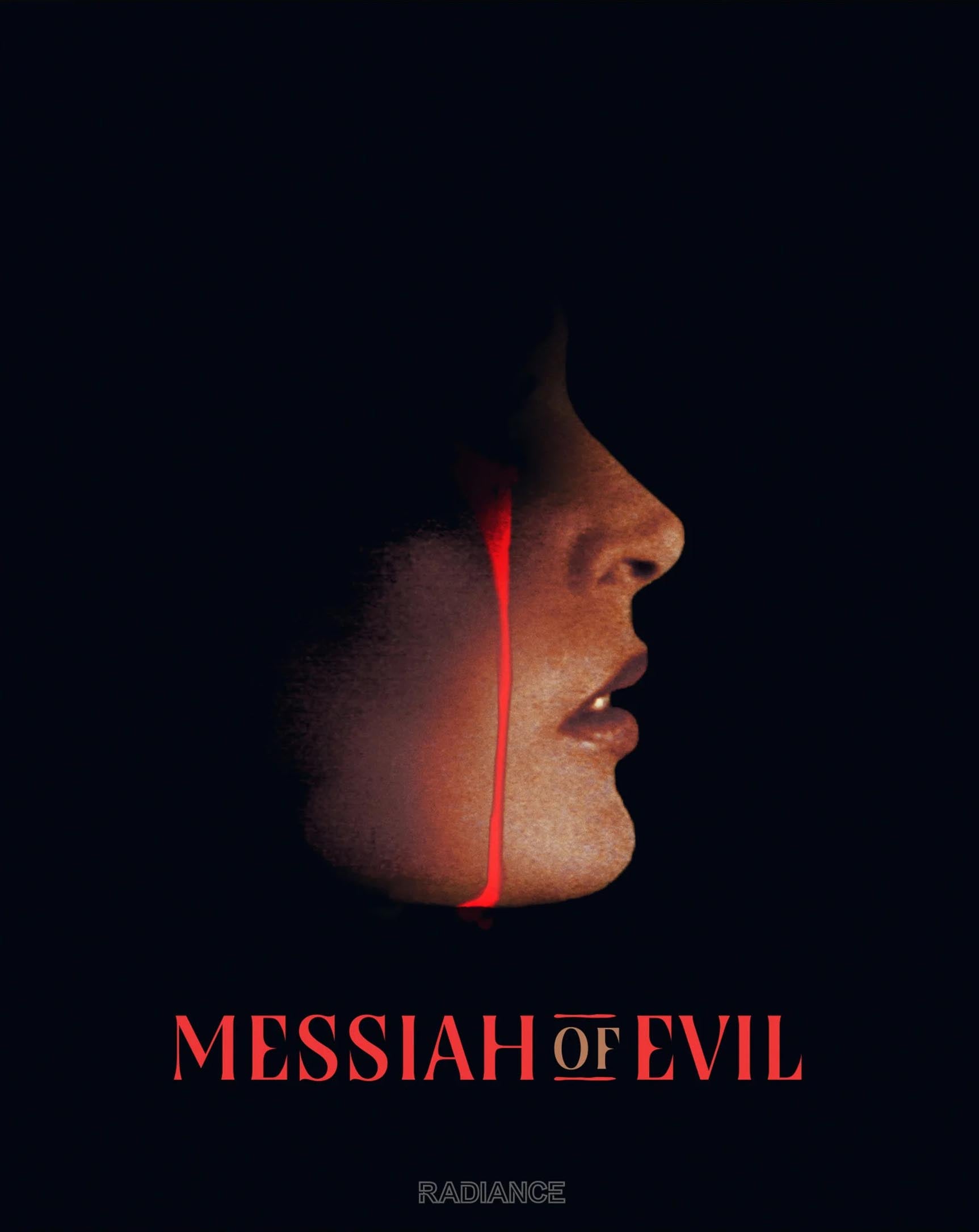
 It’s hard to believe at first glance that the surreal Lovecraftian horrors of Messiah of Evil are courtesy of Willard Huyck and Gloria Katz, who wrote both the warm nostalgia bath that is American Graffiti and the absurd comic book antics of Howard the Duck. But there are definite similarities between these films. American Graffiti and Messiah of Evil each capture a particular milieu at the end of an era, whether that’s provincial Modesto before the Beatles and Vietnam, or a beach town being overtaken by an evil cult. And Messiah of Evil and Howard the Duck both concern a cataclysmic threat from another realm.
Messiah of Evil focuses on Arletty (Marianna Hill), a young woman who’s come to Point Dune on the California coast looking for her famous artist father, Joseph Lang (Royal Dano). She soon makes the acquaintance of raffish Thom (Michael Greer), a nomadic collector of folk tales who’s accompanied in his travels by two young women, Laura (Anitra Ford) and Toni (Joy Bang). Slowly, this unlikely quartet uncover tales of the Blood Moon and a Dark Stranger who, once every 100 years, brings evil and death in his wake. At the same time, the locals are falling victim to some disease or other condition that leaves them insensitive to pain, bleeding from the eyes, and disposed to the consumption of raw flesh.
Some of the surrealism evident in Messiah of Evil has to do with its convoluted, occasionally disconnected narrative. This was partly the result of having the film’s final edit taken out of their hands, but it was also a conscious storytelling choice made by Huyck and Katz. Like Robert Wiene’s silent classic The Cabinet of Dr. Caligari, the film is bookended by a frame narrative set in a mental asylum. While that fact ultimately undermines Caligari’s anti-authoritarian intent, it only serves to reinforce the ambiguity of the account related by Arletty. Did it all actually happen, or is it nothing more than her mad ravings? The film’s prioritization of poetic tone over narrative cohesion is in keeping with other American horror films of the era.
Arletty’s story is further complicated by the inclusion of journal entries written by her missing father, a local legend recounted by the town drunk (Elisha Cooks Jr.), and a flashback to strange events that happened 100 years ago. The film’s narrative complexity points to its gothic literary heritage. It cannily replicates the experience of reading a story by H.P. Lovecraft, an admitted influence on Huyck. References to a cult that worships “old gods and old, dark ways” only compound the similarly to Lovecraft’s Cthulhu mythos. Then, too, the idea of a tale being told by a mad person goes back even further to works of Edgar Allan Poe like “The Tell-Tale Heart.”
Messiah of Evil is a triumph of mood and atmosphere. Its distinctive aesthetic, derived largely from European arthouse cinema, informs Stephen Katz’s brooding cinematography, Jack Fisk’s weird set design, and the disorienting Pop Art paintings by Joan Mocine that dominate Arletty’s father’s house. Much of the film’s eerie efficacy is due to its uncanny sense of urban alienation, replete with scenes of characters wandering through deserted streets and empty stores.

Unsurprisingly, the film’s two most horrific set pieces take place in derelict spaces: a Ralphs grocery store where a a handful of infected patrons go from eating packages of uncooked meat to devouring human flesh, and a sparsely attended movie theater (the marquee outside cheekily advertises the 1950 noir Kiss Tomorrow Goodbye) that slowly fills up around a hapless victim. Owing to its idiosyncratic style, and bolstered by scenes like these, Messiah of Evil will lodge itself in your brain with all the implacable force of Arletty’s final resounding scream.
Image/Sound
The new 4K restoration of Messiah of Evil, sourced from “the best existing elements,” looks truly fabulous. It’s a definite improvement over Code Red’s 2014 Blu-ray, boasting a brighter image overall, with more vibrant colors, deeper blacks, as well as increased depth and detail. Instances of damage evident in the earlier release have been removed. The English LPCM 2.0 mix sounds great, nicely delivering Phillan Bishop’s eerie electronic score.
Extras
The excellent audio commentary from Kim Newman, author of Nightmare Movies, and Stephen Thrower, author of Nightmare U.S.A., provides lots of information on the film’s production history, post-production changes, connections with other 1970s American horror films, and the history of electronic music in genre cinema. In a 2019 interview with Mike White from the Projection Booth podcast, co-writer and director Willard Huyck discusses his film school days, personal and working relationship with co-writer Gloria Katz, making Messiah of Evil while taking a break from writing American Graffiti, doctoring the Star Wars script, making Howard the Duck, and what he’s been up to since Katz passed away.
The feature-length documentary What the Blood Moon Brings assembles a notable team of genre cinema experts, including Guy Adams, Dr. Alexandra Heller-Nicholas, Dr. David Huckvale, Mikel J. Koven, and Maitland McDonagh, to explore many fascinating aspects of the film. Rounding out a terrific roster of supplements, there’s a thoroughgoing visual essay from Diabolique editor Kat Ellinger that covers the literary history of the American Gothic style, touching on key works from Charles Brockden Brown, and Charlotte Perkins Gilman, to Stephen King, before delving into how Messiah of Evil exhibits these influences.
Overall
Willard Huyck and Gloria Katz’s eerily brooding Messiah of Evil remains an undervalued gem of American gothic filmmaking.
Since 2001, we've brought you uncompromising, candid takes on the world of film, music, television, video games, theater, and more. Independently owned and operated publications like Slant have been hit hard in recent years, but we’re committed to keeping our content free and accessible—meaning no paywalls or fees.
If you like what we do, please consider subscribing to our Patreon or making a donation.


I had a pre-order for the $35 deluxe-ish version on (evil empire) Amazon Prime for months. I didn’t think I could get a used copy of the Code Red disc for under $50 and I expected the $35 might just drop in price. Fun story, right? I found a used Code Red disc for maybe $23 and then meant to cancel the $35 order until it shipped earlier than expected. And this is why I talk about scary money issues in my other comments, the stuff still does not grow on trees and the last thing I wanted was to purchase both discs.
I have no idea why a few weeks ago the $35 package edition soared to about $100 (and the standard edition is now $39.99); it’s just still 1 disc’s content but with a neat booklet and a stylish outer cardboard box. It’s only around $75 now.
Part of me is just glad I have the best presentation of the film. Just wish it hadn’t cost me nearly $60.