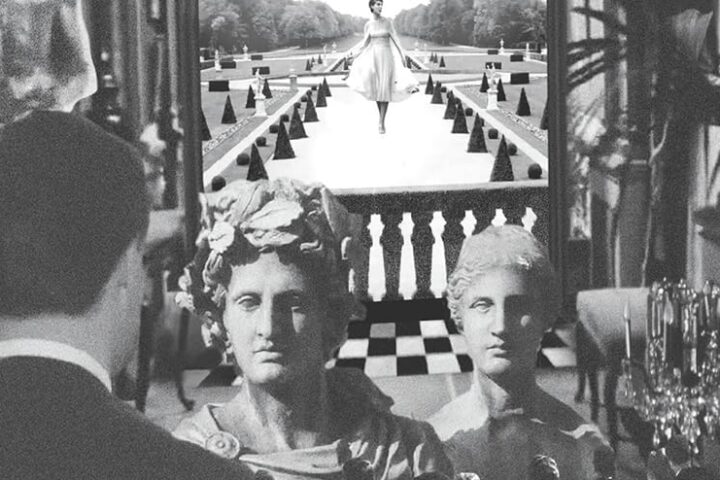
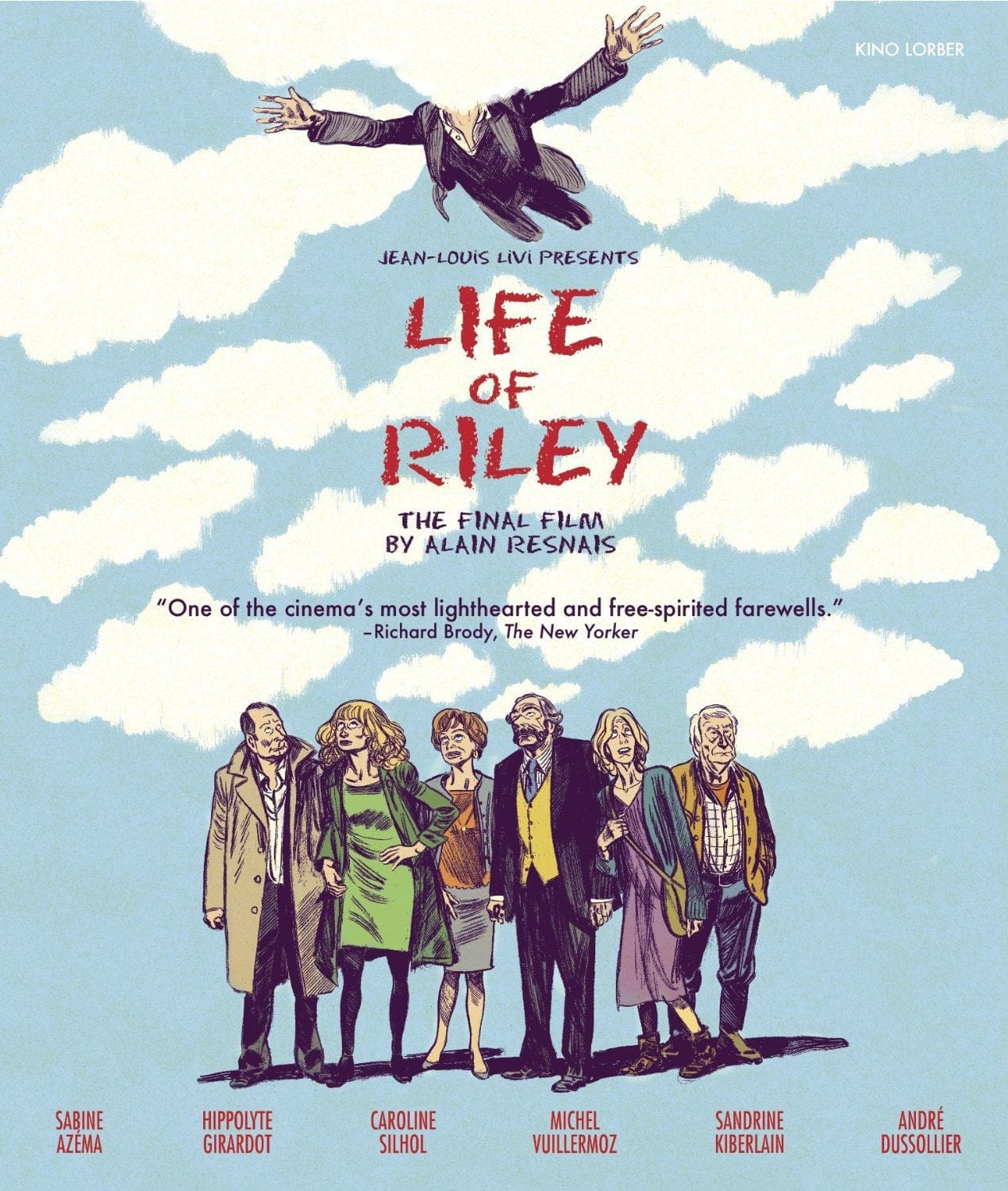
 Alain Resnais’s final films have a whimsy that masks their elegiac tones. They also take for their subject matter the versatility of acting, using self-reflexive theatricality to pore over the layers of conscious and unconscious performance in everyday interaction. Life of Riley, the director’s final film, foregrounds its anti-realism with sketched exterior shots and soundstage interiors flattened by strips of chromatic fabric that limit the dimensions of each area. Within these spaces, a small ensemble cast act out pathos related to themselves, as well as the characters who these characters perform while rehearsing a play.
The first interaction of the film, between amateur actor couple Kathryn (Sabine Azéma) and Colin (Hippolyte Girardot), proceeds with the awkward cadence of a first rehearsal, and soon the scripted bickering and the couple’s own disagreements blend together to the point that they become indistinguishable. The actors even deliver their ostensibly real conversations with a theatrical remove compounded by the sparsely furnished set in which they sit and talk. Yet if such interactions are unrealistic, Resnais uses them to argue for melodrama as a basic form of informational exchange, not to mention a deceptively complex means of self-expression.
The nuance of the melodrama is reinforced when Kathryn, Colin, and their friends discover that their mutual acquaintance, George, has a terminal illness. While the news prompts the group to try and reach out to George, it also turns their focus inward, which in turn is manifested outward again in their rehearsals and thoughts on acting. Kathryn and actor friend Tamara (Caroline Silhol) discuss the ageist biases stacked against them, arguing that roles written for younger women require the experience and world-weariness they can easily conjure. Meanwhile, Colin and Tamara’s beau, Jack (Michel Vuillermoz), entertain the possibility of letting George rehearse with them to take his mind off things, as if to lend legitimacy to the supposed power of art to heal and cheer. Meanwhile, George’s ex, Monica (Sandrine Kiberlain), is urged to temporarily break up with her new, more loving husband Simeon (André Dussollier) to return to George until his death, acting out a facsimile of their relationship to soothe the man’s passing.
Resnais’s direction emphasizes the artifice of the entire enterprise: The camera highlights the flattened composition in master shots, while close-ups occur in front of a rear-projected mesh screen of white and black lines that isolate each character in a void. It’s celebratory filmmaking, and despite its arch formalism, it constantly keeps attention on the performers as they begin to act out their characters’ hang-ups and doubts, deriving humanistic insights from their unnatural, deliberately stilted delivery. The men’s insecurities over their partners’ fondness for George, which reach acute levels when the dying man invites the women out on one last trip, may be overblown, but they communicate real resentments in people, as well as the convoluted logic and emotional response that takes over people having to deal with a friend’s impending mortality while also continuing to live their own, ego-driven lives.
Death hangs over Resnais’s final films, but one person’s demise always helps to unite the living. These movies suggest that an artist’s greatest contribution to the world is to bring other artists together to let them interact, not just as collaborators, but as human beings with harmonious and conflicting sensibilities. Life of Riley may revolve around the end of a revered friend, but it may be one of the least egocentric last works in cinema. One gets the impression that if Resnais left the world with any regrets, it’s that he couldn’t see these people keep working without him.
Image/Sound
For such a compartmentalized film, Life of Riley contains a dynamic visual schema, from cinematographer Dominique Bouilleret’s bold fluctuations in lighting to Jacques Saulnier’s sparse but richly colored production design. Kino’s Blu-ray preserves the film’s beauty with an exceptional transfer that boasts perfect colors and no visible artifacts. The 5.1 surround track is equally robust, if necessarily less showy given the sonic isolation of the soundstage and the front-channel-focused dialogue.
Extras
The disc comes with some standard cast interviews and a theatrical trailer, while an accompanying booklet contains an introduction from Alain Resnais and an essay from Glenn Kenny.
Overall
Alain Resnais’s final film is a graceful display of his unorthodox style and his love of actors, and Kino’s Blu-ray wisely doesn’t attempt to explain its layers with copious extras, leaving the viewer to tease out the director’s final head game.
Since 2001, we've brought you uncompromising, candid takes on the world of film, music, television, video games, theater, and more. Independently owned and operated publications like Slant have been hit hard in recent years, but we’re committed to keeping our content free and accessible—meaning no paywalls or fees.
If you like what we do, please consider subscribing to our Patreon or making a donation.