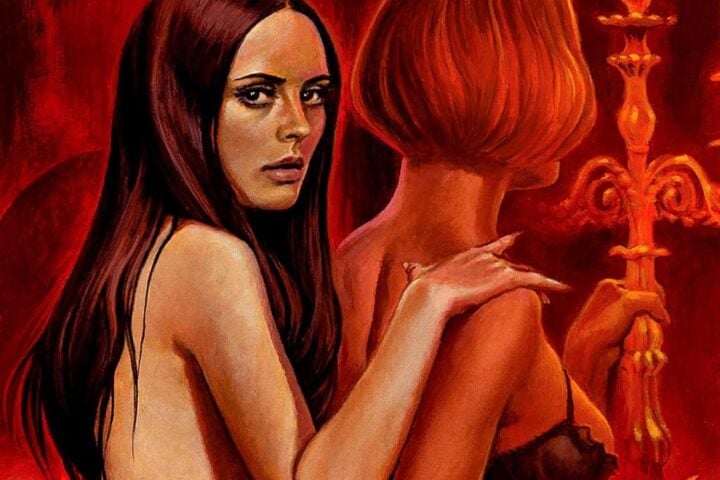
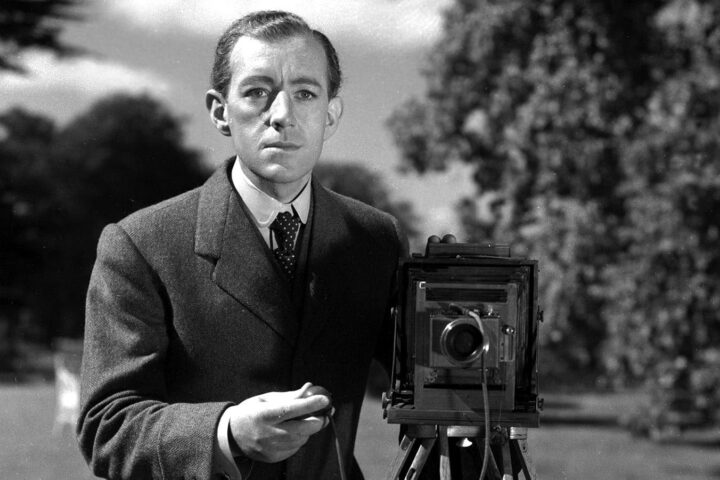
A class can be taught comparing British and American manners using only Kind Hearts and Coronets and The Family Jewels, two films that are honest to the culture and time from which they originate. Jerry Lewis’s 1965 film could be read as a reverse remake of Robert Hamer’s 1949 Ealing Studios comedy. Lewis plays seven roles in The Family Jewels, six uncles and one chauffer to a little rich girl who seeks a new “father” to share her $30 million fortune, while in Kind Hearts and Coronets, the great Alec Guinness plays eight relatives that come under attack by a distant relation denied his rightful place within their family. Both films are concerned with the nature of privilege, and the means by which the characters in these films attempt to preserve and attain status mirrors the nature of British and American modes of behavior. One film explodes in the same way the other implodes.
Like its aesthetic, The Family Jewels’s performances are loud, brash, and colorful. Kind Hearts and Coronets, by comparison, exudes an extraordinary feeling of reserve; its absence of color suggests a vulgar policy of exclusion. Quite possibly the darkest of the Eailing Studios comedies, it isn’t very funny—even by the stiff-upper-lip standards of the Brits, the humor is so dry and nonchalant as to appear nonexistent—but Hamer’s gift for character observation is generous and insightful, which he cleverly echoes in the fiber of the film’s early scenes.
Often restricting action and light to the center of the screen (in one scene, the curvature of a tree limb provides the frame of the picture with an iris-like border), Hamer reflects Louis Mazzini’s (Dennis Price) outrage and exclusion using his constricting camera. Valerie Hobson’s Edith D’Ascoyne, widow of one of Louis’s victims, is neutered by her husband’s death in the same one-dimensional way as the woman with the funny hat from Robert Siodmak’s Phantom Lady, and while Louis’s girlfriend, Sibella Holland (Joan Greenwood), suggests another wet-noodle type, Hamer unleashes the character’s wit and cunning after an interesting twist of events, giving Louis a nemesis he can tango with on equal footing. This respect and understanding for the role of the female, her suffocation, and her desire and potential for outrage within British society exposes the depth of Hamer’s kind heart and mind.
Image/Sound
There are older films in The Criterion Collection’s canon that look and sound better than this. Blacks are muscular, shadow delineation is good, and the level of grain and instances of specs are tolerable, but the image is blurry at times, suggesting the people at Ealing may not have taken good care of this film over the years if this sub-par print was the best one Criterion could get its hands on. The transfer’s flaws are most evident around the 30-minute mark: After Mazzini’s character buys a camera and heads to the country, notice how horribly blurred the upper left section of the image appears; this defect isn’t consistent throughout-just for about 10 minutes or so-but does seem to crop up again and again in spots. In the sound department, the regular ol’ mono track is predictably tinny; the British accents are scarcely heavy or unwelcoming, but you’ll still need to pump up the volume.
Extras
On disc one: a theatrical trailer, two stills gallery (“Costumes and Portraits” and “Production and Publicity”), and the film’s alternate ending which adhered to the ridiculous Production Code’s demand that “crime must not be seen to pay.” On disc two: a rare appearance by Alec Guinness on Michael Parkinson’s show in 1977 and a remarkably dense and informative 1986 episode of the BBC program Omnibus, produced by Roland Keating and narrated by Gavin Muller, devoted to the history of Ealing Studios. Also included here is a new essay by film critic Philip Kemp.
Overall
The film’s laughs are served on the rocks, but in spite of the humor feeling watered-down, this 1949 Ealings Studios comedy remains an interesting dissection of the pathologies of the British class system.
Since 2001, we've brought you uncompromising, candid takes on the world of film, music, television, video games, theater, and more. Independently owned and operated publications like Slant have been hit hard in recent years, but we’re committed to keeping our content free and accessible—meaning no paywalls or fees.
If you like what we do, please consider subscribing to our Patreon or making a donation.