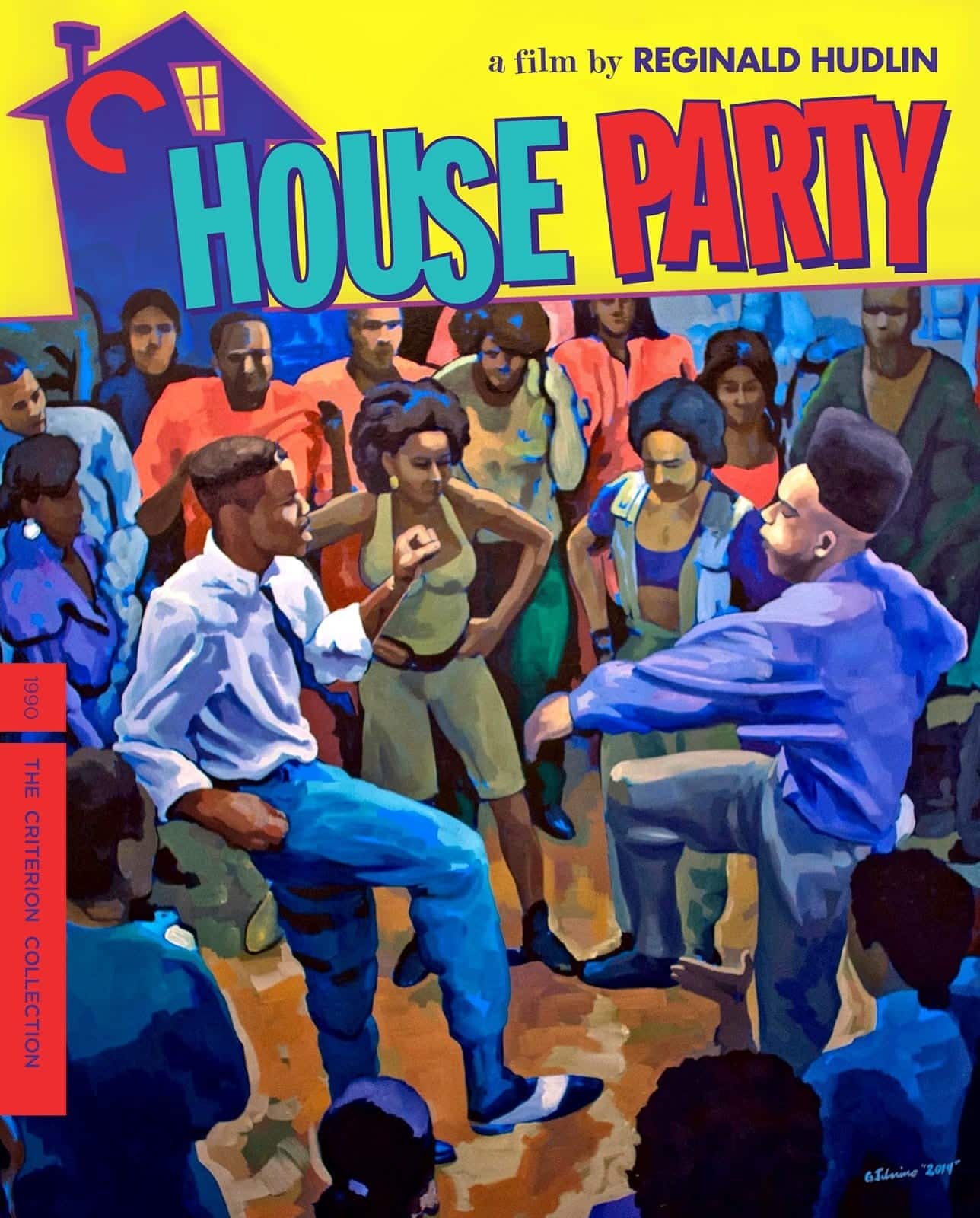
 Reginald Hudlin’s House Party opens with the camera gliding toward and into a house, the snare-heavy hip-hop beats on the soundtrack interrupted every few seconds by a low bass rumble that causes the camera to violently shake. Once inside the house, the camera proceeds through a large cloud of smoke to reveal dozens of teens dancing before tilting upward to reveal the roof being literally blown off. As a declaration of intent, the shot is efficient and jubilant in equal measure. And even if the rest of the film never quite matches that level of unrestrained joyousness, it sets just the right celebratory tone for a film about Black youth culture.
Indeed, Hudlin’s 1990 feature debut is a charming time capsule of the hip-hop culture, both in its visual and musical aesthetics and in its capturing the genre’s transition from the underground to the mainstream. Everything from the new jack swing beats to the colorful clothes, the casting of Kid ‘n Play and Full Force, and even the wobbly, neon green font of the opening credits is a signifier of hip-hop’s mainstream assimilation.
For all its accessibility, House Party is filled with little grace notes that speak to the realities of Black experience in America. It sees the way that Kid’s (Christopher Reid) Dolemite-loving father, Pop (Robin Harris), rules with an iron fist as being of a piece with the man’s empathic concern for his son and his future. It’s cultural specificity is evident as well in the harassment endured by the characters by two white police offers (Barry Diamond and Michael Pniewski), who see every Black male as a potential criminal first and a person second.
There are elements here that are best left in the ’90s—namely Kid’s homophobic prison rap—but its joyful, nuanced portrait of Black teenage experience has aged quite nicely. As, of course, has its ACAB cherry-on-top moment, tucked away partway through the end credits, when the roof blown off in the opening sequence comes down and crushes the racist cops.
Image/Sound
The Criterion Collection’s 4K transfer ensures that all the bright colors of those baggy hip-hop fashions practically jump off the screen. Skin tones are naturalistic throughout, while the nighttime sequences feature strong black levels and high detail. Grain distribution is remarkably consistent in visible density. The 4.0 surround audio, meanwhile, is full bodied and resonant. Those hip-hop beats sound amazing, while dialogue is clean as a whistle.
Extras
In a new audio commentary, director Reginald Hudlin discusses the genesis of the original 1983 short of the same name that was adapted into this feature film and his desire to inject social and political nuance into mainstream Hollywood genre films. He allows too much dead air between his insights, but his enthusiasm for House Party is undeniable and infectious.
Hudlin returns, with his brother and the film’s producer, Warrington Hudlin, in a new interview with film scholar Racquel Gates, to talk about his influences and the desire to capture the importance of hip-hop music to the youth culture of the late ’80s. Rounding things out is a lively and endearing cast reunion Zoom call, the 1983 short film, and a foldout booklet with an essay by author Michael Harriot on the authenticity of the film’s portrait of Black teenage experience.
Overall
With its roof-blowing 4K transfer and slate of entertaining and enlightening extras, Criterion’s release of Reginald Hudlin’s feature debut is sure please fans of the cult classic.
Since 2001, we've brought you uncompromising, candid takes on the world of film, music, television, video games, theater, and more. Independently owned and operated publications like Slant have been hit hard in recent years, but we’re committed to keeping our content free and accessible—meaning no paywalls or fees.
If you like what we do, please consider subscribing to our Patreon or making a donation.