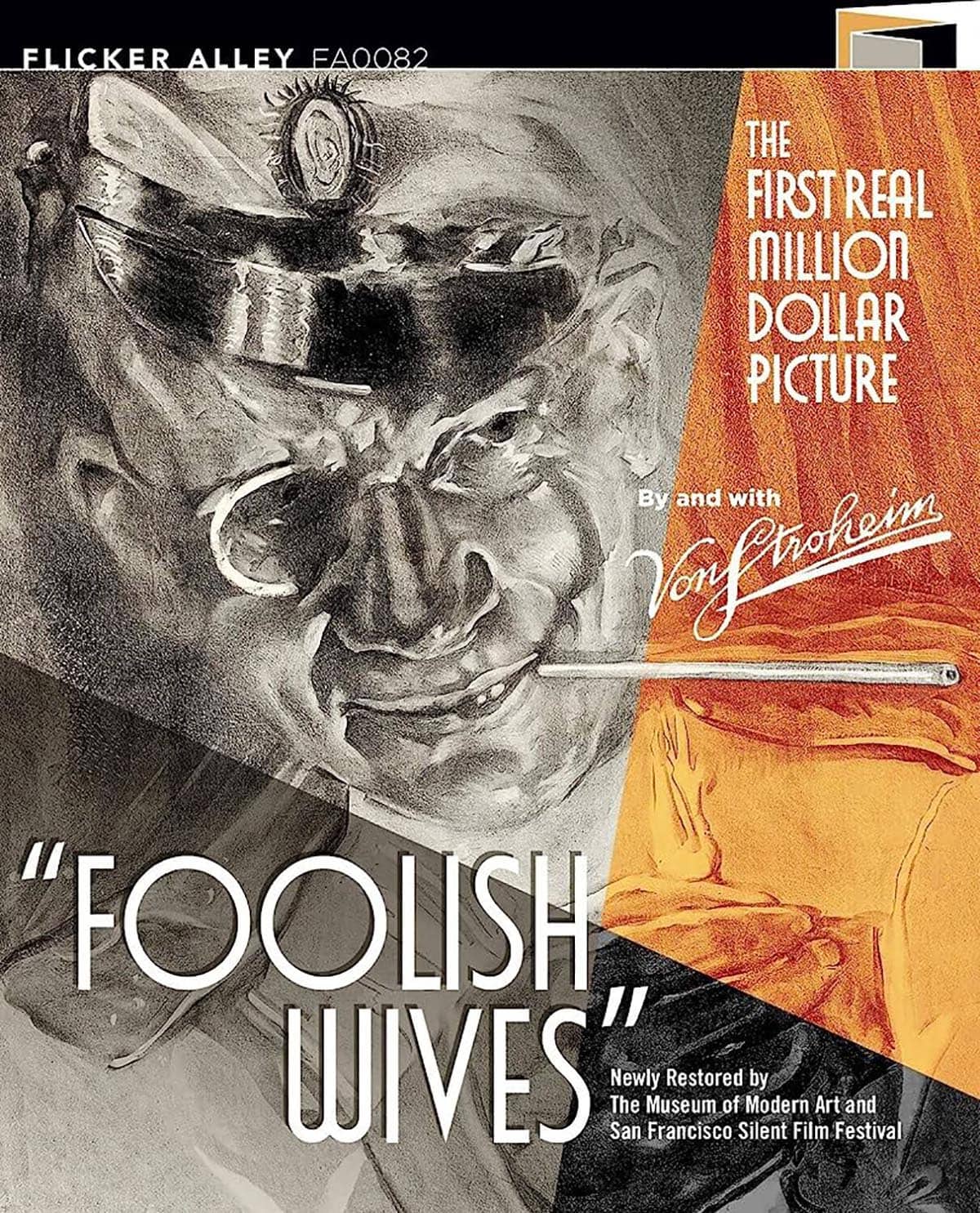
 There are obscure treasures and there are holy grails. Of the latter, none is more mythic than the original 131-minute cut of Orson Welles’s The Magnificent Ambersons, believed by many to be lost somewhere in Brazil. All others arguably belong to Erich von Stroheim. Born in Vienna in 1885 into a Jewish household, von Stroheim is mostly remembered for playing evil Germans in films like Jean Renoir’s Grand Illusion. Cinephiles, though, know him as the unluckiest auteur in the history of cinema.
Intended to run anywhere between six and 10 hours, many of von Stroheim’s films, from Greed to the Gloria Swanson vehicle Queen Kelly (the inspiration for Billy Wilder’s Sunset Boulevard, which stars von Stroheim as the butler to Swanson’s faded star), were severely bastardized by studio heads upon their release. In this context, the iris shot that opens 1922’s Foolish Wives feels especially poignant. This is no ordinary “fade into” effect, but an entrancing reinforcement of the sinister, insular, and constrictive nature of the film’s milieu. Because on Stroheim spent much of his life hiding his Jewish background, it comes as no surprise that there’s so much lingering beneath the surface of his films, waiting to be unearthed.
A bogus Russian count, Sergius Karamzin (von Stroheim), and his two “cousins”-cum-mistresses, Olga (Maude George) and Vera Petchnikoff (Mae Busch), set out to seduce rich women and extort money from them. After conferring with their pathetic counterfeiter, Cesare Ventucci (Cesare Gravina), they descend upon Helen Hughes (Miss DuPont), the wife of an American envoy (Rudolph Christians) sent to Monte Carlo to meet with the Prince of Monaco (C.J. Allen). Karamzin’s business is destroying lives, and over the course of the film he takes advantage of two other women in addition to Helen: a hotel maid, Maruschka (Dale Fuller), and the counterfeiter’s intellectually disabled daughter, Marietta (Malvine Polo).
At the time of its release, Foolish Wives was the most expensive film ever produced, and it shows. Though von Stroheim was widely considered a lavish spendthrift, his film is a triumph of period detail. No less evocative, Foolish Wives features what may be the most daring intertitles in the history of silent cinema, with von Stroheim using their stream-of-conscious nature to enhance startling aesthetic shifts and point to the politics at work throughout the narrative.
Karamzin is a monster, not so much because his “eyeopener” is oxblood and his “cereal” is caviar, but because he understands how to oppress others using the sinister nature of his surroundings. Who knows what Universal suits left on the cutting room floor, but you get a sense that Karamzin knew poverty once. “Dense Marshes—Slimy—Sombrous—Betraying—Then—Night.” The count uses darkness to scare and seduce Helen, who defends her weakness to her husband in the only way she can: “I’m Free—White—and Twenty-One.”
Given its clipped quality, one can only imagine what was deleted from the film, especially during the climax depicting Karamzin’s murder. After Karamzin sneaks into Ventucci’s house to seduce Marietta and a duped Maruschka kills herself, Ventucci is seen pulling Karamzin from a closet as a black cat darts across the frame, before then dumping his body into a sewer. And yet, the sense of missing-ness that hangs over the film only adds to its gleefulness and perversity.
Foolish Wives is a seductive film, but it’s also supremely sad because von Stroheim sees something morally and emotionally debilitating in the way that his characters forcibly cling to facades, from Dupont’s disillusioned would-be feminist to the “cousins” who don’t own up to their true identities until cops pull off their wigs. “Take off that monocle,” says Helen’s husband to Karamzin before punching him in the face. There’s a place and breaking point for everyone here, and Foolish Wives is a piquant chronicle of disillusionment, von Stroheim style.
Image/Sound
The restoration of Foolish Wives presented on this disc was completed in 2020 by the San Francisco Silent Film Festival and the Museum of the Modern Art and it’s a mighty improvement over the American Film Institute restoration that Kino Lorber released in 2013. This is evident in the image’s stellar clarity and fine detail, as well as the overall stability, but especially in the meticulous recreation of the original color effects.
The disc also comes with a spectacular new orchestral score by Timothy Brock that matches the baroque intensity of the film’s images. Purists may scoff at Brock not having been commissioned to at least perform Sigmund Romberg’s original score, but given ample evidence of Romberg’s impatience during the recording of his score and how much of the footage that matches its cues is lost to time, the decision to go in a new direction is completely justified.
Extras
This two-disc set comes with a series of extras that delve into everything from the film’s on-location shooting to the evidence-based restoration process that the San Francisco Silent Film Festival and MoMA undertook. (More detailed information about the restoration, including the new score, can be found in the souvenir booklet.) Most essential is “The Waves and the Merry-Go-Round: On Location with Erich von Stroheim,” during which cultural historian Brad Rosenstein discusses the film’s production and unpacks its interlocking narrative, symbolism, and references—from Freud to The Great Train Robbery—in just under 40 minutes.
Overall
Erich von Stroheim’s Foolish Wives lives anew, with a brand-new restoration and a newly commissioned score, on Flicker Alley’s essential Blu-ray release.
Since 2001, we've brought you uncompromising, candid takes on the world of film, music, television, video games, theater, and more. Independently owned and operated publications like Slant have been hit hard in recent years, but we’re committed to keeping our content free and accessible—meaning no paywalls or fees.
If you like what we do, please consider subscribing to our Patreon or making a donation.