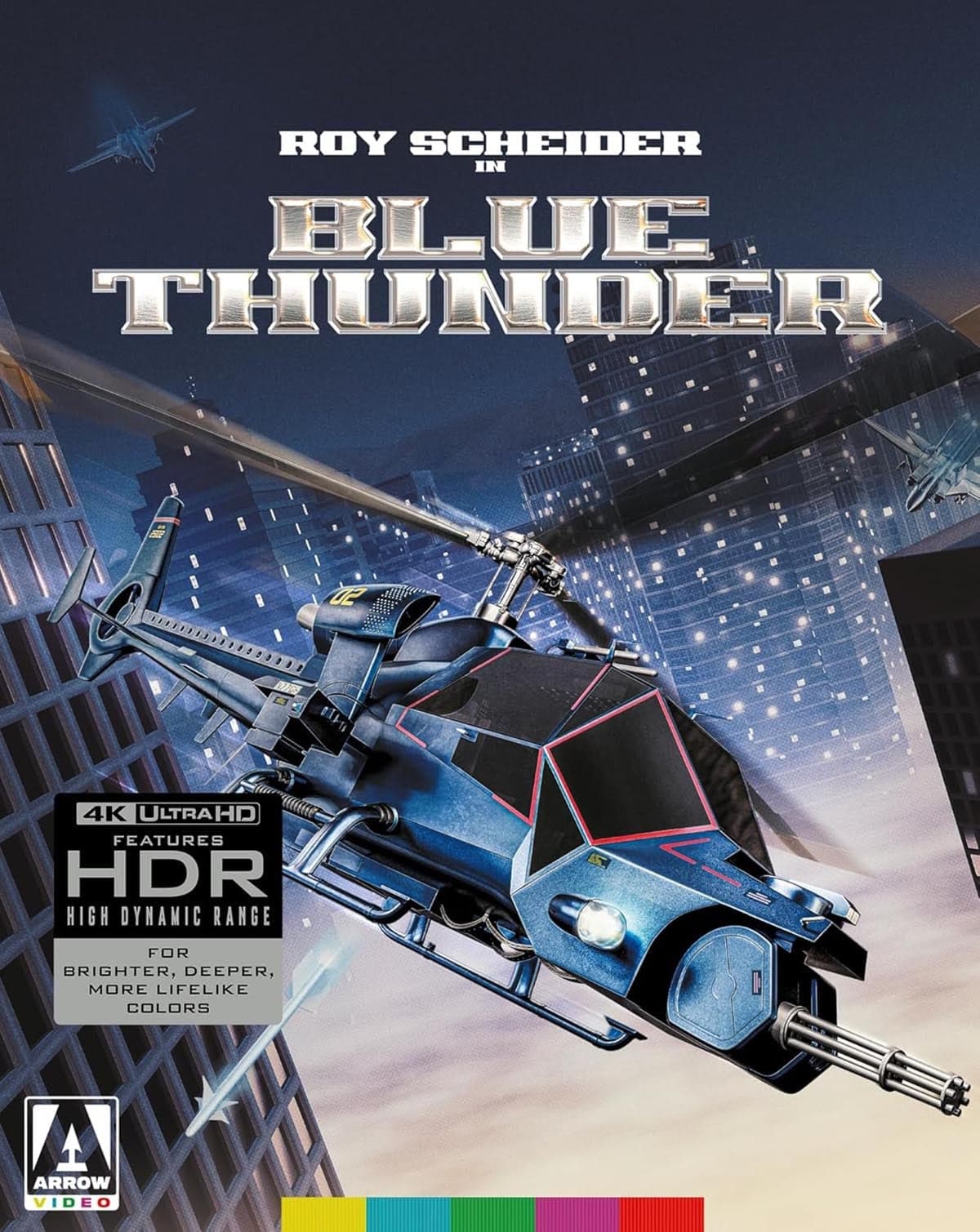
 John Badham’s Blue Thunder is a rip-roaring action film with a subversive political agenda, touching on the trauma of Vietnam, the slaughter at the 1972 Munich Olympics, and L.A.’s long history of race riots and other civic violence. But the real crux of the film concerns the use of intrusive surveillance technology in an Orwellian bid for social control. Not for nothing did it come out on the cusp of 1984.
Vietnam vet and helicopter pilot Frank Murphy (Roy Scheider), who suffers from a severe case of PTSD that sometimes affects his performance, is tapped to test a militarized chopper sporting high-tech surveillance capabilities codenamed Blue Thunder. This brings him into direct conflict with his old war nemesis, Colonel Cochrane (Malcolm McDowell), who’s part of a cabal of high-ranking police and politicos who’ve been fomenting in L.A.’s ethnic communities in a bid to prove Blue Thunder’s capabilities as an offensive weapon.
Dan O’Bannon and Don Jakoby’s screenplay intriguingly and rather amusingly equates the invasiveness of the helicopter’s technology with the act of voyeurism. Even before they’re given access to Blue Thunder, Murphy and his partner, Richard Lymangood (Daniel Stern), are caught spying with binoculars on a lady doing naked yoga. Later, Lymangood uses the chopper’s zoom lens-equipped camera to gaze down the plunging neckline of a streetwalker. In another scene, they use the rotorcraft’s high-powered microphones to eavesdrop on a couple having rather unsatisfactory sex. Not only are the civil liberties of the public at risk with Blue Thunder, but the very fabric of people’s individual private lives.
Throughout, Badham really keeps things moving, with nearly every scene erupting into some kind of mayhem. Even Murphy’s requisite love interest, Kate (Candy Clark), gets caught up in the chaos, getting to participate in a protracted car chase sequence that opens in an empty drive-in and winds through downtown L.A. In the dizzying final helicopter pursuit between Cochrane and Murphy, a whole lot of buildings blow up in a pyrotechnic frenzy, including a BBQ restaurant, resulting in the sight gag of dozens of chickens raining down on the street.
In addition to the aforementioned actors, Blue Thunder boasts the final film performance from cult favorite Warren Oates as Murphy’s irascible yet supportive captain, a stock figure in cop movies that Oates effortlessly elevates with his trademark aura of weathered affability combined with some distinctive line readings. Oates can turn dialogue like “I had 20 years in this outfit, when your idea of a good time was sittin’ in front of the TV tube, watchin’ Bugs Bunny and gnawing on your Fudgsicle!” into sheer poetry. (The film is dedicated to his memory.)

You can take Blue Thunder at face value as rollicking blow ‘em up, with its impressive practical effects and flying footage. Or you can dip below the surface to appreciate its wry commentary on governmental overreach and its concomitant Orwellian tendencies. Thankfully, though, Murphy doesn’t end up loving Big Brother, as his final act is a fiery fuck you to the shadowy elite.
Image/Sound
The 2160p UHD restoration of Blue Thunder, sourced from the original 35mm camera negative, does full justice to John Alonzo’s atmospheric cinematography. There’s a real uptick in color saturation and the legibility of fine details in comparison to the transfer on Sony’s 2009 Blu-ray edition of the film. Black levels are deep and dark, which is a good thing since a lot of Blue Thunder takes place at night. Audio comes in English DTS-HD Master Audio 5.1 and LPCM 2.0 tracks. The surround sound really opens up the film’s soundscape, especially conveying the rushing swoops and abundant gunfire hear during the flying sequences, while both options nicely convey composer Arthur B. Rubinstein’s engaging electronic score.
Extras
Carried over from Sony’s 2009 Blu-ray are an audio commentary, a three-part retrospective, and two archival featurettes. The commentary with director John Badham, editor Frank Morriss, and motion control supervisor Hoyt Yeatman is a thorough and frequently fascinating discussion of the film’s construction and technical merits, covering the location shooting, effects work, details about the helicopters (both real and invented), and more. The making-of documentary intriguingly covers most aspects of the film’s creation, shooting, and post-production, with contributions from Badham, actor Roy Scheider, screenwriter Dan O’Bannon and others. A brief featurette delves into the design of the title aircraft. An EPK promo featurette, on the other hand, is pretty disposable fluff.
New to this edition are three on-camera interviews filmed in 2025. Badham talks about not being pigeonholed as a filmmaker, getting Rubenstein to channel Tangerine Dream for the score, and working with the actors. Actress Candy Clark discusses working alongside Scheider, doing her own driving stunt work, and provides an interesting comparison of the directing styles of Badham, George Lucas on American Graffiti, and Nicolas Roeg on The Man Who Fell to Earth. Finally, Malcolm McDowell talks about coming to the project after Cat People, his intense dislike of helicopters, and the continuing relevance of the film’s sociopolitical themes.
Overall
Looking better than ever in UHD from Arrow, John Badham’s Blue Thunder is that rare beast: a rollicking action film with a subversive political agenda.
Since 2001, we've brought you uncompromising, candid takes on the world of film, music, television, video games, theater, and more. Independently owned and operated publications like Slant have been hit hard in recent years, but we’re committed to keeping our content free and accessible—meaning no paywalls or fees.
If you like what we do, please consider subscribing to our Patreon or making a donation.